

Peck Model and Lifetime Evaluation: MTTF, MTBF, and Experimental Design
Why a 50,000-hour lifetime is a calculation, how HALT differs from MTTF evaluation, the Peck model for humidity and temperature, and how to design the experiment.
On this page
When evaluating the service life of a product, we often inform customers that the expected lifetime is 50,000 hours. However, this number is not derived from actual testing, but rather from theoretical calculations.
Product lifespan is estimated by accelerated life testing; HALT (Highly Accelerated Life Test) finds design weaknesses. HALT is a testing methodology that applies stress conditions far beyond normal usage, such as high/low temperatures, rapid thermal cycling, and vibration, to quickly expose potential weaknesses in a product. The primary purpose of HALT is not to determine the product’s exact lifespan, but to identify design flaws and early failure mechanisms, and to pinpoint which components are most susceptible to damage.
In practice, however, we more commonly use MTTF (Mean Time To Failure)-based evaluation strategies. MTTF is a quantitative reliability metric based on statistical lifetime distribution models (such as exponential or Weibull distributions). It estimates the average lifetime of a product by operating a set number of samples under standard or accelerated conditions, recording any failures over time.
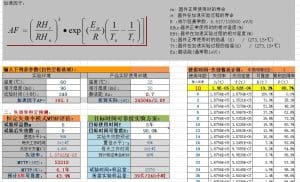
The following table presents a real-world case we encountered. The accelerated aging model we used for analysis was the Peck model.
Introduction to the Peck Model
The Peck model is an empirical model used to predict the accelerated aging of electronic components and materials under the combined effects of temperature and humidity. Unlike the traditional Arrhenius model, which considers only temperature, the Peck model introduces a humidity exponent parameter, making it more suitable for simulating the impact of hot and humid environments on product lifetime. Its mathematical expression is:
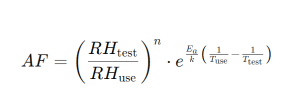
Where:
- AF is the acceleration factor,
- RH is the relative humidity,
- n is the humidity exponent (typically ranging from 2 to 4; we use 3),
- E is the activation energy (commonly 0.7 eV for LCDs),
- k is the Boltzmann constant,
- T is the absolute temperature in Kelvin.
Using this model, the duration of an accelerated test can be converted into an equivalent lifetime under normal operating conditions.
For example, in our table, by substituting the following values:
RHtest: test relative humidity (90%)
RHuse: usage relative humidity (50%)
Ttest=333.15K
Tuse=298.15K
Ea =0.7eV
k=8.617×10⁻⁵ eV/K
n=3
AF=102.1
Equivalent Operating Time T=240hrs*102.1=24,504hrs.
Next, we need to substitute T into the MTBF formula.
Definition and Difference Between MTTF and MTBF
Both MTTF and MTBF are used to describe product reliability, but they apply to slightly different scenarios.
MTTF (Mean Time To Failure) refers to the average time a device operates before its first failure. It is applicable to non-repairable systems and represents the statistical expected lifetime, reflecting the reliability level of a product.
MTBF (Mean Time Between Failures) is typically used for repairable systems, and indicates the average operating time between two consecutive failures. For non-repairable systems (such as LCDs in our testing, which cannot be repaired once damaged), MTBF can be approximated as MTTF.
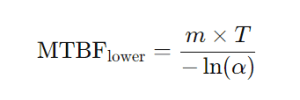
The formula for MTBF is as follows:
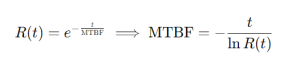
To calculate reliability from MTBF, the formula is as follows:
Experimental Design
Test Objectives:
Achieve the required MTBF lower bound corresponding to a 10-year lifetime, with both 5-year and 10-year reliability exceeding 90% under known conditions.
Equivalent test time per unit: 24,504 hours (based on extrapolation from 240 hours at 60°C / 90% RH using the Peck model).
Confidence levels: Sample size calculations for 90%, 95%, and 99% confidence levels.
Sample Size Requirements (Based on MTBF Reliability Calculation):
| Confidence Level | Samples for 90% Reliability @ 5 Years | Samples for 90% Reliability @ 10 Years |
| 90% | 40 | 79 |
| 95% | 51 | 102 |
| 99% | 79 | 157 |
Test Plan Details:
- Sample Size: Select based on desired reliability and confidence level; it is recommended to include a margin for contingency.
- Test Conditions: Continuous aging under 60°C / 90% RH for at least 240 hours (widely accepted industry standard).
- Data Monitoring: All failure events and times must be recorded throughout the test. If any failures occur, recalculate and adjust the plan accordingly.
- Periodic Assessment: After testing, use the Peck model to convert the test duration to equivalent lifetime. Evaluate MTBF and reliability using appropriate statistical methods.
- Risk Management: In case of failures, analyze the failure modes, adjust materials or processes, and optimize the design as needed.
Expected Conclusion:
If 79 samples are tested under 60°C / 90% RH for 240 hours, and no failures occur, the equivalent 10-year reliability of the product can be estimated at 90% (i.e., only 10% of units are expected to fail), which meets the general standard for consumer electronics (typically 80–90% reliability).
In contrast, if only 5 samples are tested (as shown in the initial table), the 5-year reliability would be just 43.9%, meaning that nearly half the units are expected to fail within 5 years, a conclusion that is not favorable for presentation to customers.
Frequently asked questions
Is the 50,000-hour product lifetime based on testing?
What is the Peck model?
What is the difference between MTTF and MTBF?
How is a 240-hour test converted into an equivalent lifetime?
How many samples are needed to show 90% reliability over 10 years?
New engineering articles by email.
Keep reading
Display Lifetime and Reliability
Design and IntegrationDisplay Operating Temperature
Design and IntegrationCover Glass and Surface Treatments
Enclosure & ReliabilityEnclosure Surface Finishes: Types, Benefits, and How to Choose the Right Finish
Enclosure & ReliabilitySolving ESD Failures in Modern Electronic Systems
Enclosure & ReliabilityMethods for Securing TFT and OLED Display Panels in an Enclosure
Have a display project in mind?
Talk to an engineer about the display your application needs.