

Display Lifetime and Reliability
A display’s lifetime spec is one of the most misread numbers in a datasheet, because most of it describes gradual dimming rather than the moment the part stops working, and several alarming-looking failures are fully reversible. Specifying reliability well means knowing which wear-out mode actually limits your product, stating the life with the conditions that make it meaningful, and not confusing a lifetime with a failure rate. This sits alongside the environmental limits in display operating temperature, which sets the range this lifetime is measured within.
Part of the Specifying and Sourcing knowledge hub.
The backlight usually sets the clock
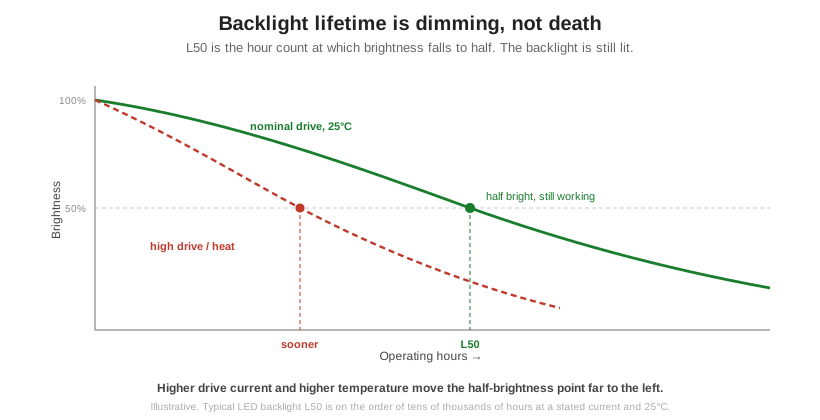
In a modern LCD the liquid crystal outlives everything around it; the LED backlight is almost always the component that defines useful life. Backlight life is quoted as L50, also called half-life: the number of operating hours until brightness falls to 50% of its initial value. It is not a time-to-failure. At L50 the backlight is still lit and the display still works; it is simply half as bright. Typical figures run into the tens of thousands of hours, on the order of 30,000 to 50,000 and beyond, but always at a stated drive current and temperature. Two things shorten it sharply. Drive current sets brightness, and running the LEDs harder for more nits burns the backlight down faster. Heat compounds it: LED degradation accelerates roughly exponentially with junction temperature, so the same module can reach L50 in a fraction of the hours when it runs hot. The levers are the mirror image: drive below maximum, dim or sleep the backlight when idle, and give the LEDs a thermal path. The same panel can be a 25,000-hour part or a 50,000-hour part depending only on how it is driven.
OLED ages by the pixel
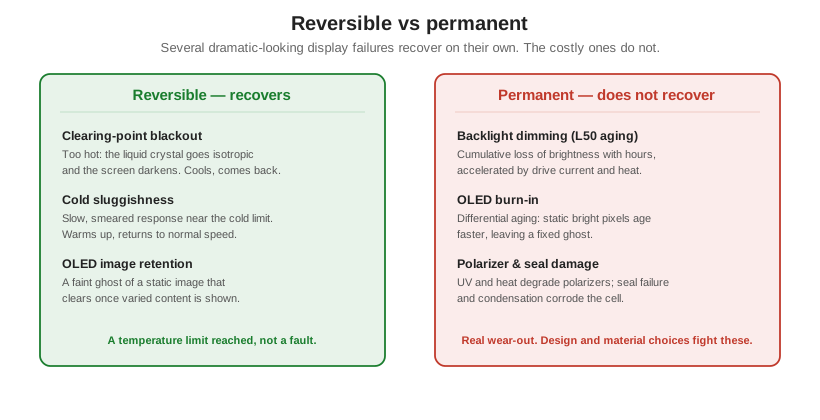
An OLED has no separate backlight; each subpixel emits its own light, so subpixel aging is the lifetime. Life is specified the same way, to 50% of initial luminance, with typical figures again in the tens of thousands of hours but strongly dependent on brightness and content. The blue subpixels are the weak link, degrading roughly two to three times faster than red and green, so an aged OLED shifts color as well as dims, which is exactly why life is defined at half luminance rather than at failure. The distinction to hold onto is burn-in versus image retention. Image retention is temporary: a faint ghost of a static image that clears once varied content is shown. Burn-in is permanent: differential aging where pixels that displayed bright static content, a logo or a status bar, have physically aged more than their neighbors, leaving a fixed pattern. Static, high-brightness content is what turns the first into the second, so the mitigations are lower brightness, pixel-shifting, and avoiding fixed bright UI.
Reversible versus permanent
Some display failures recover on their own and some never do, and telling them apart prevents a lot of needless alarm and warranty churn. The screen going dark in the heat is the classic false alarm: past the liquid crystal’s clearing point the material turns isotropic and can no longer rotate light, so the display blacks out, but this is a reversible phase transition, like ice to water, that returns to normal once it cools. Cold sluggishness is the same story in reverse. The permanent failures are the ones worth designing against: cumulative backlight dimming, OLED burn-in, polarizer degradation from UV and heat, which discolors and loses contrast, and seal failure or moisture ingress, which corrodes the cell. The permanent risk near heat and humidity is not the blackout; it is condensation, which drives electrochemical damage. Keep operation below roughly 90% relative humidity and out of condensation.
MTBF is a rate, not a lifespan
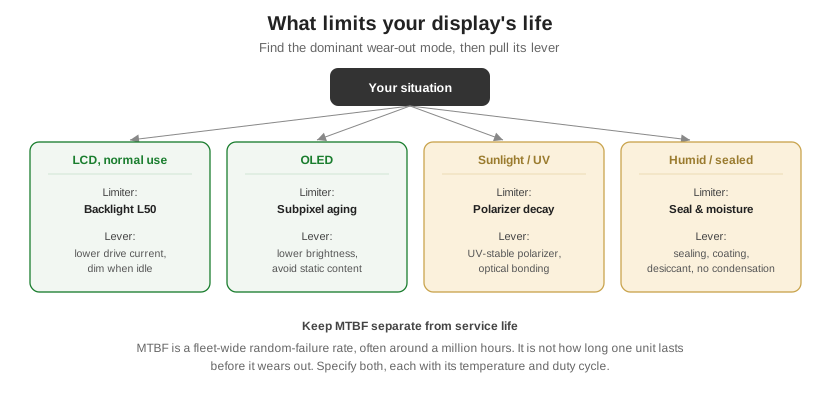
Mean time between failures is one of the most abused numbers in a spec. MTBF is a statistical failure rate over the flat, random-failure portion of a large population’s life; it answers how often a unit in a fleet fails during its useful-life window, not how long one unit lasts before it wears out. That is why MTBF figures are enormous, up to around a million hours, while the same display’s service life is measured in tens of thousands. The two are independent, and you need both to describe reliability. When you read or write an MTBF, pin down the temperature, duty cycle, and standard it was computed under, and never read it as a longevity guarantee. For the acceleration math behind these figures, see the Peck model and accelerated-life testing.
Specifying a lifetime that means something
A lifetime number is meaningless without its conditions, so state them together: the target operating hours; the end-of-life criterion, the luminance threshold that counts as end of life, whether that is L50 or the stricter L70; the duty cycle and whether the display dims when idle; the drive or brightness the life is rated at, since life at full brightness is not life at half; and the ambient temperature assumed, since life at 25°C is not life at 70°C. Specify MTBF separately, with its own conditions, and do not fold it into the service-life number. The figure below routes a product to its dominant limiter and the lever that extends it; the table gives orientation on the numbers themselves.
| Item | Typical figure | What it means |
|---|---|---|
| LED backlight half-life (L50) | tens of thousands of hours (~30,000–50,000+) | Hours to 50% brightness, at a stated current and 25°C. Not failure. |
| Backlight when run hot | a fraction of the 25°C figure | Degradation accelerates with junction temperature. |
| OLED panel (T50) | tens of thousands of hours | Hours to 50% luminance; heavily content- and brightness-dependent. |
| Liquid crystal itself | not the wear-out item | Long-lived; failures come from backlight, polarizer, and seal. |
| Storage shelf life | ~12 months sealed (longer controlled) | In moisture-barrier packaging with desiccant. |
| Operating humidity | below ~90% RH, no condensation | Above this, or with condensation, damage is permanent. |
Because L50, clearing point, and polarizer stability are all set by the backlight drive and the materials chosen, they are design choices a custom build can tune to the application, not fixed properties you have to accept. Orient Display can set the backlight operating point to a target hour count, and select wide-temperature, UV-stable materials and sealing for harsh environments, across its TFT and sunlight-readable lines. This is part of the wider case for a purpose-built panel in custom vs off-the-shelf displays; to set reliability targets for a specific design, start a custom project.