

Enclosure Surface Finishes: Types, Benefits, and How to Choose the Right Finish
Six common finishes compared, what Ra values mean, and how to choose and confirm a finish before mass production.
On this page
The surface finish of an electronic enclosure is more than an aesthetic choice. It affects durability, corrosion resistance, wear performance, heat dissipation, and the overall quality of the finished product. For industrial displays, automotive interfaces, medical devices, and other electronic equipment, selecting the right enclosure surface finish is an important part of product design and manufacturing.
Different finishing processes offer different advantages in appearance, protection, surface texture, and cost. Understanding these differences helps engineers balance functional requirements, product design, and manufacturing feasibility.

1. Why Does Enclosure Surface Finish Matter?
An enclosure protects internal electronic components while providing the exterior appearance and tactile experience of the product. The surface treatment can influence several key performance characteristics:
- Corrosion resistance: Helps protect the enclosure from moisture, oxidation, and environmental exposure.
- Wear and scratch resistance: Improves durability in applications involving frequent handling or contact with other surfaces.
- Appearance and texture: Creates a consistent color, gloss level, and surface texture that align with the product design.
- Heat dissipation: Certain surface treatments can affect thermal radiation and heat transfer, depending on the material and operating conditions.
- Cleanability and maintenance: Important for medical equipment, industrial control panels, and devices used in demanding environments.
- Manufacturing consistency: Helps achieve repeatable surface quality across production batches.
The ideal finish depends on the enclosure material, operating environment, performance requirements, and target cost.
2. Common Types of Enclosure Surface Finishes
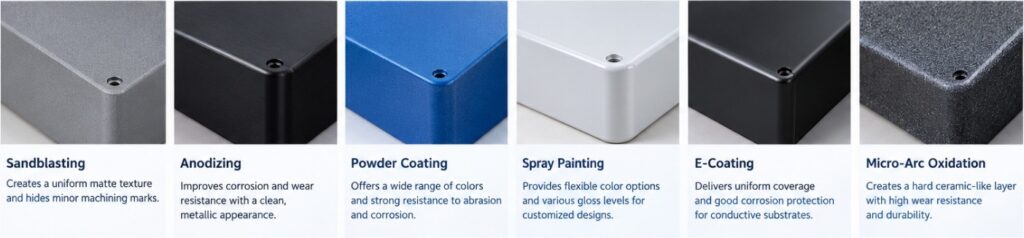
2.1 Sandblasting
Sandblasting, also called abrasive blasting, uses abrasive media propelled against the enclosure surface to create a uniform matte texture. For aluminum enclosures, suitable blasting media and process parameters can help produce a refined, consistent appearance.
Key advantages:
- Creates a non-glossy, uniform surface texture.
- Reduces the visibility of minor machining marks.
- Provides a suitable base for subsequent finishing processes.
- Supports modern, understated industrial and consumer product designs.
Sandblasting is frequently used before anodizing or other surface treatments. However, blasting alone does not provide the same corrosion protection as a dedicated protective coating. The final texture depends on the abrasive media, particle size, pressure, and processing time.
2.2 Anodizing
Anodizing is an electrochemical process that forms a controlled oxide layer on aluminum. It is widely used for aluminum electronic enclosures because it combines an attractive appearance with improved surface durability.
Key advantages:
- Improves corrosion resistance when properly processed and sealed.
- Provides good surface wear resistance.
- Supports a range of colors, including black, silver, and natural aluminum.
- Offers a durable finish without adding a thick conventional paint layer.
Anodizing can be combined with sandblasting to create a uniform matte appearance. Black anodizing is particularly common in industrial electronics and display housings.
However, anodizing is primarily suitable for aluminum and certain other metals. Color consistency can vary with alloy composition, surface preparation, and process conditions. Anodized surfaces are also electrically insulating in the treated areas, which must be considered when the enclosure requires electrical grounding or conductive contact.
2.3 Powder Coating
Powder coating applies a dry powder to the enclosure, typically using electrostatic spraying, followed by curing to form a protective coating.
Key advantages:
- Offers a broad selection of colors and gloss levels.
- Provides good resistance to abrasion, impact, and corrosion when the coating system is properly selected.
- Can cover relatively large surfaces uniformly.
- Supports customized product branding and industrial design requirements.
Powder coating is commonly used for industrial control equipment, instrument housings, and larger electronic enclosures.
Potential limitations include coating thickness, edge coverage, curing requirements, and dimensional changes around precision features. Masking may be necessary for threaded holes, grounding points, connector interfaces, and tight-tolerance assembly areas.
2.4 Spray Painting
Spray painting applies a liquid coating to the enclosure to achieve a specific color, gloss level, or visual effect. Depending on the coating system, it can be used on metals, plastics, and other compatible substrates.
Key advantages:
- Offers extensive color and appearance customization.
- Supports smooth, glossy, matte, and specialty finishes.
- Can be suitable for complex shapes and detailed cosmetic requirements.
- Allows flexibility for small production runs and customized designs.
The performance of a painted surface depends on the coating chemistry, substrate preparation, film thickness, curing conditions, and environmental exposure. Compared with some anodized or powder-coated surfaces, certain paint systems may be more susceptible to chipping, scratching, or peeling if not properly specified and applied.
2.5 Electrophoretic Coating
Electrophoretic coating, commonly called e-coating, uses an electric field to deposit a coating onto a conductive workpiece immersed in a coating bath. It can provide relatively uniform coverage, including on complex geometries.
Key advantages:
- Provides consistent coating coverage on suitable conductive substrates.
- Offers good corrosion protection when the coating system is properly designed.
- Can achieve a smooth, uniform appearance.
- Works well as part of a controlled industrial finishing process.
Black electrophoretic coating is often considered for electronic enclosures that require a clean, uniform black appearance.
E-coating is not the same as anodizing: it deposits a coating rather than forming an oxide layer from the substrate. The resulting electrical insulation, scratch resistance, and corrosion performance depend on the coating system and process specifications.
2.6 Micro-Arc Oxidation (MAO)
Micro-arc oxidation, also known as plasma electrolytic oxidation, is an electrochemical surface treatment used on certain valve metals, including aluminum, magnesium, and titanium. It produces a hard ceramic-like oxide layer through a high-voltage process.
Key advantages:
- Can provide high surface hardness and wear resistance.
- Offers potential benefits in demanding mechanical environments.
- Produces a distinctive ceramic-like surface.
- Can be useful when conventional finishes do not meet the required performance.
MAO may be appropriate for specialized industrial or outdoor equipment that requires enhanced surface durability. However, it generally involves more complex processing and can cost significantly more than conventional finishing methods.
The resulting surface may be relatively rough or porous, depending on the process. Achieving a fine surface roughness, such as Ra 1.2 μm, may require additional process development or finishing operations. Feasibility should be confirmed with the supplier rather than assumed from the coating type alone.
3. Surface Roughness: Understanding Ra Values
Surface roughness is another important consideration when specifying an enclosure finish. It is commonly expressed as Ra, or the arithmetic average roughness, measured in micrometers (μm).
A lower Ra value generally indicates a smoother surface, while a higher value indicates greater surface texture.
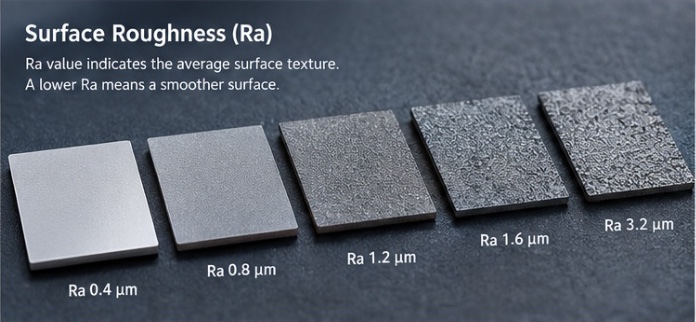
For example:
- Ra 1.2 μm: A relatively fine surface texture that may be required for certain precision or cosmetic applications.
- Ra 1.6 μm: A moderately fine finish that can be suitable for selected machined or treated surfaces.
- Higher Ra values: May be acceptable for textured, functional, or less appearance-sensitive enclosure surfaces.
These values are illustrative rather than universal classifications. The actual appearance associated with a given Ra value depends on the material, measurement direction, surface treatment, and measurement method.
Importantly, surface roughness is not the same as gloss or visual uniformity. Two enclosures with similar Ra measurements can look different because of variations in texture direction, color, reflectivity, or coating characteristics.
If surface roughness is a critical requirement, the drawing should specify the required Ra value, the measurement location, and any applicable inspection method.
4. Comparing Common Enclosure Surface Finishes
| Surface finish | Main advantages | Potential limitations | Typical applications |
|---|---|---|---|
| Sandblasting | Uniform matte texture; hides minor machining marks | Limited protection when used alone | Aluminum housings, pre-treatment |
| Anodizing | Good corrosion and wear performance; metallic appearance | Primarily for suitable metals; color variation may occur | Industrial and automotive electronics |
| Powder coating | Wide color selection; durable coating | Adds thickness; masking may be required | Industrial control enclosures |
| Spray painting | Flexible appearance and color customization | Performance varies by coating system | Customized equipment housings |
| E-coating | Uniform coverage; good corrosion protection with suitable systems | Requires conductive workpieces and specialized processing | Complex metal enclosures |
| Micro-arc oxidation | Hard ceramic-like oxide; high wear resistance | Higher cost; roughness and color options require evaluation | Specialized industrial equipment |
No single finishing process is best for every enclosure. The correct choice depends on the substrate, required protection, appearance, dimensional tolerances, and production budget.
5. How to Select the Right Finish for Your Application
When choosing an enclosure surface finish, engineers should evaluate the following factors.
5.1 Base Material
Determine whether the enclosure is made of aluminum, steel, stainless steel, magnesium, or plastic. Not every finishing process is compatible with every material.
5.2 Operating Environment
Consider exposure to moisture, salt spray, chemicals, UV radiation, temperature changes, and mechanical wear. For outdoor or automotive applications, environmental testing may be necessary to verify the complete finishing system.
5.3 Appearance Requirements
Define the required color, gloss level, texture, and cosmetic acceptance criteria. Reference samples or approved master samples can help reduce disagreements between design, engineering, and manufacturing teams.
5.4 Surface Roughness and Dimensional Tolerances
Specify Ra requirements where necessary, and account for coating thickness or material removal. Threaded holes, mounting surfaces, connector openings, and precision interfaces may require masking or post-processing.
5.5 Electrical and Thermal Requirements
Check whether the enclosure needs electrical grounding, EMI shielding, or heat dissipation. Anodized and painted surfaces can be electrically insulating, so grounding points and conductive interfaces may need special treatment. Thermal performance should be evaluated based on the complete assembly rather than the finish alone.
5.6 Cost and Production Volume
Consider material preparation, finishing, masking, inspection, rework, and yield. A finish that meets all technical requirements but is difficult to reproduce consistently may increase overall manufacturing cost.
6. Why Surface Finish Should Be Confirmed Early
Changing the enclosure finish late in a product development project can affect cost, schedule, tooling, and qualification requirements. For example, switching from conventional black anodizing to a specialized ceramic-like surface treatment may require additional process development and a new evaluation of roughness, color, and dimensional compatibility.
To minimize these risks, manufacturers and customers should confirm the following before mass production:
- Base material and surface preparation.
- Finishing process and color specification.
- Surface roughness and cosmetic acceptance criteria.
- Required corrosion, wear, chemical, or environmental tests.
- Masking areas and electrical contact requirements.
- Approved samples and inspection standards.
Early confirmation helps ensure that the finished enclosure meets both functional and cosmetic expectations while avoiding unnecessary redesign or qualification delays.
Conclusion
Selecting the right enclosure surface finish requires balancing appearance, durability, corrosion resistance, dimensional accuracy, and cost. Sandblasting and anodizing are popular choices for aluminum housings, while powder coating, spray painting, electrophoretic coating, and micro-arc oxidation offer alternatives for different materials and performance requirements.
By defining the material, environment, surface roughness, and acceptance criteria early in the design process, engineers can make better finishing decisions and improve manufacturing consistency.
For electronic display assemblies and customized enclosure projects, working closely with an experienced manufacturing partner can help identify a practical surface finish that meets the product’s technical requirements, appearance goals, and production budget.
Frequently asked questions
Why does enclosure surface finish matter?
Which surface finishes are common for electronic enclosures?
Does anodizing affect electrical grounding?
What does the Ra value on an enclosure drawing mean?
When should the enclosure finish be confirmed?
New engineering articles by email.
Keep reading
Display Lifetime and Reliability
Design and IntegrationDisplay Operating Temperature
Design and IntegrationCover Glass and Surface Treatments
Enclosure & ReliabilityMethods for Securing TFT and OLED Display Panels in an Enclosure
Display Selection & ApplicationsOutdoor Display Design Checklist
Optics, Cover Glass & CoatingsIntroduction to Cover Glass for Displays
Specifying a display and its enclosure?
Include your enclosure material, environment, finish and Ra requirements in your RFQ.