

Specifying Display Brightness and Sunlight Readability
Readability outdoors is not set by how bright a display is. It is set by how bright the display is relative to the light reflecting off its front surface. An engineer who specifies only a nit figure has specified half the problem, and often the less important half. The metric that actually governs readability is ambient contrast ratio, and it is driven as much by reflectance and surface treatment as by luminance. This article is about specifying that outcome. The construction behind it lives in the existing articles on backlight types, reflective, transmissive, and transflective modes, optical bonding, and cover glass and surface treatments.
Part of the Specifying and Sourcing knowledge hub.
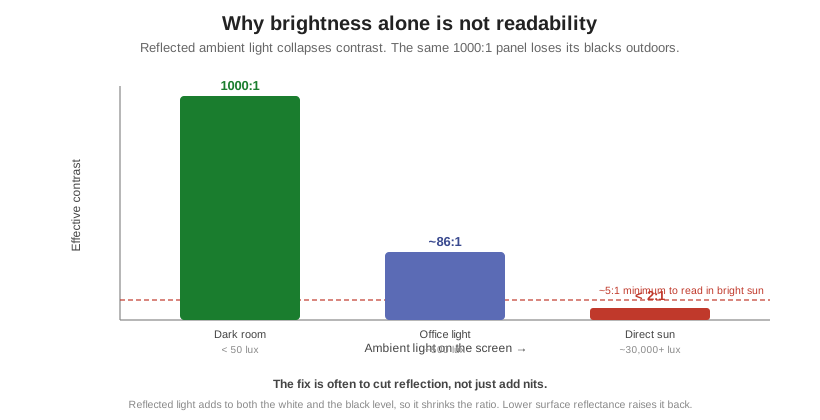
Nits and lux are not the same thing
Two units get confused constantly, and the spec falls apart if you mix them. Luminance is the light the display emits, measured in candela per square meter, where one nit equals one cd/m² exactly. That is the number you put on the display. Illuminance is the ambient light falling onto the display, measured in lux, and it describes the environment, not the part. Direct sun is on the order of 30,000 to 100,000 lux, an overcast day a few thousand, office light around 300 to 500. You use the lux figure of the target environment as the input that decides how many nits, and how low a reflectance, you need. The spec is written in nits; the room is described in lux. As a rough guide, an indoor UI wants 200 to 350 nits, a bright industrial floor around 500, a shaded outdoor screen 700 to 1000, and full-color legibility in direct sun 1500 and up, but those are ranges and the top of the scale is where reflection control starts to matter more than raw brightness.
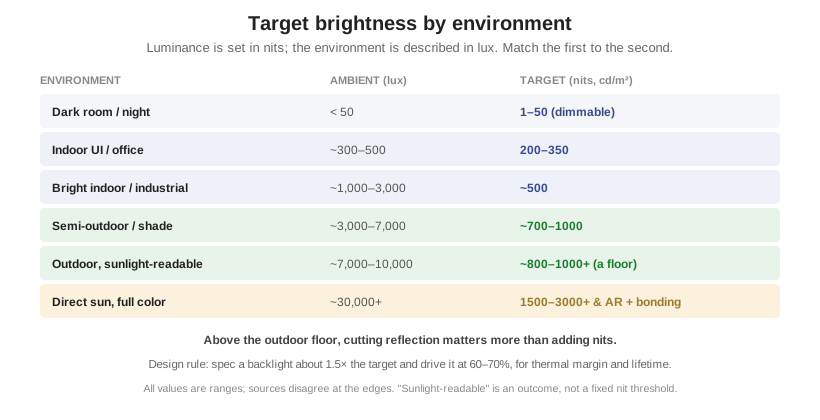
Ambient contrast is what you are really specifying
The contrast ratio on a datasheet is a dark-room number: the bright state divided by the dark state with no ambient light. A panel might spec 1000:1 that way, and outdoors it is nearly irrelevant. Ambient contrast ratio adds the reflected ambient light to both terms, and because that reflected light lands in both the numerator and the denominator, it collapses the ratio. A 1000:1 native panel drops to roughly 86:1 under 500 lux of office light, and a modest 200-nit panel can fall under 2:1 in direct sun. The eye needs roughly 5:1 to reliably read text in bright sun, and more to be comfortable, so the real requirement is a minimum ambient contrast ratio at the worst-case ambient, not a native contrast on a spec sheet. Two levers move it: raise the emitted brightness, or cut the surface reflectance. Cutting reflectance is usually the cheaper, cooler, longer-lived lever.
Cut reflection, do not just add nits
Surface reflectance is the fraction of ambient light the front stack bounces back at the viewer, and every air-to-glass interface reflects about 4% of it. There are a few ways to attack it, and they solve different problems. Anti-glare roughens the surface to scatter mirror-like specular reflections into diffuse haze; it kills hot spots but slightly softens the image. Anti-reflective coatings reduce the total reflected light, from about 4% per interface down toward half a percent on a good stack, preserving sharpness at higher cost. A circular polarizer suppresses reflections off internal metal and electrode layers, which matters for OLED and some touch stacks, at the cost of cutting the display’s own output. And optical bonding, filling the air gaps between panel, touch, and cover glass with an index-matched adhesive, removes the internal reflections that wash out blacks in sunlight and is the single most effective step for a bonded stack. For true direct-sun performance, anti-reflective treatment combined with optical bonding is usually the only viable path, and it beats brute-forcing the backlight.
| Technique | What it does | Tradeoff |
|---|---|---|
| More nits (backlight) | Raises emitted brightness | More power, heat, and shorter backlight life |
| Anti-glare (AG) | Scatters specular glare into haze | Slightly softens the image |
| Anti-reflective (AR) | Cuts total front-surface reflection (~4% → ~0.5%) | Costlier; wants a hard coat |
| Circular polarizer | Blocks internal metal/electrode reflections | Also cuts the display’s own output |
| Optical bonding | Removes air-gap reflections, lifts sunlight contrast | Process cost; permanent lamination |
| Transflective mode | Uses ambient light to illuminate the panel | Dimmer and less saturated indoors and at night |
Brightness has a cost
More nits is not free, and over-specifying it has a real reliability and thermal price. Backlight luminance scales with LED drive current, and that current becomes heat at the LED junction and behind the panel, so a high-brightness module needs thermal design. It also shortens life: LED backlight half-life falls as drive current rises, and heat compounds it, a relationship covered in display lifetime and reliability. The practical design rule is to never run the LEDs flat out. To deliver a given brightness reliably over the product’s life, spec a backlight capable of roughly 1.5 times the target and drive it at 60 to 70%. That buys thermal margin, lifetime, and headroom for the brightness decay that comes with age. Above roughly 50°C ambient, expect to derate the drive current. This is the honest reason reflection control is so often the better first move: it raises readability without paying the backlight’s power, heat, and lifetime penalty.
Writing a brightness spec that holds up
Specify the outcome, not just the input. State a minimum luminance measured at the cover glass, after the touch sensor and bonding, not at the bare panel, because every layer costs transmission and a “1000-nit panel” delivers less at the surface the user actually looks at. State a minimum ambient contrast ratio at a stated ambient illuminance, for example at least 5:1 at 30,000 lux, which is the real readability requirement. State a maximum surface reflectance and the required treatments. State the viewing conditions: the light’s angle, the viewing angle, and whether color must stay saturated or monochrome legibility is enough. And state brightness over life: the initial nits, the end-of-life nits at the rated half-life, and the minimum dim level for night use. The figure routes a product to its target and treatments.
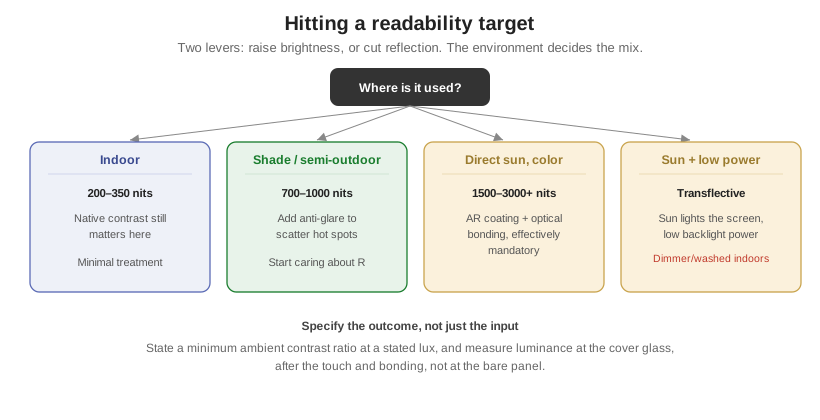
Because brightness, reflectance, and bonding are all build choices, a custom maker can hit a readability target with margin rather than shipping a stock panel run flat out: binning the LEDs and designing the backlight for the target with thermal and lifetime headroom, bonding the stack in-house, and matching anti-glare, anti-reflective, or a circular polarizer to the stated environment. Orient Display measures luminance at the finished cover glass so the datasheet number is the number the user sees, across its sunlight-readable TFT and TFT lines. For the make-or-buy view, see custom vs off-the-shelf displays; to set a readability target for a design, start a custom project.