

Reflective, Transmissive, and Transflective LCDs
LCDs come in three light-transmission modes, set by the rear polarizer: reflective, transmissive, and transflective. A reflective display uses ambient light only and needs no backlight, so it runs on the least power and reads best in bright light. A transmissive display uses a backlight only and reads best indoors, but washes out in sunlight. A transflective display does both, using ambient light when it is available and a backlight when it is not, so it works everywhere. The mode is chosen by the lighting the product will face. For the underlying cell that these modes light up, see what an LCD is and how it works.
Part of the Display Fundamentals knowledge hub.
The three modes at a glance
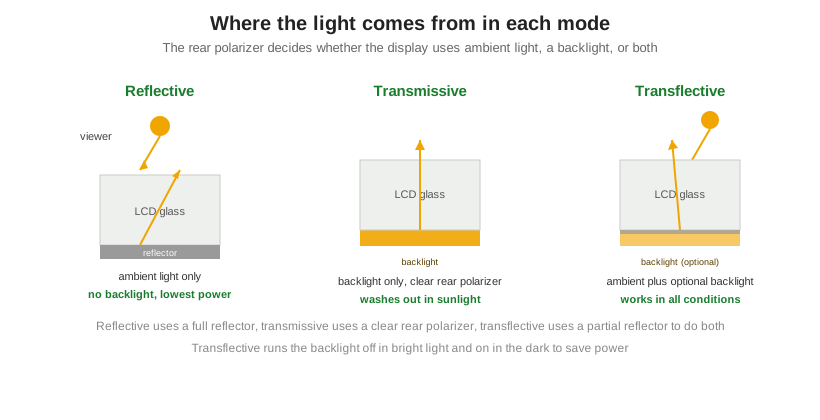
All three modes share the same liquid crystal cell. What differs is the rear polarizer: a full reflector, a clear window, or a partial reflector. That one part decides the light source, the power draw, and whether the display survives sunlight.
| Attribute | Reflective | Transmissive | Transflective |
|---|---|---|---|
| Rear polarizer | Reflector bonded on | Clear, no reflector | Partial reflector |
| Light source | Ambient only | Backlight only | Ambient plus optional backlight |
| Backlight | None | Required, always on | Optional; off in bright light, on in the dark |
| Best environment | Bright, outdoor, well-lit | Low to medium indoor light | All conditions, including direct sun |
| Sunlight readable | Yes | Washes out | Yes |
| Relative power | Lowest | Highest | Low to moderate |
| Typical use | Watches, calculators, meters | Indoor instruments, handhelds | Automotive, thermostats, marine |
How light travels in each mode
In a reflective display, ambient light enters the front, passes through the cell, hits a reflector bonded to the rear polarizer, and bounces back to the viewer. No backlight is needed, which is why reflective displays draw the least power and get sharper as light increases. In a transmissive display, the rear polarizer is clear, so a backlight behind the cell shines forward to the viewer. It looks excellent in low light but loses contrast against bright sun. A transflective display uses a partial reflector, so it reflects front light like a reflective display and also lets a backlight through from behind. Users run the backlight off outdoors to save power and on in the dark. The backlight itself is a separate design choice, covered in LCD backlight types.
Matching a mode to where the product lives
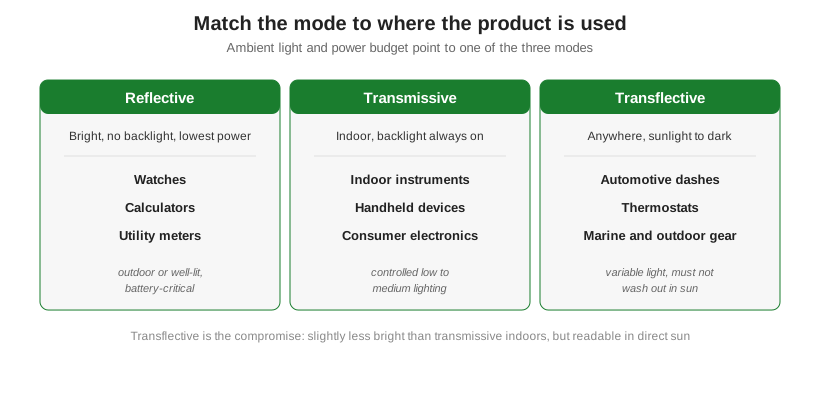
Pick the mode by the lighting the product will actually see, then by power budget. Bright or outdoor use with a tight power budget points to reflective. Controlled indoor light points to transmissive. Variable light that includes direct sun, where the display must never wash out, points to transflective. Transflective is the safe compromise for anything that moves between indoors and sun, at the cost of being slightly dimmer than a pure transmissive display indoors. For sunlight-critical color displays, this same logic carries into sunlight-readable TFT.
Readability across lighting conditions
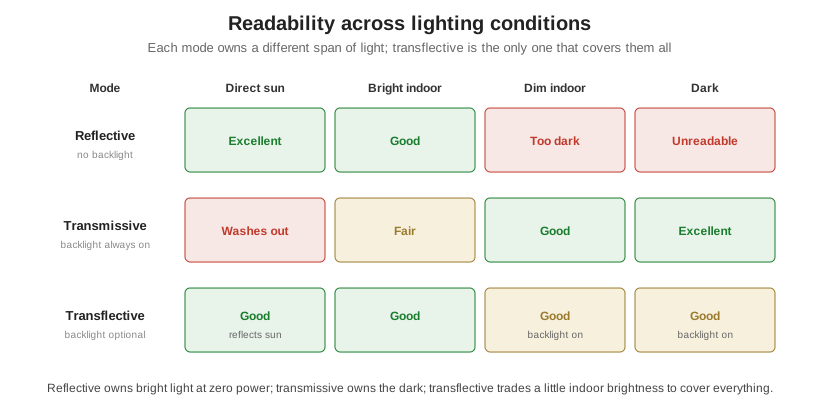
The practical way to choose is to look at how each mode reads across the full range of light a product will see. A reflective display is excellent in direct sun and good in bright rooms because it lives on ambient light, but it goes dark as the light drops and is unreadable in the dark. A transmissive display is the mirror image: it washes out in sun, is only fair in a bright room, and is at its best in dim light and darkness, where its backlight carries the whole image. A transflective display stays readable across the entire range, reflecting sun by day and switching its backlight on as the light falls, at the cost of being a little less bright indoors than a pure transmissive panel. The grid below lays out the same picture at a glance.
The transflective compromise, and what it costs
Transflective looks like the obvious winner because it covers every condition, but it is a compromise, not a free upgrade. Its partial reflector splits the light two ways, so it reflects less ambient light than a full reflector and passes less backlight than a clear window. The result is a display that is readable everywhere but not the brightest option in any single condition: a pure reflective panel is sharper in direct sun, and a pure transmissive panel is brighter indoors. The partial-reflector polarizer also costs a little more and adds some complexity to the stack. So default to transflective only when the product genuinely moves between sunlight and darkness. When the lighting is controlled, the single-purpose mode that matches it is brighter and cheaper, and the simpler choice is the right one.
Orient Display specifies the polarizer and reflector for the environment a product ships into and builds the matching custom glass from concept to production; see the LCD product line.