

Custom vs Off-the-Shelf Displays
Once you know the panel and the technology you want, one commercial decision shapes the whole program: do you buy a standard catalog display, or commission a custom one? The honest answer is rarely all-or-nothing. There is a middle path, semi-custom, that captures most of the benefit of custom at a fraction of its cost and commitment. This article is about reading your own project, volume, fit, and product life, and landing on the right one of the three. For the menu of what can actually be changed, see what you can customize on a display.
Part of the Specifying and Sourcing knowledge hub.
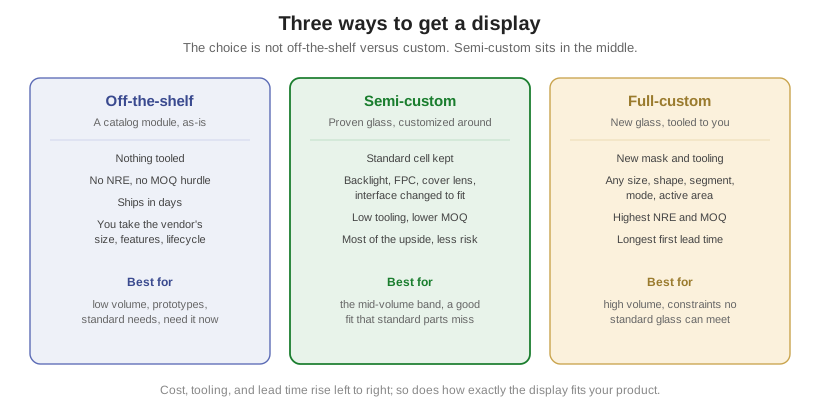
Three options, not two
Off-the-shelf is a catalog module used as it ships. Nothing is tooled, there is no minimum order to clear, and you can hold hardware in days. In exchange you accept the vendor’s size, feature set, and lifecycle. Full-custom is the opposite: a new glass cell is tooled to your exact outline, active area, or segment layout, which buys an exact fit but carries the highest one-time cost, the highest minimum order, and the longest first lead time. Semi-custom sits between them and is where most programs should start. It keeps a proven, already-tooled glass cell and customizes the module around it, the backlight, the flex tail and connector, the cover lens, the touch sensor, the interface. You get the fit that matters without paying to tool new glass, and both the tooling charge and the minimum order stay small. Treat the decision as a choice among three, and the middle one usually wins.
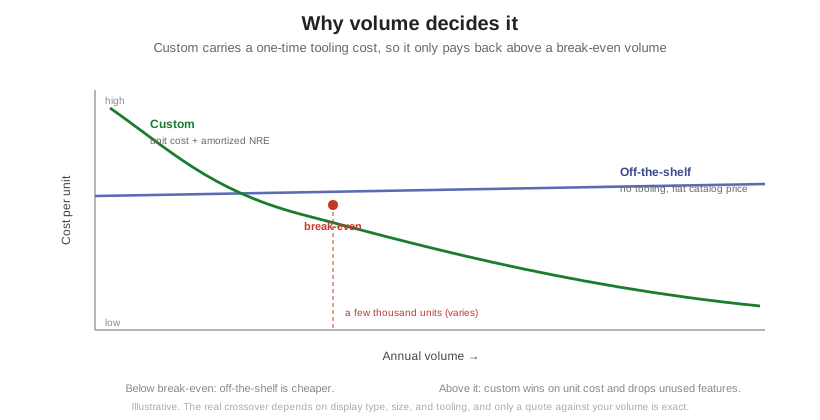
Volume sets the floor
Custom carries a one-time tooling and engineering charge, and that cost has to be spread across the units you build. Below a break-even volume, the amortized charge makes each unit more expensive than a catalog part; above it, custom is cheaper per unit and cheaper at the system level, because a purpose-built module drops the connectors, controller features, and backlight zones you were paying for but not using. The crossover is not a fixed number. As a rough industry rule of thumb it tends to land somewhere in the low thousands of units per year for a semi-custom build, and much higher before a genuinely new color TFT glass cell pays off. The only reliable break-even is the one calculated against a real quote for your specific part, which is why the numbers live in MOQ, tooling, and lead times rather than here.
Fit is the other half
Volume tells you when custom pays; fit tells you when it is the only option. A standard part is built for the average of many buyers, so it will miss hard requirements that are specific to your product. Mechanically, a custom or semi-custom build hits an exact outline, thickness, mounting, and connector exit direction, and can take a non-rectangular shape or a cutout a catalog part will never offer. Optically, it lets you specify the brightness and reflection control a sunlight-readable design needs, a wider viewing angle, or optical bonding, covered in specifying brightness and sunlight readability. Environmentally, it lets you order a wide operating-temperature grade that consumer catalog modules rarely meet, discussed in display operating temperature. And electrically, it lets you match the exact interface, voltage, and pinout your board already assumes, removing level-shifters and glue logic. When a standard part cannot meet one of these, the decision is made for you.
Lifecycle is the quiet deciding factor
The axis engineers underweight is supply control over the life of the product. Industrial, medical, and instrument products often ship for eight to fifteen years, far longer than a typical catalog display stays on the market. With an off-the-shelf part, the vendor controls the lifecycle: they can issue an end-of-life notice on their schedule and force you into a last-time-buy, a redesign, and a full requalification, sometimes with a spare-parts gap in the middle. A part you own the tooling for lets you lock the bill of materials, negotiate change-notice terms, and choose stable glass generations and multi-sourced backlights up front, aligning supply to your product’s life instead of the vendor’s. Off-the-shelf does not remove obsolescence risk; it just hands you the timing of it. For a long-life product, that alone can justify going custom, and it pairs with the reliability targets in display lifetime and reliability.
Making the call
Weigh the three axes together. Low or uncertain volume, standard requirements, and a need for hardware now point to off-the-shelf. High steady volume, a tight mechanical or optical fit, or a long product life that demands supply control point to custom. When the requirement is real but a standard glass could still carry it, semi-custom is almost always the answer, because it meets the need at the lowest tooling, the lowest minimum order, and the shortest first lead time.
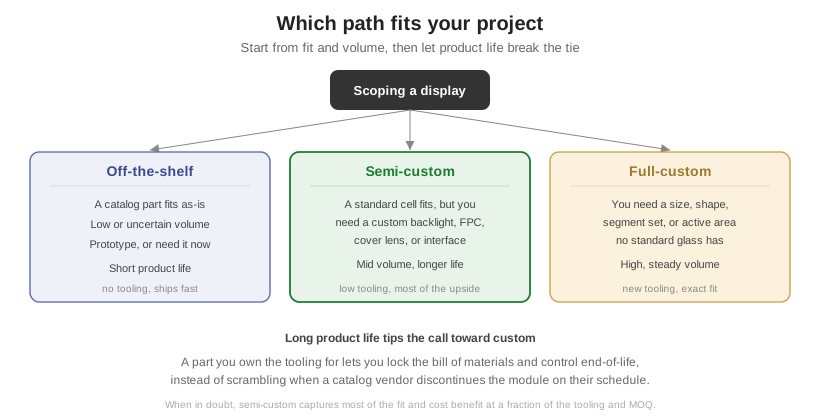
| Factor | Favors off-the-shelf | Favors custom or semi-custom |
|---|---|---|
| Annual volume | Low or uncertain | Mid to high, steady |
| Time to first hardware | Need it now | Can absorb a sample cycle |
| Mechanical fit | A standard outline works | Custom outline, thickness, connector, cutouts |
| Optical needs | Indoor, standard brightness | Sunlight-readable, wide angle, bonded |
| Temperature | Consumer / indoor | Wide / industrial / automotive |
| Interface | A common interface is fine | Must match an exact controller and pinout |
| Product life | Short or disposable | Long; needs BOM lock and EOL control |
| Per-unit cost at scale | Not yet critical | Must strip unused cost out |
If the project points toward custom, the next questions are what to change and what it costs: see what you can customize on a display and MOQ, tooling, and lead times. Orient Display builds standard, semi-custom, and full-custom LCD and TFT displays, and will steer a project to the lowest-tooling path that still meets the requirement. To weigh the options for a specific design, start a custom project.