

Blog
Introduction to APF (Advanced Polarizing Film)

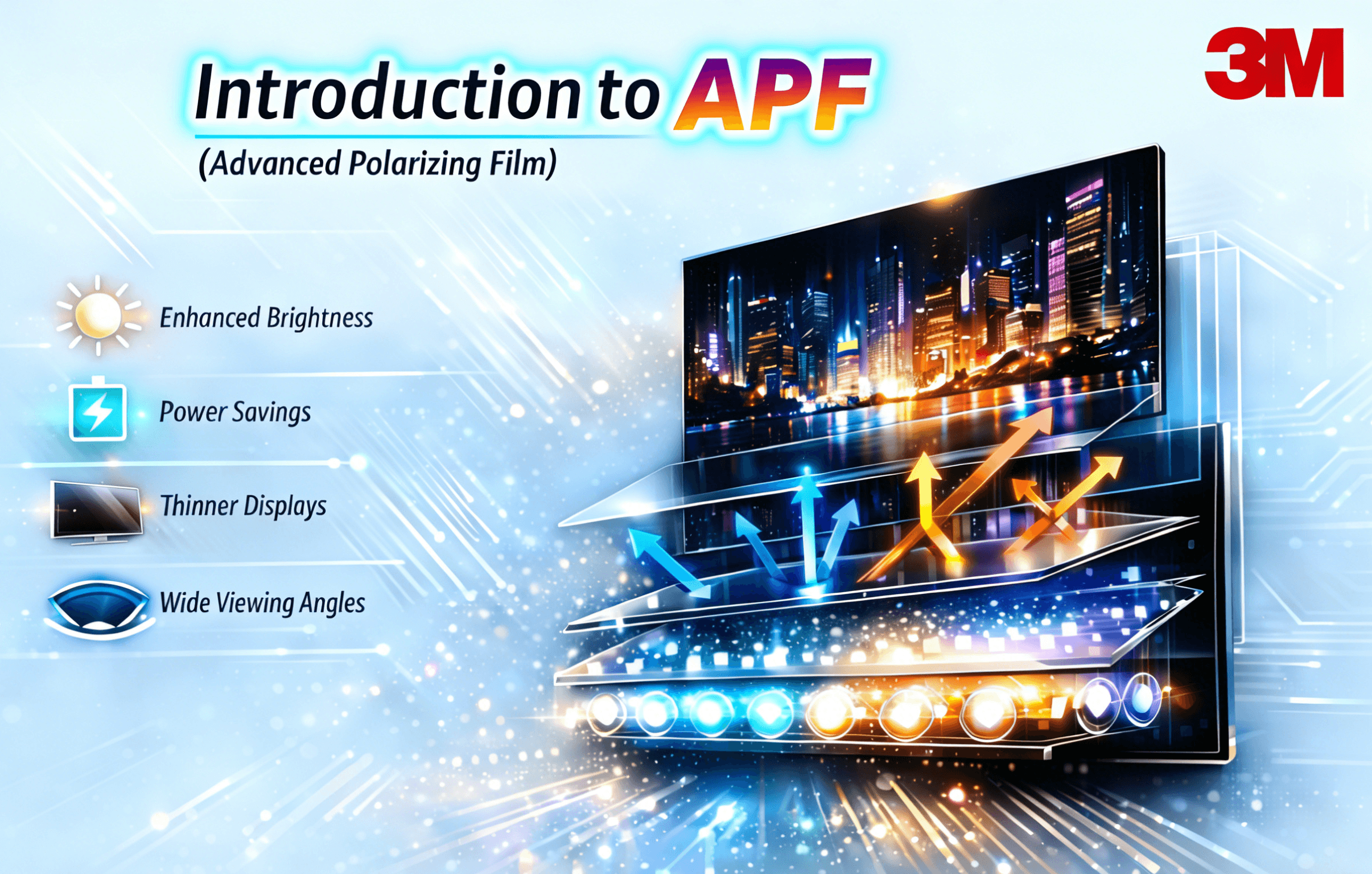
3M’s APF (Advanced Polarizing Film) is not a traditional “absorptive polarizer.” Instead, it is an on‑glass reflective polarizer applied directly to the LCD glass. Its primary functions are to improve backlight efficiency, increase brightness, reduce module thickness, and enhance display performance from wide viewing angles.
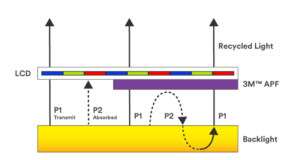
As shown in the picture below, APF allows the polarization direction required by the LCD to pass through, while reflecting the orthogonal polarization back into the backlight system. The reflected light undergoes multiple scatterings inside the backlight cavity, and part of it returns with a rotated polarization state that can be reused. In other words, APF recycles light that would otherwise be wasted, thereby improving brightness and energy efficiency.
Reference: https://www.3m.com/3M/en_US/p/d/b5005047084/
Advantages of APF
-
Brightness Enhancement (by around 30%)
Reduces optical loss and improves both on‑axis and wide‑angle brightness.
-
Power Savings
By increasing backlight efficiency, APF reduces backlight power consumption, helping achieve lower energy usage and longer battery life.
-
Thinner Module
Since APF is laminated directly on glass, it can replace part of the BEF/DBEF stack, simplifying the optical structure.
-
Better Viewing‑Angle Performance
The reflective polarizer structure improves brightness uniformity and wide‑angle brightness.
-
Higher Environmental Robustness
More stable than “free‑standing reflective films,” with lower thermal load and better durability.
Comparison Between APF and DBEF
| Item | APF (Advanced Polarizing Film) | DBEF (Dual Brightness Enhancement Film) |
| Basic Type | On‑glass reflective polarizer (laminated on LCD glass) | Backlight reflective polarizer (placed inside the backlight module) |
| Installation Position | Laminated directly on the rear polarizer of the LCD (on‑panel laminate) | Located inside the backlight system (typically above the light guide plate) |
| Primary Function | Transmits the required polarization and reflects the orthogonal polarization back to the backlight cavity to improve polarization efficiency | Recycles absorbed polarization to increase backlight brightness |
| Brightness Gain | ~30% (per 3M), with better wide‑angle brightness retention | Typically 30–60%, but more viewing‑angle dependent |
| Energy Efficiency | Higher efficiency → lower backlight power → longer battery life | Higher brightness → potential for lower backlight power |
| Thickness Impact | Thinner; reduces BEF/DBEF stacking; ideal for narrow‑bezel designs | Thicker; adds layers to the backlight stack |
| Viewing‑Angle Performance | Superior wide‑angle brightness | Strong viewing‑angle dependence; off‑axis brightness drops significantly |
| Integration Level | High (on‑glass integration) | Medium (backlight component) |
| Environmental Robustness | Higher (on‑glass structure is more stable with lower thermal load) | More affected by backlight cavity temperature |
| Indentation Resistance | Hard‑coat surface reduces pressure marks | No hard‑coat; more susceptible to mechanical pressure |
| Typical Applications | Smartphones, tablets, laptops, VR, IoT devices | Smartphones, tablets, laptops, large‑size displays |
| Typical Models | APF‑QWP, APF‑V3‑26, APF‑T35 | DBEF6, DBEF‑D, DBEF‑E, etc. |
| Cost | Higher (due to high integration and on‑glass lamination) | Medium (standard backlight material) |
| Design Targets | Thin‑and‑light designs, narrow bezels, high efficiency, wide viewing angles | High brightness, cost‑sensitive designs, traditional backlight structures |
Based on the comparison above, we will recommend APF when you need thinness, efficiency, and wide‑angle performance, and DBEF when you need maximum brightness at lower cost.
Should you have any questions, please consult our engineering.
