

Blog
Automotive Rearview Mirror Reflectance Requirements: Why Reflectance Matters and How It Is Controlled

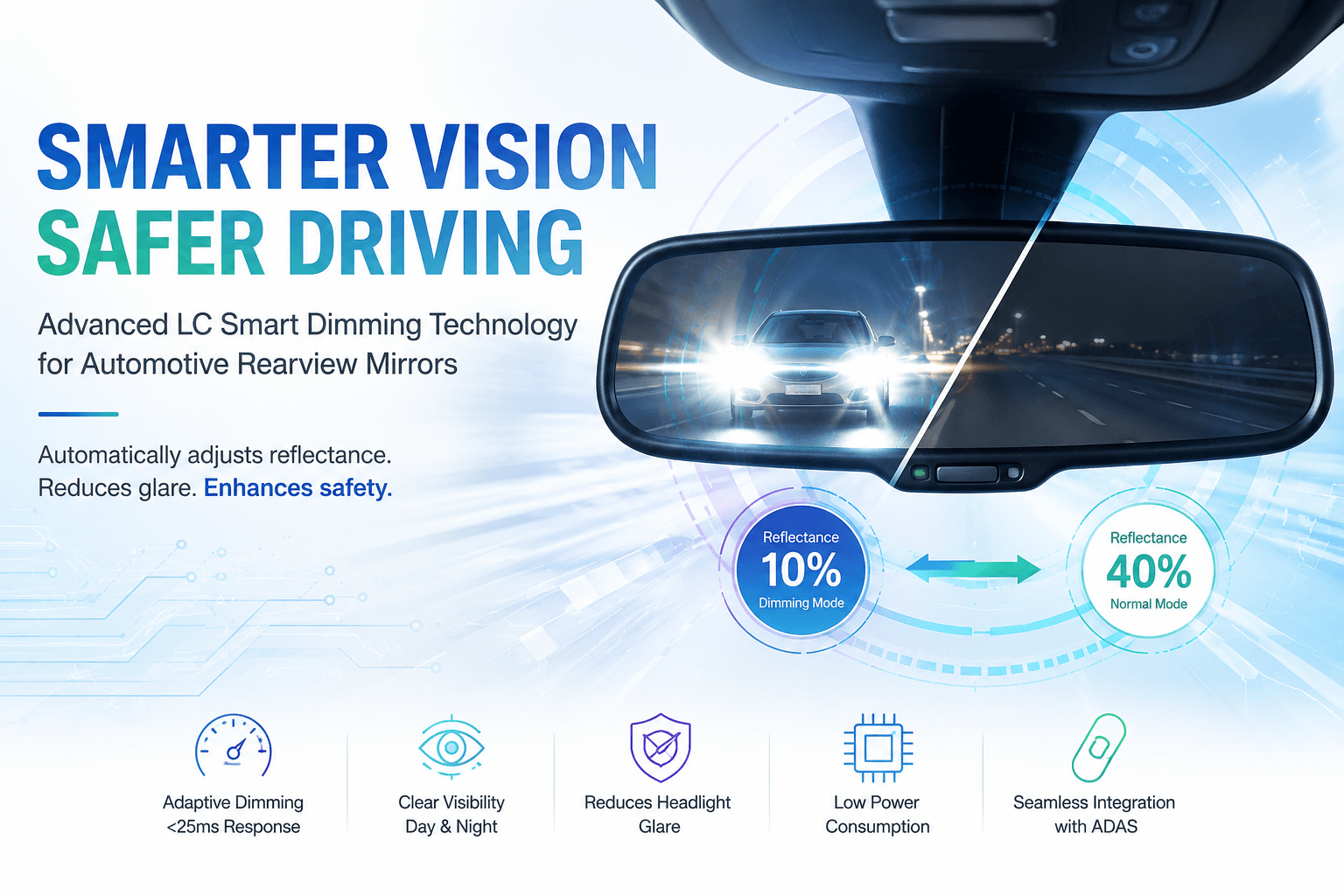
Automotive rearview mirrors play a critical role in driving safety by providing drivers with clear visibility of surrounding traffic. One of the most important optical parameters of a rearview mirror is reflectance—the percentage of incident light that is reflected by the mirror surface.
A mirror with insufficient reflectance produces a dim image, while excessive reflectance may contribute to glare. Therefore, automotive mirrors are designed to meet strict optical and regulatory requirements.
What Is Mirror Reflectance?
Reflectance is the ratio of reflected light to incident light, usually expressed as a percentage. For example:80% reflectance means that 80% of the incoming light is reflected and 20% of the light is absorbed or transmitted through the mirror.
Higher reflectance generally provides Brighter images with better contrast, results improved object recognition. However, under nighttime conditions, very high reflectance can increase glare from following vehicles. If the mirror reflectance is too low, the reflected image becomes dim and lacks sufficient clarity, reducing the driver’s ability to accurately perceive objects behind the vehicle. Conversely, if the reflectance is too high, the glare from following vehicles’ headlights can become a significant distraction during nighttime driving, negatively affecting driver visibility and comfort.
For this reason, the reflectance of conventional automotive rear-view mirrors is typically designed to be around 40%, providing a balanced compromise between image brightness and glare reduction.
Our solution further enhances this performance by integrating Liquid Crystal (LC) smart dimming technology. Under normal driving conditions, the mirror provides clear visibility. When the system detects a potential glare hazard—such as intense headlights from a vehicle behind—it automatically switches to a dimming mode, reducing the mirror reflectance to approximately 10%. This significantly suppresses glare while maintaining sufficient rearward visibility, improving both driving comfort and safety during nighttime operation.
Regulatory Requirements
| Country/Region | Main Regulation / Standard | Application Scope | Minimum Mirror Reflectance Requirement | Remarks |
| Europe (EU) | UNECE Regulation No.46 (R46) | Interior/exterior rear-view mirrors and indirect vision systems | ≥40% | The primary regulation in Europe; electrochromic auto-dimming mirrors are allowed to reduce reflectance at night. |
| United States | FMVSS 111 | Rear visibility mirrors | Industry products commonly achieve 60–85%) | Focuses more on field of view and mirror performance; unlike UNECE R46, FMVSS 111 does not define a single universal reflectance requirement for all mirrors. |
| Canada | CMVSS 111 | Rear-view mirror systems | Generally follows North American FMVSS requirements | Requirements are similar to those in the United States. |
| China | GB 15084 Performance and Installation Requirements of Indirect Vision Devices for Motor Vehicles | Interior and exterior rear-view mirrors | ≥40% | Requirements are largely aligned with UNECE R46 |
| Japan | JIS / Road Vehicle Safety Standards (aligned with UNECE regulations) | Rear-view mirrors | ≥40% | Requirements are largely aligned with UNECE R46 |
| South Korea | KMVSS (Korean Motor Vehicle Safety Standards) | Rear-view mirrors | ≥40% | Requirements are largely aligned with UNECE R46 |
| Australia | ADR 14 | Rear vision mirrors | ≥40% | Requirements are aligned with UNECE R46. |
| Mexico | NOM-related regulations | Rear-view mirrors | Approximately ≥40% | Requirements are generally close to the North American market. |

Most global automotive rearview mirror regulations are harmonized around a minimum reflectance requirement of approximately 40%, with UNECE R46 serving as the primary reference standard. In practical mass-production applications, conventional glass mirrors typically achieve 70–85% reflectance, while advanced technologies such as electrochromic (EC) mirrors, LC digital mirrors, and smart rear-view mirror systems require additional consideration of optical performance, glare reduction, and night-time visibility.
Smart Dimming: The Future of Automotive Rearview Mirrors
As the automotive industry moves toward digital cockpits, intelligent sensing, and software-defined vehicles, rearview mirrors are evolving from passive reflective components into smart optical systems.
Compared with conventional fixed-reflectance mirrors, Liquid Crystal (LC) smart dimming technology offers several advantages:
- Fast response (<25ms) to changing lighting conditions
- Continuously adjustable reflectance for optimal driver comfort
- Reduced headlight glare during nighttime driving
- High optical clarity under daytime conditions
- Low power consumption and long service life
- Easy integration with ambient light sensors, cameras, and ADAS systems
By dynamically controlling mirror reflectance instead of relying on a fixed optical design, LC technology provides an optimal balance between visibility, safety, and driver comfort under all driving conditions.

Smart LC mirror with dimming function (right)
Conclusion
Mirror reflectance is one of the key optical parameters affecting driving safety. While international regulations generally require a minimum reflectance of approximately 40%, modern intelligent vehicles demand more than regulatory compliance—they require adaptive optical performance.
Liquid Crystal smart dimming technology enables rearview mirrors to automatically adjust reflectance according to ambient lighting conditions, significantly reducing glare without sacrificing image quality. As automotive displays and smart cockpit technologies continue to evolve, LC-based smart mirrors are expected to play an increasingly important role in enhancing both safety and the overall driving experience.
Looking for an advanced LC smart dimming solution for your automotive mirror application? Contact us to learn how our automotive-grade LC technology can help improve optical performance, driver safety, and user experience.
If you have any questions, please contact our engineering.
