
Arduino / Maker OLED
Arduino / Maker OLED
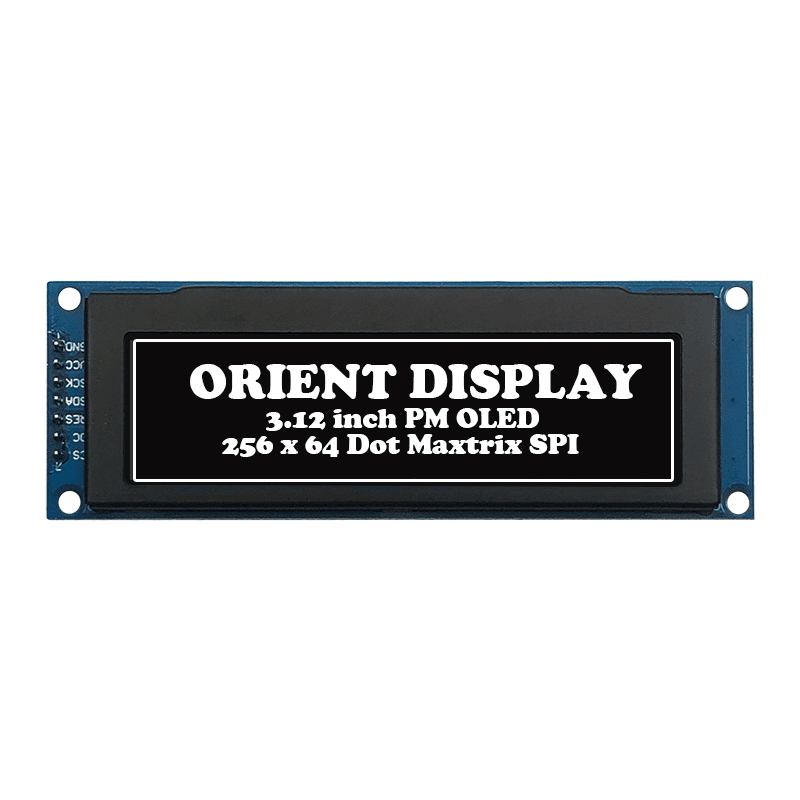
Arduino / maker OLEDs are Arduino-compatible OLED breakout displays — wired and library-supported for prototyping, hobby projects, and evaluation, so you can bring a crisp, high-contrast OLED readout up on an Arduino without designing a custom carrier board or writing a display driver from scratch. The same driver ICs used across the wider OLED module range appear on these boards, so common Arduino libraries (SSD1306 in particular) work out of the box for the mono variants, and the RGB variants use their own Adafruit-compatible drivers.

Arduino / maker OLED specifications
Standard ranges across the Arduino OLED breakout catalog. For a specific size, color, or controller, start a custom project.
- Sizes: 0.66″ to 3.12″
- Resolutions: 64×48 up to 256×64 (incl. 96×64, 96×96, 128×64, 128×96, 128×128, 64×128)
- Brightness: 60 to 140 cd/m²
- Interface: 4-wire SPI, Arduino-compatible
- Color: monochrome — white, blue, or yellow — and RGB
- Controllers: SSD1306, SSD1315, SSD1316, SSD1317, SSD1311, SH1107
- Part suffix: -ANO (Arduino) on the AOM (mono) / AOC (color) families
- Catalog depth: 16 products in the Arduino OLED category, spanning the size, resolution, and color combinations above
Where it fits
Typical applications: prototyping and proof-of-concept, education and maker projects, evaluating an OLED at its intended size and color before committing to a production design, and small in-house tools where a full production PCB is overkill.
How it differs from OLED modules: these are the same PMOLED technology, mounted on a breakout PCB with headers and library support instead of supplied as a bare production part. The two catalogs overlap on size and resolution — both run to 3.12″ and both reach 256×64 — so the choice is not a spec comparison, it is form factor and intent: a breakout to prove a design on the bench, an OLED module to ship it, with the panel and controller carrying across unchanged. Bare driverless glass is a custom order, quoted through OLED modules. For anything larger than roughly 3″ or phone-class resolution, OLED is not the answer at any tier — talk to us about a TFT path.
The family, small to large


Learn more before you buy
Background on OLED technology and moving from a breakout to a production part.
OLED: PMOLED vs. AMOLED
The passive- vs. active-matrix split behind every part on this page.
Read the guideDisplay Interfaces Explained
How SPI and the other common interfaces move pixels from your MCU to the panel.
Read the guideCustom vs. Off-the-Shelf Displays
When to stay on a breakout and when it is time to move to a production module.
Read the guideDisplay Connector and Pinout Basics
Reading a breakout's header pinout before you wire it to your board.
Read the guideReady to move on an Arduino or maker OLED build?
Prototyping now, scaling later? Tell us the size, color, and controller you are on and we will map your dev board to a production module of the same spec.