

Liquid Crystal Types
Passive LCDs come in four common types: TN, HTN, STN, and FSTN. The difference between them is how far the liquid crystal twists between the two glass surfaces. That single choice sets the contrast, the viewing angle, how many lines the display can drive, and the cost. This guide compares the four, shows why twist angle drives everything else, and helps you match a type to your product. For the full picture of how a cell works, start with what an LCD is and how it works. All four here twist the liquid crystal parallel to the glass; a separate family, vertical alignment (VTN) LCD, aligns it perpendicular to the glass instead, for a true black background and even higher contrast.
Part of the Display Fundamentals knowledge hub.
The four passive LCD types at a glance
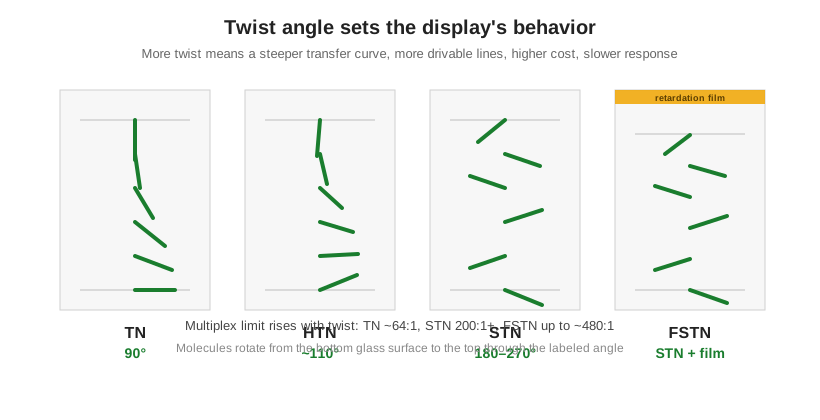
TN is the cheapest and fastest and is the right choice for simple segment and character displays. Each step up the twist scale buys more contrast, wider viewing angles, and the ability to drive more lines, at higher cost and slower response. FSTN adds a compensation film to an STN cell to deliver a neutral black-and-white image.
| Type | Twist angle | Multiplex ratio | Contrast and color | Relative cost | Typical use |
|---|---|---|---|---|---|
| TN | 90° | up to ~64:1 | Moderate contrast, slight color cast | Lowest | Calculators, meters, appliance segment and character displays |
| HTN | ~110° | Moderate | Better contrast and wider viewing than TN | ~10% over TN | Handheld and battery devices needing better readability |
| STN | 180–270° | High (200:1+) | High contrast, yellow or blue cast unless compensated | Higher | Graphic modules, multi-line character, portable equipment |
| FSTN | 180–270° + film | Highest (to ~480:1) | Highest contrast, neutral black and white | Highest | High-information graphic displays, negative-mode high-contrast panels |
Twist angle is the variable that sets everything else
A TN cell twists the liquid crystal 90 degrees between the two glass surfaces. Increase that twist and the display’s brightness-versus-voltage curve gets steeper. A steeper curve lets you drive more rows without losing contrast, which is why an STN cell near 270 degrees can multiplex far more lines than TN’s practical limit of about 64:1. HTN sits between the two at roughly 110 degrees, a low-cost way to gain contrast and viewing angle for handheld products.
The tradeoff is real. Higher twist means slower response, and in STN it introduces a color cast that has to be corrected. So the question is never which type is best in the abstract. It is how many lines you need to drive and how the display has to look.
From STN to FSTN, getting to true black and white
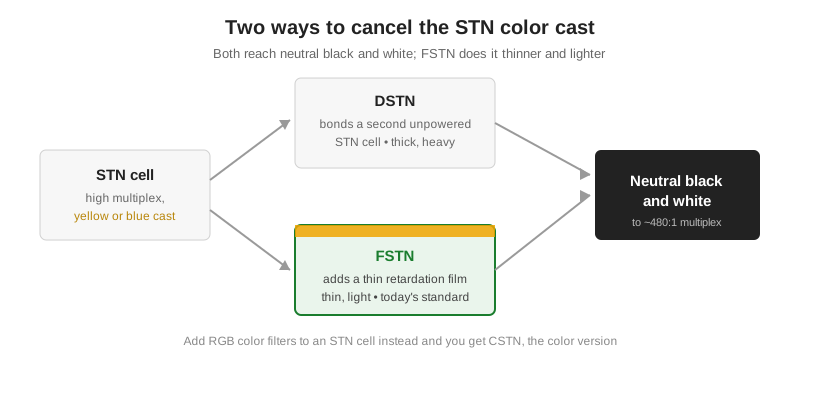
Early STN displays showed a yellow-green or blue cast because the birefringent cell colored the light passing through it. Two fixes emerged. DSTN bonds a second, unpowered STN cell to the first to cancel the cast, but the result is thick and heavy. FSTN instead adds a thin retardation film, delivering the same neutral black-and-white image in a much thinner and lighter package. That is why FSTN is the standard today, and why FSTN reaches multiplex ratios as high as about 480:1.
Color is a separate path. Add RGB color filters to an STN cell and you get CSTN, the color version of the technology. For a full treatment of how monochrome and color are produced, see positive vs negative display modes.
Choosing the right type for your product
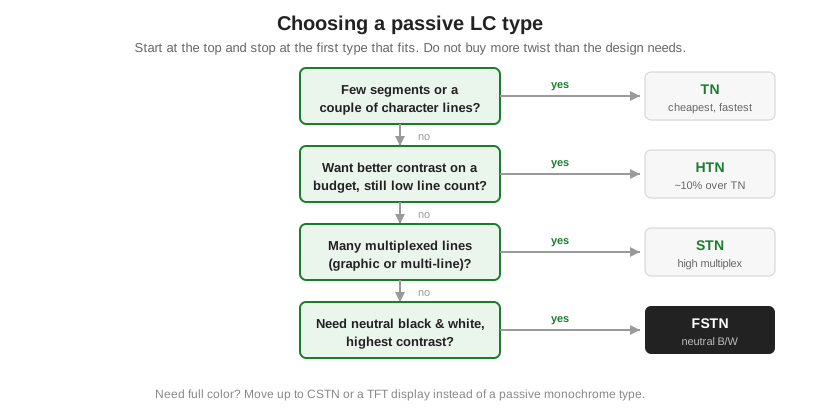
The instinct to reach for STN or FSTN because it looks better usually wastes money. Twist angle is a tradeoff, not a ranking. If your display is a handful of segments or a few lines of characters, TN is cheaper, faster, runs at lower voltage, and is the correct choice. Step up only when the design demands it: more multiplexed lines, a wider viewing angle, or a neutral high-contrast black-and-white readout. Viewing angle in particular is worth understanding before you commit, covered in LCD viewing angle, direction, and contrast.
Orient Display builds character and graphic modules across all four types and designs custom glass from concept to production, so the type follows the product instead of the product bending to an off-the-shelf part. Browse the LCD product line and our graphic LCD modules, where high-multiplex STN and FSTN types do most of their work.