

Blog
Why Does a Black Border Appear Outside the Display Area of an E-Paper Display?

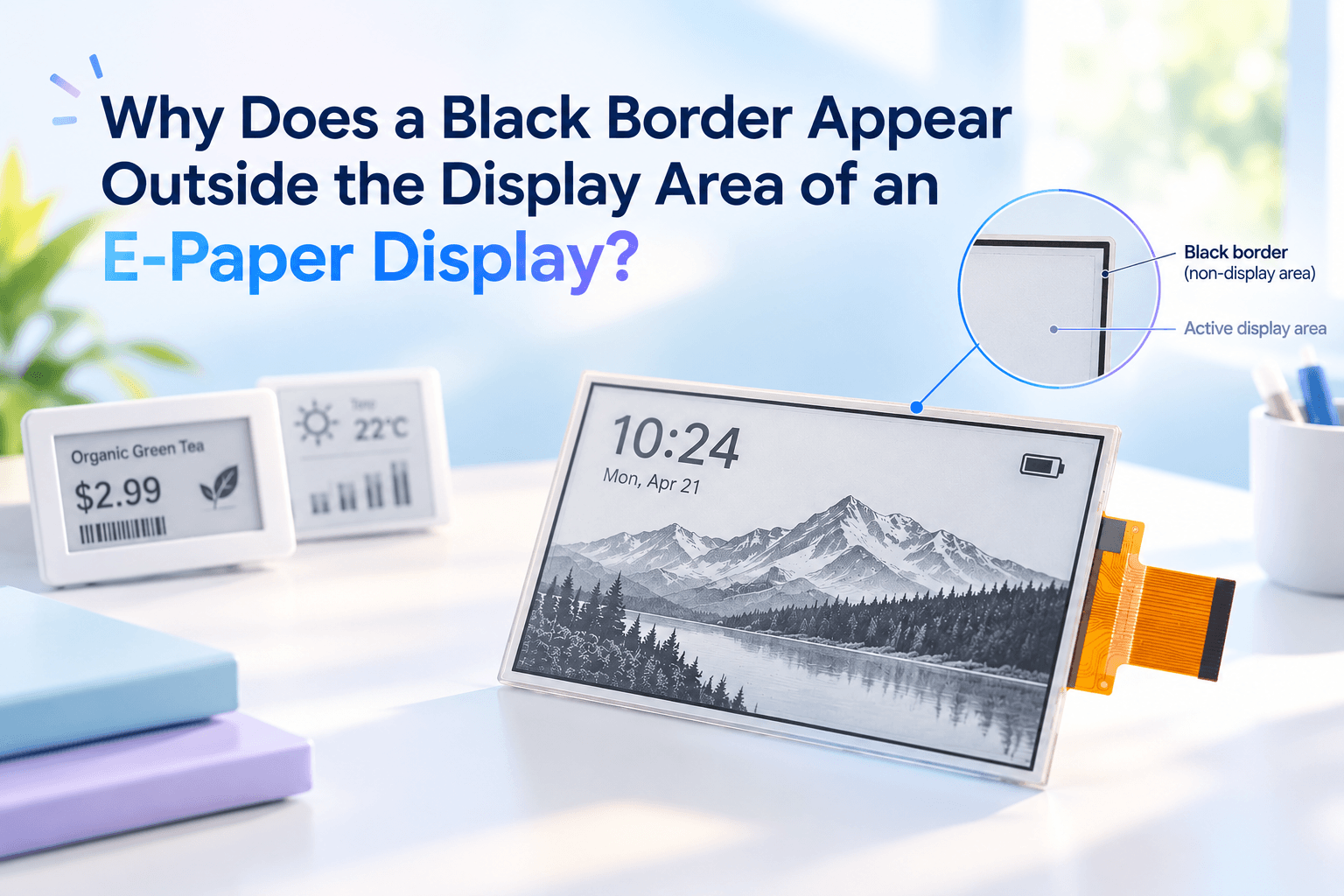
E-paper displays are widely used in electronic shelf labels, industrial instruments, smart devices, logistics labels, and other applications that benefit from low power consumption and excellent sunlight readability.
During the manufacturing and assembly of an e-paper module, a particular cosmetic phenomenon may occasionally be observed: a black or dark border appears in the FPL area outside the active display area.
At first glance, this may appear to be related to the FPL dimensions, printing, or even a display defect. However, in certain cases, this dark border can be associated with electrostatic effects generated when the protective film is peeled from the FPL during the manufacturing process.
What Is FPL?
FPL stands for Front Plane Laminate and is a key component of an e-paper display.
The FPL contains the functional layers responsible for e-paper imaging, including the structures and materials that allow charged particles to move and form the visible image.
During manufacturing, a protective film is typically applied to protect the FPL surface and functional layers. As part of the lamination process, this protective film must be peeled away before the FPL is bonded to the next layer.
This peeling process is one of the points at which electrostatic charging can occur.
How Can the Black Border Be Formed?
When the protective film is separated from the FPL, contact and separation between different materials can generate electrical charges. This is commonly associated with triboelectric charging, also known as contact electrification.
If a relatively strong electrostatic charge is generated during the peeling process, it may temporarily affect the charged particles within the FPL and cause a localized change in appearance.
Because this effect can occur in the area outside the active display region, it may appear visually as a black or dark border around the display.
Importantly, this does not necessarily indicate structural damage to the FPL or a functional problem with the active display area.
Why Does It Occur on Some Units but Not Others?
One of the most common questions is why some units show the dark border while others do not.
The electrostatic charge generated during film peeling is influenced by multiple factors, including:
- The material characteristics of the protective film and FPL
- Peeling speed
- Peeling angle
- Temperature and humidity
- Handling method
- Surface conditions of the materials
- The instantaneous charge accumulation and discharge conditions
Therefore, even when appropriate ESD control measures are implemented, it can be difficult to ensure that no electrostatic charge is generated during every single peeling operation.
This explains why the phenomenon can be random:
Little or no significant electrostatic charging → the border may not appear
Higher electrostatic charging → a dark border may appear
From a manufacturing perspective, the practical objective is therefore to minimize and control electrostatic charging and reduce the occurrence rate, rather than assuming that electrostatic charging can always be eliminated completely.
How Is Static Electricity Controlled During Production?
E-paper manufacturers typically implement a combination of ESD control measures during FPL processing.
-
Ionizers
Ionizers generate positive and negative ions to neutralize electrostatic charges on the product surface. They are commonly used in manufacturing environments where sensitive materials are processed.
-
ESD-Controlled Workstations
Anti-static work surfaces, tools, grounding systems, and personnel grounding can help reduce the accumulation and transfer of static electricity.
-
Environmental Control
Temperature and humidity can affect the electrostatic behavior of materials. Maintaining appropriate production conditions can help reduce static charge accumulation.
-
Process Optimization
The peeling speed, angle, and handling method can also affect the amount of charge generated during film separation. Optimizing these parameters may further reduce the occurrence of the effect.
However, even with these measures in place, the instantaneous electrostatic charge generated by the separation of two materials cannot always be completely eliminated.
As a result, some degree of variation may still occur in production.
Does the Black Border Affect Display Performance?
The most important question when evaluating this phenomenon is:
Does the dark area extend into the Active Area?
If the color change remains completely outside the active display area and does not interfere with the viewing area, it is generally considered a cosmetic condition in the non-display area rather than a functional display defect.
For products that are assembled with a cover glass, bezel, or housing, the affected area can normally be hidden by the mechanical structure of the final product.
This is also one reason why e-paper modules typically include a defined border or non-display area around the Active Area to accommodate lamination, assembly tolerances, and mechanical integration.
Why Not Simply Cover the Area with Black Printing?
A straightforward solution might seem to be adding black printing to cover the dark border.
However, this approach is not always practical.
The dimensions and positioning of the FPL, lamination, and printed area all have manufacturing tolerances.
If the printed border is designed too close to the Active Area:
- Some units may not be fully covered;
- Tolerance accumulation may cause the printing to extend into the Active Area;
- The printing itself could create a more noticeable cosmetic or display issue.
For this reason, using the cover glass, bezel, or housing of the final product to conceal the non-display area is often a more robust design approach.
If you have questions or would like to explore your next design, please contact our engineering.
Need a display built to your own spec? Start a custom project and our engineers respond within one business day.
Start a Custom Project