

AMOLED
AMOLED
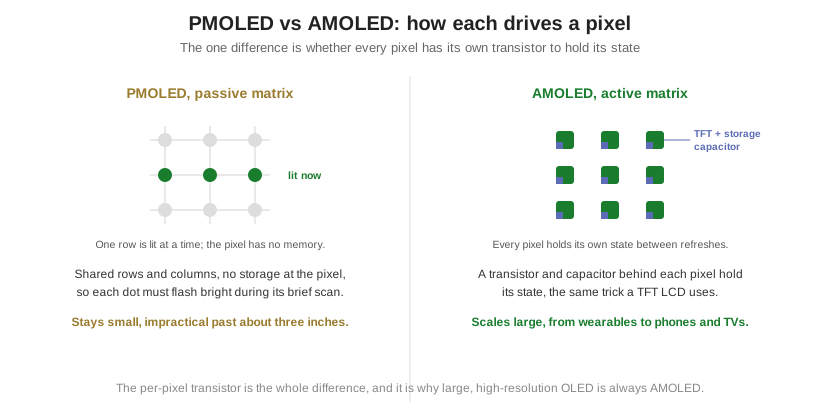
AMOLED (active-matrix OLED) drives each pixel with its own thin-film-transistor switch and storage capacitor, instead of scanning shared rows and columns the way a passive-matrix (PMOLED) panel does. That per-pixel drive is what lets AMOLED scale past the roughly 3″ ceiling where PMOLED brightness and lifetime start to trade off, so it is the OLED technology behind larger, higher-resolution builds — round and full-color panels included. Every part below is a custom-quoted build; there is no stocked SKU in this family yet.
AMOLED specifications
Five parts define the current range. All are Contact Us — tell us the size, resolution and interface and we will quote it.
- Technology: active-matrix OLED (AMOLED), self-emitting, no backlight
- Sizes: 1.43″ – 8″
- Parts in range: 5, every one Contact Us (custom-quoted)
- Interfaces: MCU / MIPI / QSPI / SPI
- Controllers: CO5300AF-08, CO5300AF-42, GD7658AV110, RM690B0, RM69380
- Shapes: rectangular and round glass (see Features column)
Active-matrix OLED, explained
Per-pixel drive, not scanned lines. A PMOLED panel lights one row at a time, so every pixel has to flash briefly and brightly as its line is scanned — the higher drive voltage that requires is what limits PMOLED to small panels. AMOLED backs every pixel with its own transistor and capacitor, so each pixel holds its state and emits continuously between refreshes at a much lower drive voltage. That is the whole basis for scaling to larger, higher-resolution, and round or non-rectangular panels without the PMOLED brightness/lifetime tradeoff.
Same self-emitting technology underneath. Like PMOLED, an AMOLED pixel is its own organic light source between two electrodes, with no backlight anywhere in the stack — so contrast, thinness and viewing angle carry over, and an off pixel is genuinely black. What changes is the backplane and the interface: AMOLED modules in this range are driven over MIPI, SPI, QSPI, or MCU parallel, depending on the controller, and pair with round as well as rectangular glass. See the PMOLED vs. AMOLED guide for the full comparison against the smaller OLED Modules line.
The current AMOLED line
Five parts, sourced from Orient Display's product data; every row is Contact Us.
| Size (inch) | Pixels | Module Size(mm) | Brightness | Interface | Features | Controller | Model | Stock |
|---|---|---|---|---|---|---|---|---|
| 1.43 | 466x466 | 42.80x42.80x2.53 | 450nits | QSPI | Full Color, Round, CTP | CO5300AF-08 | AAC466466A0R-1.43W-C | Contact Us |
| 1.5 | 466x466 | 40.71x40.94x0.85 | 600nits | SPI | Full Color, Round | CO5300AF-42 | AAC466466A0R-1.5W | Contact Us |
| 2.4 | 450x600 | 38.72x51.56x0.78 | 800nits | MIPI/MCU/SPI | Full Color | RM690B0 | AOC450600B0-2.4W | Contact Us |
| 7 | 1080x1920 | 89.04x161.1x0.82 | 600nits | MIPI | Full Color, WT | GD7658AV110 | AAC10801920A0-7.0W | Contact Us |
| 8 | 2480x1860 | 165.89x126.12x0.78 | 430nits | MIPI, SPI | Full Color | RM69380 | AAC24801860A0-8.0W | Contact Us |
Scroll horizontally to see every column. On mobile, each row renders as a stacked card.
Choosing between AMOLED and OLED Modules
Choose AMOLED for a panel above roughly 3″, a round or non-rectangular shape, a higher resolution than a passive-matrix panel can drive cleanly, or a MIPI/QSPI host interface. Choose OLED Modules for a small, named-controller PMOLED part already in the catalog with a stocked or near-term lead time. Every AMOLED part today is a custom quote — bring us the size, resolution, shape and interface and a US-based engineer will scope it.
Learn more before you buy
Background on OLED technology and how to specify a module.
OLED: PMOLED vs. AMOLED
The passive- vs. active-matrix split that sets the size and cost boundary for OLED.
Read the guideChoosing a Display Interface
How to pick between MIPI, SPI, QSPI, and parallel for your host MCU.
Read the guideDisplay Lifetime and Reliability
How duty cycle and static content affect an emissive panel's working life.
Read the guideHow to Read a Display Datasheet
The fields that matter when comparing controller, interface, and brightness across parts.
Read the guideReady to move on an AMOLED build?
Every part in this family is a custom quote. Tell us the size, resolution, shape and interface, and a US-based engineer will reply within one business day — there is no minimum order to start.