

Display Module vs Bare Panel
Once a product needs a display, the next fork is how much of it to buy. An integrated module arrives with the driver and controller inside, so the host talks to it over a simple bus. A bare panel, the glass cell on its own, is cheaper per unit but leaves the drive electronics for you to design. This article is the decision between the two. For what an integrated module actually contains, see Embedded Display Modules Explained.
Part of the Embedded Displays knowledge hub.
What you take on with each
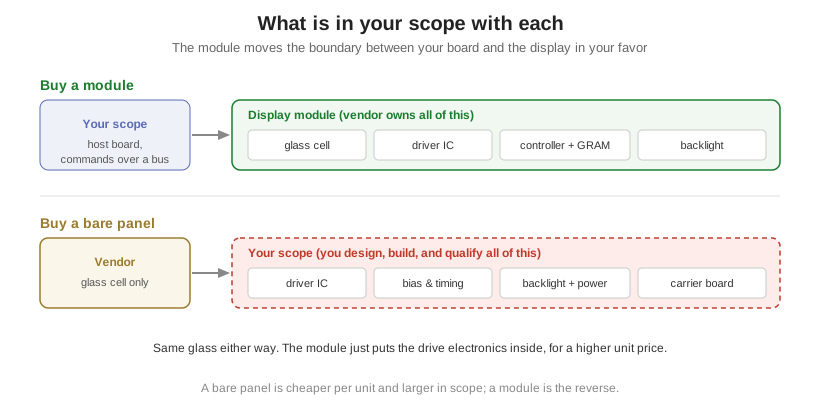
The difference is where the boundary between your board and the display sits. With a module, the vendor owns everything from the glass to a logic-level interface. Your board sends pixels or commands over SPI, I²C, an MCU parallel bus, or RGB, and the module’s built-in driver and controller handle the analog voltages, timing, and refresh. You integrate a finished part.
With a bare panel you own the drive chain. The cell needs a driver IC, the correct bias voltages, timing that matches the panel’s specification, and usually the backlight and its power as well. You design that board, bring it up, tune it to the glass, and keep it working across temperature and units. You are no longer integrating a display; you are building one.
Where the cost actually is
A module costs more per unit than the bare glass inside it, because you are paying for the driver, the controller, the assembly, and the vendor’s testing. What you are not paying is any engineering to make it work. A bare panel has a lower unit price, sometimes much lower at volume, but it carries real non-recurring engineering: the driver-board design, the bring-up, the firmware, and the qualification that a module vendor already absorbed.
So the comparison is not module price versus panel price. It is module price versus panel price plus amortized NRE plus the board’s own parts. Below some volume the module is cheaper all-in because the NRE has too few units to spread across. Above it, the per-unit saving on the bare panel eventually pays back the engineering. Where that crossover sits depends on your volume and how much the driver board costs to develop, not on a fixed rule.
| Cost element | Integrated module | Bare panel plus your driver |
|---|---|---|
| Unit price of the display part | Higher | Lower |
| Extra board parts (driver, power) | None | Driver IC, bias, timing, backlight supply |
| Non-recurring engineering | Near zero | Board design, bring-up, firmware, qualification |
| Best at | Low to moderate volume | High volume where unit BOM dominates |
Engineering effort and risk
The NRE line hides most of the risk. Driving a bare panel means getting bias voltages and timing right, keeping a high-speed RGB or parallel bus clean enough to avoid noise and EMI problems, and writing the firmware that initializes and feeds the panel. It means qualifying the result over the full temperature range, because a driver that works on the bench at room temperature can fail cold or hot. Each of these is solvable, and a team that has done it before will move quickly, but they are schedule and they are where a display project slips.
A module removes that work by definition. Its interface is documented, its timing is fixed inside, and its controller is already matched to the glass. The tradeoff is control: you take the vendor’s optical stack, backlight, and driver choices as given, where a bare panel lets you tune all of them. For the controller and driver parts a module hides, see Display Controller and Driver ICs.
Volume, lifecycle, and supply
Volume sets the cost answer, but lifecycle sets the risk answer. A bare-panel design ties you to a specific driver IC and a specific glass; if either goes end-of-life you re-engineer the board. A module vendor manages that supply chain for you and can often carry a design across a panel change without touching your board, as long as the interface holds. For a product that has to ship for years with a stable BOM, that continuity can matter more than the unit-cost saving.
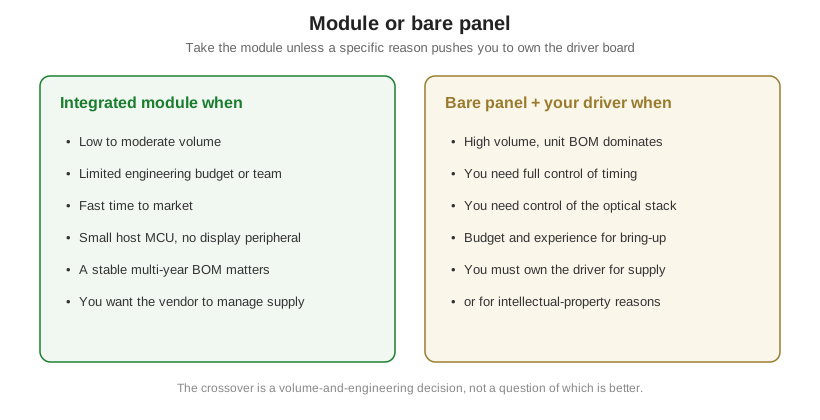
The reasonable default follows from all three. Take the module unless a specific reason pushes the other way: very high volume where the unit saving is large, a need for full control of the optical or timing stack, or a driver you must own for supply or IP reasons.
Orient Display supplies both bare LCD and TFT glass and the integrated modules built around it, and can put a controller with GRAM behind a panel so a small MCU drives it over a simple bus. When you have set the interface and the integration level, you can start a custom project.