

History of Display Technology
The display on a device today is the result of a century of solving one limitation after another: too bulky, too power-hungry, too dim in sunlight, too small to scale. Cathode-ray tubes gave way to segmented LEDs, then to the liquid crystal display that made portable electronics possible, then to the active-matrix and emissive panels behind modern screens. This is the short version of how display technology got here, and why the liquid crystal display still anchors so much of it. For the device at the center of that story, see what an LCD is and how it works.
Part of the Display Fundamentals knowledge hub.
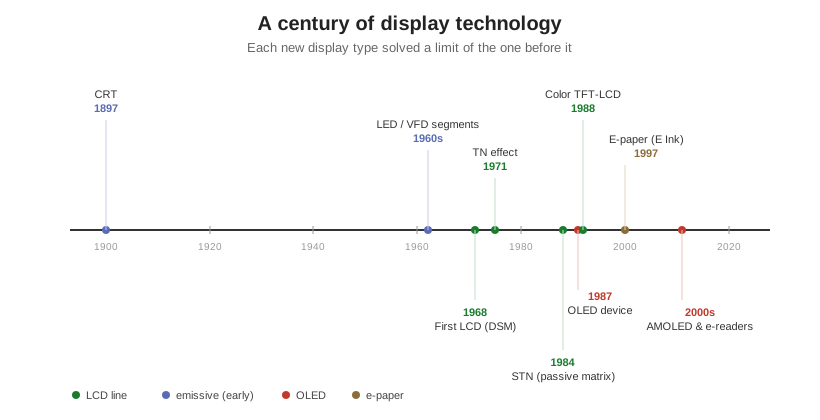
The tube era and the first electronic displays
The cathode-ray tube, demonstrated by Ferdinand Braun in 1897, was the first electronic display and stayed dominant for the better part of a century, driving oscilloscopes, radar, televisions, and computer monitors. It was bright and fast, but it was also deep, heavy, and hungry for power, which is exactly what a portable device cannot afford. Alongside it, the middle of the twentieth century brought the first small digital readouts: cold-cathode Nixie tubes, vacuum fluorescent displays, and, once the visible light-emitting diode arrived in the 1960s, the seven-segment LED. These lit up calculators and instrument panels, but each segment made its own light and drew its own current, so they never scaled to a dense screen.
The liquid crystal breakthrough
The change that made portable electronics possible was the liquid crystal display, because it does not emit light at all; it shutters light that is already there, so it sips power. RCA showed the first working LCD in 1968 using a dynamic-scattering effect, but the practical breakthrough was the twisted-nematic (TN) effect in 1971, which is what put displays into digital watches and calculators within a few years. TN could only address a limited number of lines before contrast collapsed, so the super-twisted nematic (STN) fluid arrived in 1984 to drive the denser passive-matrix screens of early laptops. Why a steeper fluid was needed to add lines is the story told in liquid crystal types and how LCDs are driven.
The next leap put a transistor at every sub-pixel. Active-matrix TFT-LCDs, commercialized in color from the late 1980s, gave each dot its own switch, which held contrast steady no matter how many lines the panel had. That removed the ceiling on resolution and made the LCD the default for laptops, monitors, and eventually televisions through the 1990s and 2000s. The full picture is in what a TFT display is.
Emissive flat panels and reflective displays
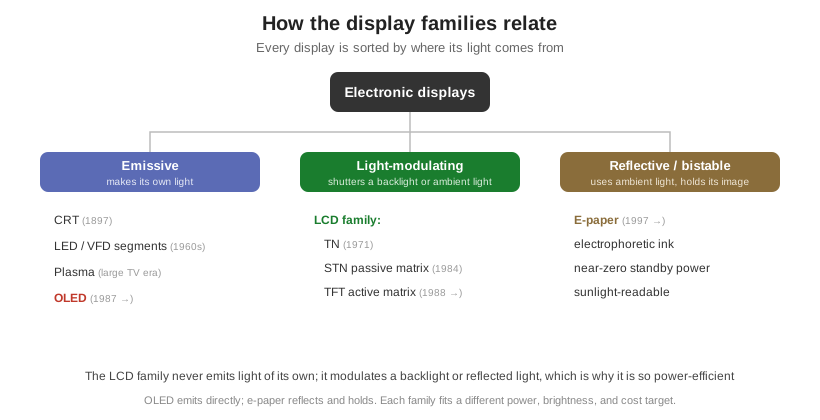
Two other families grew up beside the LCD. The emissive branch returned with the organic light-emitting diode: an efficient OLED device was demonstrated in 1987, and by the late 2000s it powered AMOLED phone screens and later large televisions, offering per-pixel light with no backlight. The reflective branch went the opposite way: electrophoretic e-paper, commercialized from E Ink’s work founded in 1997, uses ambient light instead of a backlight and holds its image with almost no power, which is what made the e-reader practical from the mid-2000s. The clean way to see the three is by where the light comes from, which is the subject of LCD vs OLED vs e-paper, with the emissive types compared in OLED, PMOLED vs AMOLED and the reflective side in what e-paper is.
Milestones at a glance
| Era | Technology | What it changed |
|---|---|---|
| 1897 | Cathode-ray tube (CRT) | The first electronic display; dominant but bulky and power-hungry |
| 1960s | LED / VFD segments | Small digital readouts, but emissive and unable to scale |
| 1968–1971 | First LCD, then the TN effect | A display that shutters light instead of emitting it: low power, portable |
| 1984 | STN passive matrix | More addressable lines for early laptop screens |
| 1988 | Color TFT (active matrix) | A transistor per pixel removed the resolution ceiling |
| 1987 onward | OLED | Per-pixel emission with no backlight |
| 1997 onward | E-paper (electrophoretic) | Reflective, bistable, near-zero standby power |
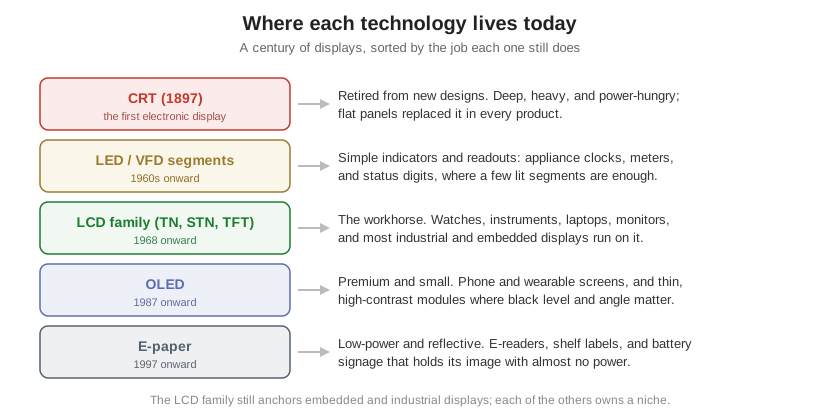
The through-line is efficiency and scale, and it is why the LCD family, from character and graphic modules to full-color TFT, remains the workhorse of embedded and industrial products. Orient Display builds across that family, character and graphic LCDs, TFT and OLED modules, and e-paper, matched to a product’s power, brightness, and cost target. The current range is organized in the display technologies hub, from LCD modules outward.