

TFT vs OLED Display Modules
An embedded color display almost always comes down to two module families: a TFT LCD or an OLED. Both arrive as integrated modules with the driver and controller built in, so the decision is rarely about how to drive them and almost always about how they look, how long they last, and what they cost. The two build an image in opposite ways, and that single difference sets every tradeoff below. For the OLED side of the choice, the panel type matters as well, which is covered in PMOLED vs AMOLED.
Part of the Embedded Displays knowledge hub.
How a TFT module and an OLED module make an image
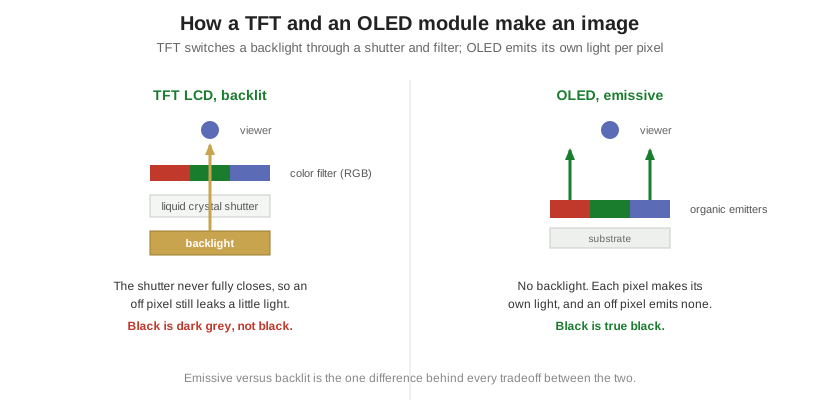
A TFT LCD does not make its own light. A backlight behind the glass shines through a liquid crystal layer that acts as a shutter for each sub-pixel, and a red, green, and blue color filter turns that light into color. The liquid crystal never blocks the backlight completely, so an unlit pixel still leaks a little light. That leakage sets the black level, and the black level sets the contrast.
An OLED makes its own light. Each sub-pixel is an organic diode that emits when current passes through it, so there is no backlight and no shutter. An unlit pixel is simply off and emits nothing, which is why OLED black is true black and its contrast is effectively unbounded in a dark room. Dropping the backlight and the color-filter stack also makes the panel thinner and lighter, and lets it bend on a flexible substrate.
Almost everything that separates the two modules follows from that one fact: emissive versus backlit.
Where they differ in practice
Held side by side, the two modules diverge on the attributes an engineer weighs when a product has to look right from every seat and in every light.
| Attribute | TFT LCD module | OLED module |
|---|---|---|
| Black level and contrast | Backlight leaks through, so black is dark grey; contrast is good but bounded | Off pixels emit nothing, so black is true black and contrast is very high |
| Viewing angle | Good on IPS and MVA cells, narrower on plain TN | Very wide; color and brightness hold across a large cone |
| Response time | Milliseconds; fine for most UI, can smear on fast motion | Microseconds; no smear |
| Color | Accurate and stable, set by the color filter | Wide gamut and saturated, shifts slightly as the panel ages |
| Thickness and shape | Backlight adds depth; flat rigid glass | Thin; available on flexible substrates |
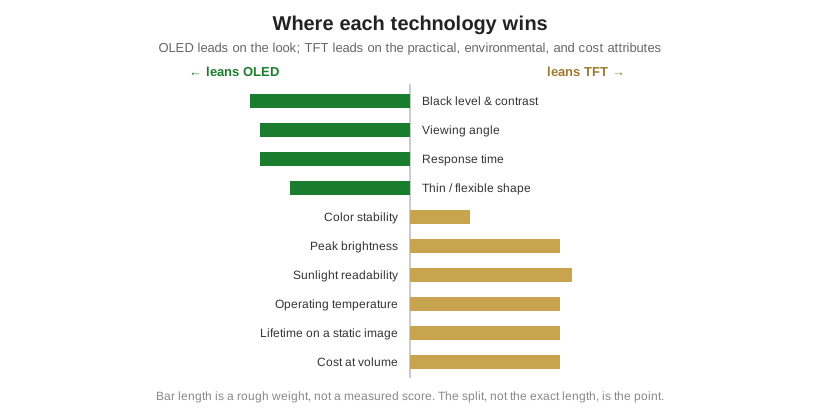
None of these is a small margin. OLED wins clearly on black level, viewing angle, and response, and those three are what make an OLED product feel premium. TFT holds its own on color stability and, as the sections below show, wins on the attributes that do not appear in a showroom.
Power, lifetime, and burn-in
An OLED draws power in proportion to what it shows. A mostly dark interface is efficient because most pixels are off, while a full white screen lights every emitter and draws the most. A TFT backlight draws a roughly constant current regardless of content, so a dark UI saves nothing. Which one is more efficient depends entirely on the artwork on the screen, not on the technology alone.
Lifetime works the same way. OLED organic materials age as they run, the blue emitter fastest, so brightness fades over tens of thousands of hours and the color point drifts. Worse for a fixed layout, a static element that stays lit in the same place, a logo, a status bar, an icon, ages faster than the pixels around it and leaves a permanent afterimage. That is burn-in. A TFT has no emissive layer to age; only its backlight LEDs dim, slowly and uniformly, over a long life.
The practical rule that falls out of this: a display that shows a fixed layout for long hours, an instrument cluster, a control panel, a status screen, is a hard case for OLED and an easy one for TFT.
Brightness, temperature, and sunlight
A TFT reaches high brightness by driving its backlight harder, and there is a lot of headroom to drive. A sunlight-readable TFT with a strong backlight and optical bonding stays legible outdoors, which is why instrument and outdoor equipment lean on TFT. An OLED reaches lower peak brightness, and pushing it up accelerates the aging above, so OLED is a poor fit for direct sun.
Temperature follows the same split. TFT modules operate across a wide industrial range and are specified down to well below freezing for automotive and outdoor use. OLED has a narrower window at both ends, and cold in particular slows it and shortens its life. If the product ships into weather or an unheated cabinet, that narrows the field quickly toward TFT.
Cost, sizes, and choosing between them
TFT is the mature, high-volume technology. It costs less, comes in the widest range of sizes from under an inch to large panels, and puts many standard modules on the shelf. OLED modules are common and inexpensive in small monochrome and small color sizes, and they get expensive and harder to source as they grow, so a large OLED is a deliberate, premium choice rather than a default.
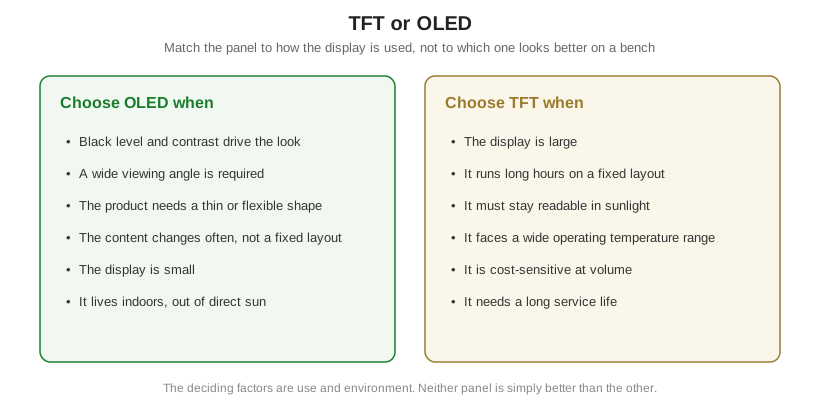
The choice comes down to what the product is for. Pick OLED when black level, contrast, viewing angle, thinness, or a flexible shape drive the design and the content changes often, a wearable, a premium handheld, a small varied-UI status display. Pick TFT when the display is large, runs long hours showing a fixed layout, has to survive sunlight or wide temperature, or is cost-sensitive at volume. Most industrial and instrument products land on TFT for exactly those reasons; consumer products that live indoors and want the look land on OLED.
Orient Display builds both TFT and OLED modules to a spec, including the backlight, cover glass, touch, and interface a product needs, rather than around a fixed catalog part. When you have matched the technology to how the display is actually used, you can start a custom project.