

Color E-Paper
Color E-Paper
Beyond black-and-white, e-paper is made in spot-color and full-color electrophoretic types, trading refresh speed and sharpness for the same zero-power, reflective, paper-like readability. It is still the same electrophoretic technology as mono e-paper — sunlight-readable, holding its image with no power — so adding color never changes the fundamentals, only what you pay for them.
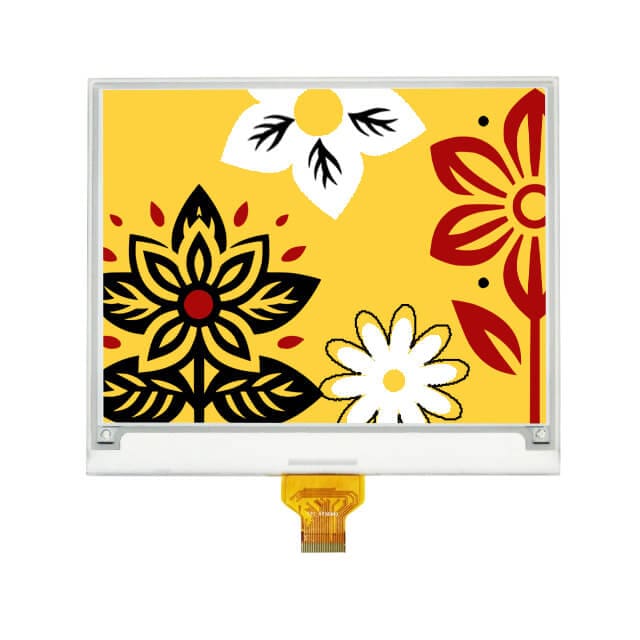
Stock four-color panels
Two four-pigment black/white/red/yellow panels are catalog parts — in stock and priced. Both are reflective active-matrix EPD, with no front light and no touch layer as supplied.
- 7.5″ · 800×480 — AES800480A00-7.5ENRS4
- Colors: four — black, white, red, yellow
- Driver / interface: JD79665CA, 3- or 4-wire SPI, 3.3 V logic
- Module outline: 170.20 × 111.20 × 1.2 mm
- Operating range: 0 to 40 °C
- 5.83″ · 648×480 — AED648480A00-5.83ENRS4
- Colors: four — black, white, red, yellow
- Driver / interface: JD79665CA, 3- or 4-wire SPI, 3.0 V logic
- Module outline: 125.40 × 99.50 × 1.20 mm
- Operating range: 0 to 50 °C
The color tiers, and choosing between them
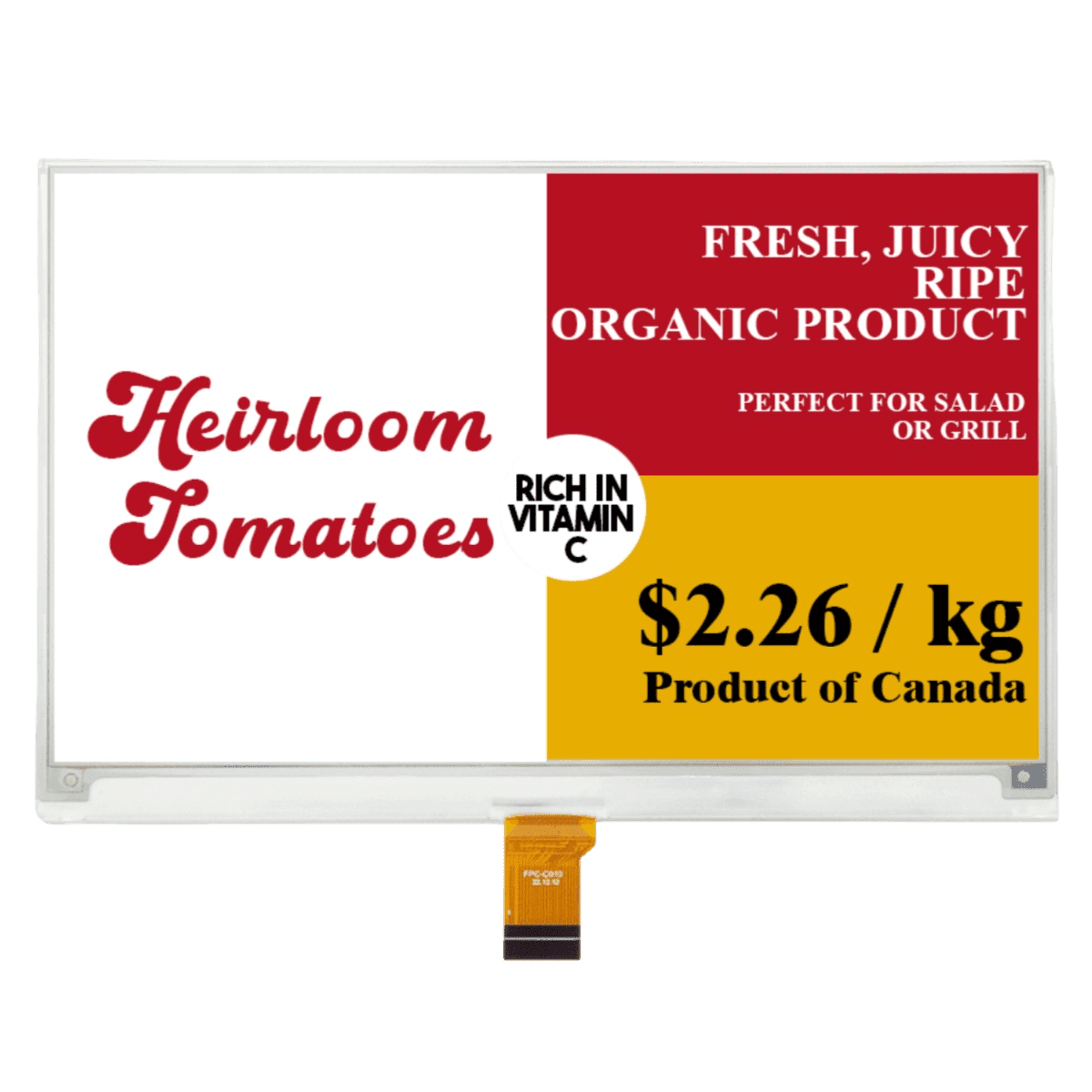
Monochrome is the classic two-pigment black-and-white ink: the sharpest text, the fastest refresh, the lowest cost, and still the right answer for most e-paper products. Spot color adds one or two fixed accent colors with a third or fourth pigment — most commonly black/white/red or black/white/yellow. It keeps almost all of monochrome's simplicity and is the workhorse of electronic shelf labels, where a red price change is all the color a tag needs. Full color opens a broad palette, built one of two ways.
A color filter array lays a thin grid of red, green and blue filters over a standard monochrome panel; the ink below still only decides light or dark, and the filter tints each pixel. Color is softer and the page reads darker, but the panel keeps its monochrome resolution and refreshes at close to monochrome speed — the better fit for color e-readers and e-notes viewed up close. A multi-pigment ink instead puts several colored pigments in every capsule, brought to the surface by voltage waveform, so the color is generated in the ink with no filter. Saturation is markedly higher and the panel stays reflective, at the cost of lower resolution on fine text and full-color updates that take seconds — the better fit for retail signage and menu boards viewed at a distance and changed infrequently.
Choosing a tier: match it to the job. Spot color, or plain black and white, is usually all a price tag or shelf label needs, and it keeps refresh fast and cost low. Multi-pigment full color earns its slower refresh on signage and poster-style layouts that want vivid color and change infrequently. A color filter array reads closest to ordinary e-paper where fine text and quick page turns matter and color is a supporting element. If the product needs motion or fast, saturated color, e-paper of any kind is the wrong tool — the technology comparison points you to TFT or OLED.
Mono baseline and the two stock color panels

Beyond the stock parts — sourced to order
The two panels above are what we hold as standard. The color e-paper we can supply is wider than the standard catalog: three-pigment spot color (black/white/red), higher-color multi-pigment panels, and sizes outside the two above are all available as custom-sourced parts rather than stock lines. These carry the normal custom terms — minimum order quantity, any tooling, and a longer lead time than a stock part — so treat them as a quoted item, not an off-the-shelf price. Tell us the color set, size and annual volume and we will come back with what is sourceable and on what terms.
Learn more before you buy
Background on e-paper technology and where color fits against the alternatives.
What Is E-Paper?
The reflective, bistable electrophoretic technology every tier on this page is built on.
Read the guideLCD vs. OLED vs. E-Paper
When color e-paper is the right tool — and when the job needs TFT or OLED instead.
Read the guideChoosing a Display Interface
How the four-color panels wire to your MCU over 3- or 4-wire SPI.
Read the guideCustom vs. Off-the-Shelf Displays
What changes when a color set or size moves from a stock part to a sourced-to-order one.
Read the guideReady to move on a color e-paper build?
Tell us the color set, size and annual volume, and we will confirm what is sourceable, weigh color against refresh speed and cost, and come back with terms.