

Capacitive touch (PCAP)
Capacitive touch (PCAP)
A projected-capacitive (PCAP) touch panel senses your finger through a solid cover lens, with no moving parts and no pressure needed. It is the choice when you want multi-touch, gestures, a glass front, and the clarity of an optically bonded stack.

Capacitive (PCAP) touch panel specifications
Standard ranges across the standalone CTP sensors and the integrated TFT-plus-touch families. For a specific size, cover lens, or bonding option, start a custom project.
- Sizes: 2.4″, 2.8″, 3.0″, 3.5″, 4.3″, 5.0″, 7.0″, 8.0″, 10.1″, 12.0″, 14″, 15.6″ (standalone CTP sensors dominate the larger sizes; smaller sizes are usually integrated)
- Sensing: projected capacitive (mutual); self-capacitance for low-cost designs; 2.5D / 3D curved-surface options
- Touch points: one-finger, two-finger, one-finger + gesture, up to 16 multi-touch points
- Controller ICs: Atmel (Microchip), Parade, Synaptics, FocalTech, Ilitek, Goodix
- Aspect ratios: 4:3 (320×240, 480×320), 16:9 (800×480, 1024×600), 16:10 (1280×800)
- Sensor interfaces: I²C (standalone panels CTP035 / CTP043 / CTP050B0 / CTP070), USB (Raspberry Pi modules); integrated TFT+touch also RGB 24-bit, LVDS (7.0″ 1024×600), MIPI (10.1″ 800×1280), HDMI/USB (RPi)
- Cover lens: chemically strengthened soda-lime, Dragontrail, or Gorilla Glass (0.4 / 0.5 / 0.7 / 1.1 mm); PMMA/PC plastic (0.6–3.0 mm)
- Optical bonding: air bonding, OCA (0.175–0.2 mm), OCR (0.3–0.5 mm), TOCA (0.2–2.0 mm)
- Surface treatments: anti-reflection (AR), anti-glare (AG), anti-finger (AF), anti-smashing (AS), anti-bacteria (AB)
- Part families: standalone CTP-series; integrated AFY / AFK / AFC
Where it fits
Typical applications: telecom, automotive, consumer, industrial instruments, home appliances, smart home, and marine.
How it differs: where resistive touch panels are pressure-based, lowest-cost, and single-touch, PCAP gives multi-touch through a durable glass front with better optical clarity. When you want the display and touch as one integrated module rather than a bare sensor, see TFT with touch in the TFT pillar.
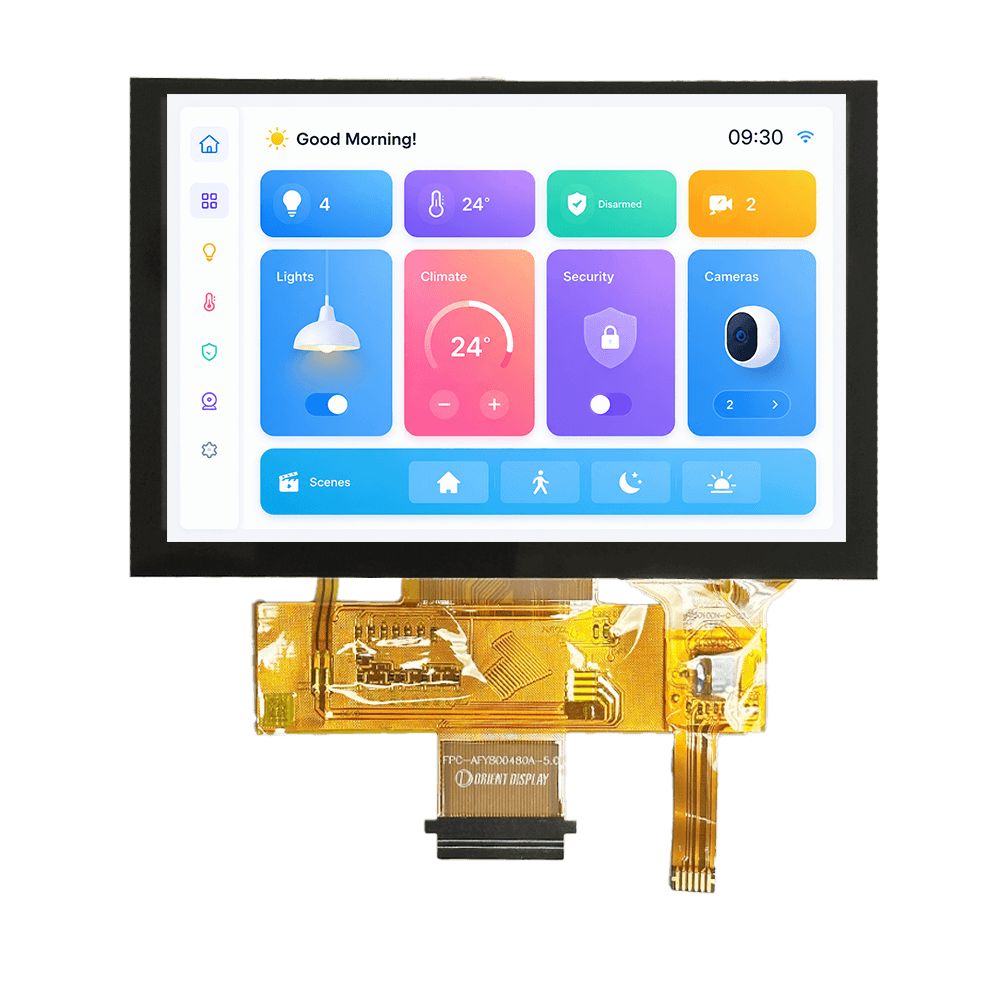
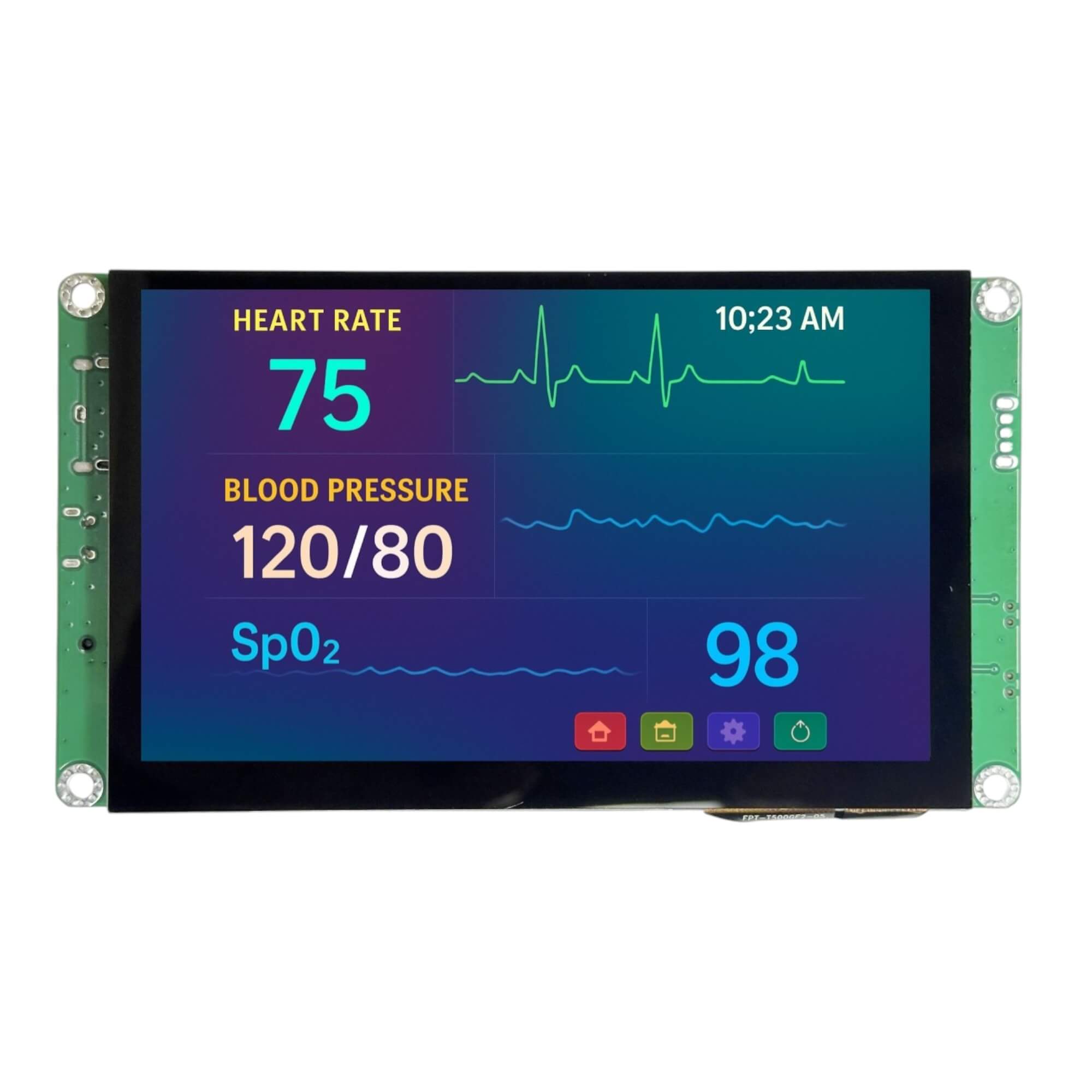
Bare sensor to integrated module

Learn more before you buy
Background on capacitive touch, cover glass, and bonding the stack.
Resistive vs Capacitive Touch
How each technology works and when to reach for PCAP over resistive.
Read the guideCover Glass and Surface Treatments
Glass materials, AR/AG/AF, and 9H hardness for the front lens of a PCAP stack.
Read the guideOptical Bonding Explained
Air gap vs bonded, OCA vs LOCA — what bonding buys a touch display.
Read the guideChoosing a Display Interface
I²C, USB, RGB, LVDS, and MIPI — matching a panel's interface to your host.
Read the guideReady to spec a PCAP touch panel?
Tell us the size, cover lens, and bonding requirements — the more detail on your enclosure and interface, the faster we can match a standalone sensor or an integrated TFT-plus-touch module.