

OLED modules
OLED Modules
An OLED module is a passive-matrix OLED display supplied as a finished part: the organic-emitter glass together with the controller IC that drives it, specified on the datasheet so you know exactly what you are designing against. You drive it over a standard parallel, SPI, or I²C interface rather than timing the raw panel yourself, and it drops onto a board much like a monochrome LCD — letting a low-cost MCU run a crisp, high-contrast readout without a dedicated display processor.

OLED module specifications
Standard ranges for the catalog PMOLED line. For a specific size, resolution, or interface, start a custom project.
- Technology: passive-matrix OLED (PMOLED), self-emitting, no backlight
- Sizes: 0.96″ to 3.12″
- Resolutions: 128×32 up to 256×64 (incl. 128×64, 128×96, 128×128, 160×128)
- Brightness: 80 to 120 cd/m² across the range
- Interfaces: parallel (8080/6800), 3-/4-wire SPI, I²C, and 6-bit RGB (on color parts)
- Color: four monochrome white parts (
AOM…) and four color parts (AOC…) - Size class: small — practical to roughly 3″, above which PMOLED is not viable and AMOLED takes over
Passive-matrix OLED, explained
How a passive-matrix panel is driven. A PMOLED lights its pixels through shared rows and columns, one line at a time, with no transistor or storage capacitor behind each pixel. That is the whole difference from an AMOLED, and it is what makes PMOLED simple and inexpensive to build. It is also what keeps PMOLED small: because each pixel is lit only briefly as its line is scanned, it has to burn brighter during that instant, which raises the drive voltage and shortens life as the panel grows. Past roughly three inches this stops being practical, and large, high-resolution OLED belongs to AMOLED instead. At the module scale most embedded products use, OLED almost always means PMOLED.
Why designers choose it. Each pixel emits its own light from organic layers between two electrodes, with no backlight anywhere in the stack. The panel can be a fraction of the thickness of an equivalent LCD, an off pixel is genuinely black rather than a leaking backlight, color and contrast hold across wide viewing angles, and response is fast — which is why crisp white text and icons on true black is what PMOLED does better than any small LCD. Three limits set the boundary honestly: organic emitters age, so a static image left on for long stretches risks burn-in; emitter lifetime is shorter than an LCD backlight under a demanding duty cycle; and an emissive panel can wash out in direct sunlight, where a reflective technology would win.
The catalog line
Eight OLED modules are catalog parts, each supplied with its controller IC specified so you know exactly what you are driving.
| Part number | Size | Resolution | Color | Controller | Interface | Luminance |
|---|---|---|---|---|---|---|
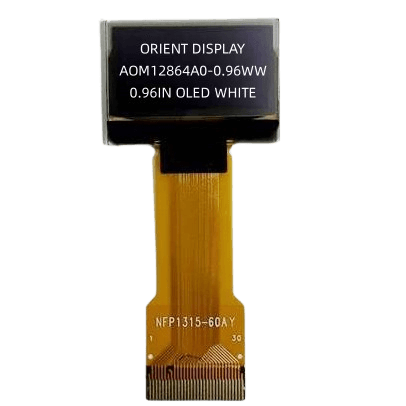
| AOM12864A0-0.96WW | 0.96″ | 128×64 | Mono white | SSD1315 | Parallel, 3/4-wire SPI, I²C | 120 cd/m² |
| AOC12896A0-1.27W | 1.27″ | 128×96 | Color | SSD1351 | Parallel, 3/4-wire SPI | 100 cd/m² |
| AOC160128A1-1.45W | 1.45″ | 160×128 | Color | SSD1333 | Parallel, 4-wire SPI, 6-bit RGB | 120 cd/m² |
| AOC128128A0-1.50W | 1.50″ | 128×128 | Color | SSD1351 | Parallel, 3/4-wire SPI | 90 cd/m² |
| AOM12864A0-1.54WW | 1.54″ | 128×64 | Mono white | SSD1309 | 8-bit parallel, 4-wire SPI, I²C | 120 cd/m² |
| AOC160128B0-1.69W | 1.69″ | 160×128 | Color | SSD1333 | 8/9-bit parallel, 4-wire SPI, 6-bit RGB | 100 cd/m² |
| AOM12832A1-2.23WW | 2.23″ | 128×32 | Mono white | SSD1305 | 8-bit parallel, 4-wire SPI, I²C | 120 cd/m² |
| AOM25664A0-3.12WW | 3.12″ | 256×64 | Mono white | SSD1322 | 8-bit parallel, 3/4-wire SPI | 80 cd/m² |
Scroll horizontally to see every column. On mobile, each row renders as a stacked card.
Driving the glass yourself. The parts above name their controller because most designs want that certainty. If your design supplies its own drive and you want the panel as bare glass, we source driverless PMOLED to order. That is a custom part rather than a stock line, so it carries a minimum order quantity, any tooling, and a longer lead time than the catalog parts above — bring us the size, resolution and drive scheme and we will quote what is sourceable.
The family, small to large


Applications and how to choose
Typical applications: instrument sub-displays, wearables and handhelds, appliance and audio front panels, medical and industrial readouts, and any MCU-hosted product that needs a thin, high-contrast screen at a small size.
Specifying one. Start from size and resolution, then the interface your host can drive — parallel, SPI and I²C are all represented across the range. After that the decisions that matter are the flex or connector interface into your board and the duty cycle you intend to run; the last of these drives lifetime more than any other choice on a PMOLED. If your design supplies its own drive entirely, say so and we will quote bare glass.
How it differs from Arduino / maker OLED: these are the production parts — panel plus named controller, with the full interface range, ordered against a datasheet. The Arduino / maker OLED boards are the same PMOLED technology mounted on a breakout PCB with headers and library support, for prototyping rather than production. The two catalogs overlap on size and resolution, so choose on form factor and intent, not on specs: a breakout to prove a design, a module to ship it. For anything larger than ~3″ or phone-class resolution, OLED is not the module answer — see the display technology comparison and talk to us about a TFT path.
Learn more before you buy
Background on PMOLED technology and how to specify a module.
OLED: PMOLED vs. AMOLED
The passive- vs. active-matrix split that sets the size and cost boundary for OLED modules.
Read the guideChoosing a Display Interface
How to pick between parallel, SPI, and I²C for your host MCU.
Read the guideDisplay Lifetime and Reliability
How duty cycle and static content affect an emissive panel's working life.
Read the guideHow to Read a Display Datasheet
The fields that matter when comparing controller, interface, and luminance across parts.
Read the guideReady to move on an OLED module build?
Need a specific size, color, or interface? Tell us the target and we will match or build it — a US-based engineer replies within one business day, and there is no minimum order to start.