
What You Can Customize on a Display
When a standard display does not quite fit, the useful question is not “custom or not” but “which parts actually have to change.” A display module is a stack of layers, and most of them can be tailored without touching the one expensive thing: the glass cell. Knowing which changes are near drop-in and which need new tooling is what keeps a custom build affordable. This article walks the menu; for the decision of whether to customize at all, see custom vs off-the-shelf displays.
Part of the Specifying and Sourcing knowledge hub.
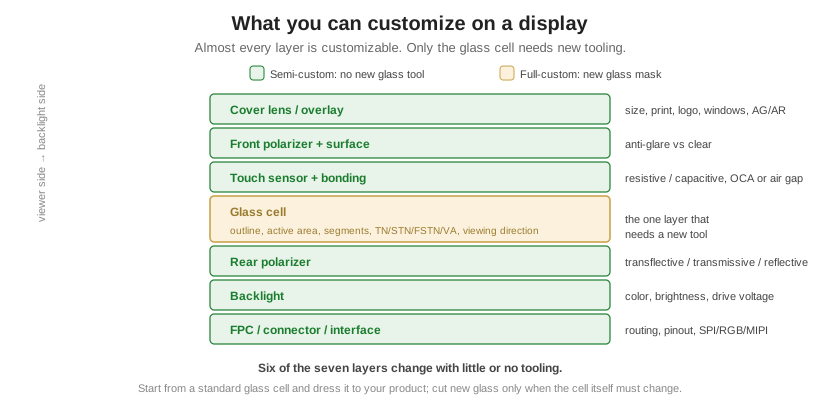
The rule: most changes do not need new glass
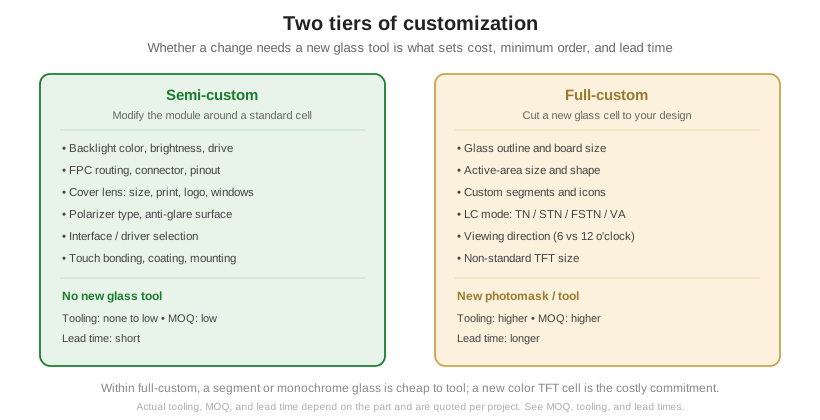
Customization splits cleanly into two tiers. The first, semi-custom, reuses an existing, already-tooled glass cell and modifies everything around it. Tooling is low or zero, the minimum order stays small, and lead time is short. The second, full-custom, cuts a new glass cell or mask and carries real tooling cost, a higher minimum order, and a longer first schedule. The whole art of scoping a custom display is staying in the first tier whenever the requirements allow, and reaching for new glass only when the cell itself genuinely has to change. Read the stack from that lens and the cost of each change becomes predictable.
Semi-custom: the module around the cell
These changes dress a standard cell and need little or no tooling. The backlight is one of the easiest: LED color, brightness, and drive voltage are usually a selection or a small change, and only a genuinely new light-guide footprint needs a modest tool. The flex tail and connector, the routing, length, exit direction, connector part, and pin assignment, are low-cost semi-custom and often reuse an existing footprint. The cover lens takes silk-screen printing, a logo, viewing windows, and a size trim cheaply, and simple print changes are close to drop-in. The polarizer choice, transflective, transmissive, or reflective, plus an anti-glare or clear front surface, is effectively a material selection on an existing cell. The interface and driver can be selected where the platform supports it, so a part can be set up for SPI, parallel, RGB, or MIPI without new glass. And assembly options, optical or air-gap touch bonding, conformal coating, heater film, and mounting, are process choices, not masks. For how these optical choices interact with readability, see specifying brightness and sunlight readability.
Full-custom: changing the glass itself
These changes redefine the glass cell, so a new photomask is cut and the cost and minimum order step up. A new outline or board size, or a changed active-area size or shape, means a new cell. A custom segment and icon layout, the tailored digits, bars, and annunciators of an appliance or meter readout, needs its own ITO pattern mask. The LC mode, TN, STN, FSTN, or VA, is chosen at cell design and sets contrast, gray scale, and background color; it cannot be swapped after the fact. So is the viewing direction, the 6 or 12 o’clock bias set by the alignment and polarizer orientation, which should match how the product is mounted. And a non-standard TFT diagonal is the highest-tooling item of all. These are the legitimate reasons to tool new glass; the point is to reach them deliberately, not by accident.
Segment glass is cheap; a TFT cell is the commitment
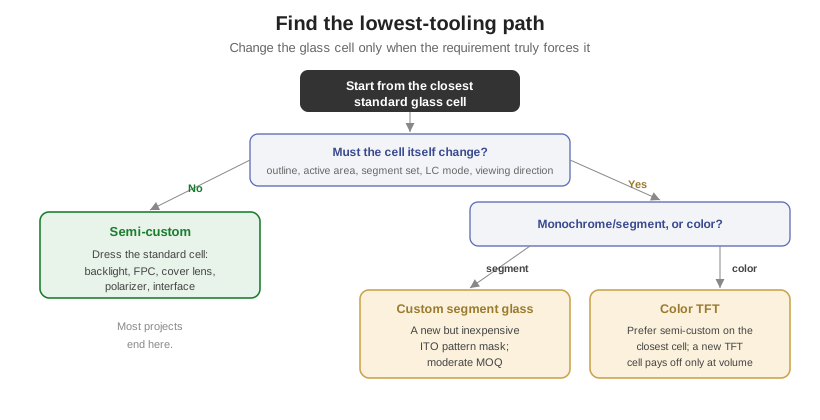
Not all new glass costs the same, and this is the most useful thing to know before scoping a color display. A custom segment or monochrome cell needs only a simple pattern mask, so its tooling is modest and within reach of a small program; different segment sizes on the same glass add nothing. A new color TFT cell is a different order of magnitude, because it is a full array of thin-film transistors on a fab’s mother glass, which is why almost no one tools a brand-new TFT cell for a single product. The practical path for color is semi-custom: take the closest standard TFT cell and customize the backlight, cover lens, touch, and interface around it. You get a display that fits your product without paying to build a new panel. The actual figures behind all of this live in MOQ, tooling, and lead times.
| What you change | Options | Tooling | Typical reason |
|---|---|---|---|
| Backlight | Color, brightness, drive voltage | Drop-in to low | Brand look, sunlight, power budget |
| FPC / connector | Routing, length, pinout, connector | Drop-in to low | Fit the host board |
| Cover lens | Size, print, logo, windows, AG/AR | Low | Branding, bezel-free look |
| Polarizer | Transflective / transmissive / reflective | Drop-in to low | Ambient-light readability |
| Interface | SPI, I²C, parallel, RGB, MIPI | Drop-in to low | Match the processor |
| Touch / assembly | Resistive/capacitive, bonding, coating | Low (process) | Ruggedness, optics |
| Glass outline / active area | New size or shape | High (new glass) | Fit a custom enclosure |
| Segment / icon layout | Custom digits, bars, icons | New glass, but low cost | Appliance / meter readouts |
| LC mode, viewing direction | TN/STN/FSTN/VA, 6 vs 12 o’clock | Cell-level (new glass) | Contrast, mounting angle |
| Custom TFT size | Non-standard diagonal | Highest | Bespoke color display |
The goal is always the lowest-tooling option that meets the requirement: dress a standard cell first, and tool new glass only when the form or content of the cell itself cannot be met any other way. Orient Display builds across the whole range, from semi-custom TFT modules to fully custom segment and graphic LCDs, and will point a design to the cheapest path that still fits. To scope what your display actually needs, weigh it against custom vs off-the-shelf and then start a custom project.