

Optical Bonding Explained
Optical bonding laminates the layers of a display stack, the cover lens, the touch sensor, and the display, into one solid unit using a clear adhesive whose refractive index matches glass. The conventional alternative, an air-gap or perimeter-taped assembly, joins those layers only at the edges and leaves a thin air cavity between them. That gap is small, but optically it is expensive: every glass-to-air surface reflects part of the light passing through, and an air gap adds two of them. Removing the gap is one of the highest-impact things you can do for a display that has to be read in bright light or survive a hard environment. It pairs closely with how a display handles ambient light, covered in reflective, transmissive, and transflective.
Part of the Design and Integration knowledge hub.
The optics: why filling the gap matters
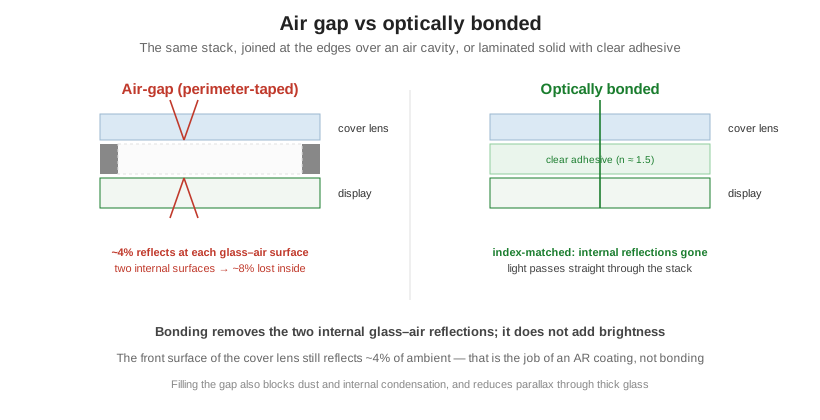
Whenever light crosses a boundary between two materials with different refractive indices, some of it reflects. This is Fresnel reflection, and at a glass-to-air surface it costs about 4 percent of the light per surface. An air gap has two such surfaces, where light leaves the glass into the air and then re-enters glass on the other side, so roughly 8 percent of the light is lost to internal reflection before it ever reaches your eye. Filling the gap with an adhesive whose refractive index is about 1.5, essentially the same as the glass, makes those two boundaries optically disappear, and the internal reflection drops to near zero.
The payoff shows up most under bright ambient light. Reflected light washes out an image, so the meaningful figure is the ambient contrast ratio, the on-screen contrast you actually perceive with sunlight or room light bouncing off the screen. Killing the internal reflections raises that effective contrast substantially; vendors cite outdoor contrast gains in the range of 300 to 400 percent, which are order-of-magnitude marketing figures rather than exact constants, but the direction is real and, importantly, it is achieved without turning up the backlight. Two things this is not: bonding does not add brightness, it improves contrast by removing reflections; and it does not touch the front surface of the cover lens, which still reflects about 4 percent of ambient light. That front reflection is the job of an anti-reflective coating, not of bonding. The two solve different surfaces and are often used together.
The other benefits: rugged, sealed, and better to touch
The optical gain is the headline, but the mechanical gains are why bonding is standard on rugged gear. The cured adhesive layer bonds the cover lens to the display and spreads mechanical load, so the stack resists impact, shock, and vibration far better than a cover lens suspended over an air gap. Because there is no internal air cavity, there is no volume for moisture to condense in when the temperature swings, which eliminates the internal fogging that plagues outdoor and cold-chain equipment, and no gap for dust to migrate under the glass. Bonding also improves touch: with a thick cover lens, a bonded stack gives better capacitive touch sensitivity and reduces parallax, the visual offset between your fingertip and the target it is over when seen through a thick, gapped piece of glass.
OCA vs LOCA: two ways to bond
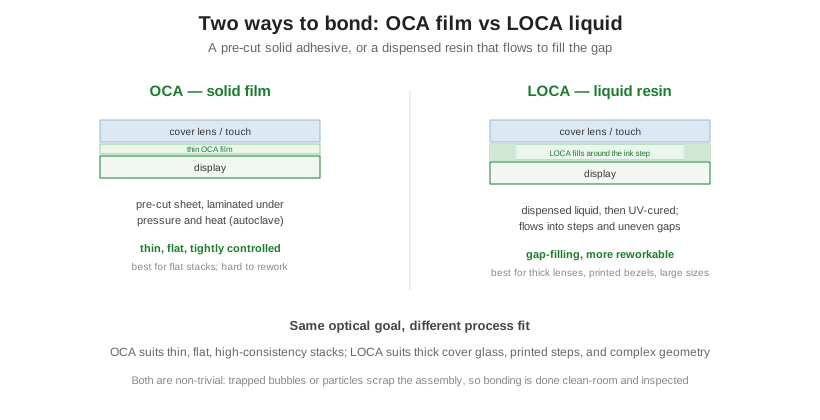
There are two adhesive approaches. OCA (optically clear adhesive) is a solid, pre-cut film laminated between the layers under pressure and heat, often in an autoclave. It gives a thin, uniform, tightly controlled bond line and suits flat, consistent stacks, but it is largely non-reworkable, so the parts have to be inspected rigorously before bonding. LOCA (liquid optically clear adhesive, also called OCR) is a resin dispensed as a liquid and then UV-cured. Because it flows, it fills uneven gaps, the step created by a printed ink bezel, thick cover lenses, and larger or more complex geometries, and it is more forgiving to rework before cure. The rule of thumb: OCA for thin and flat, LOCA for thick, stepped, or large.
The tradeoffs, and when to bond
Bonding is not free. It adds material and clean-room process cost, extends lead time, and carries yield risk: a single trapped bubble or particle can scrap an already-assembled, already-expensive stack, and bonding stress can produce mura, a localized brightness non-uniformity. Yield also falls as panel size grows. So the decision is about whether the environment justifies it.
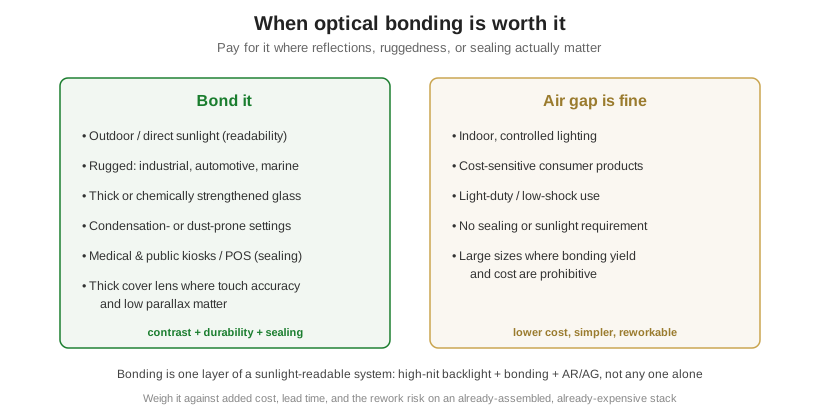
| Consideration | Air gap | Optically bonded |
|---|---|---|
| Internal reflection loss | ~8% (two glass-air surfaces) | Near zero |
| Sunlight readability | Lower ambient contrast | Much higher ambient contrast |
| Impact / shock | Cover lens suspended | Load spread, far more rugged |
| Condensation & dust | Can fog and admit dust | Sealed, no internal cavity |
| Cost & lead time | Lower, simpler, reworkable | Higher, longer, yield risk |
| Best for | Indoor, cost-sensitive | Outdoor, rugged, sealed |
The clean way to think about it: bonding is one layer of a sunlight-readable system, alongside a high-nit backlight and AR or AG surface treatments, not a substitute for either. Orient Display offers custom optical bonding, both dry (OCA) and wet (OCR), and builds it into complete sunlight-readable TFT assemblies with the cover lens, touch, treatments, and backlight engineered together. To scope a bonded, sunlight-readable stack for your product, start a custom project or explore the TFT line.