

Display Interface Quick Reference
This is the fast lookup for display interfaces: one table of operating envelopes, plus the handful of accuracy notes that keep you out of trouble. It does not re-teach the interfaces. For what each one is and how it works, see display interfaces explained; for choosing one against host support, cable length, cost, and power, see choosing a display interface. This page is the cheat sheet those two earn.
Part of the Reference knowledge hub.
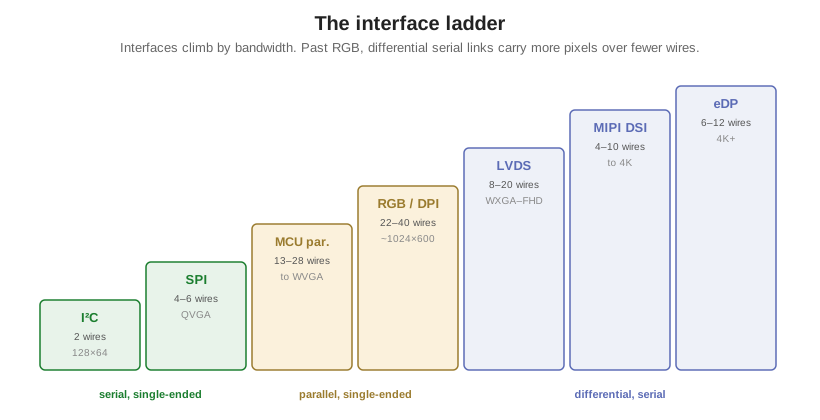
The interfaces at a glance
Wire counts are interface signal lines only (data, clock, sync, control), not power, backlight, or touch. Bandwidth and resolution ceilings are realistic ranges for custom TFT and OLED modules, not hard maxima.
| Interface | Signal type | Wires | Typical bandwidth | Resolution ceiling | Color depth | Typical use |
|---|---|---|---|---|---|---|
| I²C | Serial, single-ended, 2-wire bus | 2 | 100 kHz to 3.4 MHz | OLED 128×64, character | Mono / 1–4 bpp | Tiny status OLEDs, character LCDs, shared bus |
| SPI | Serial, single-ended | 4–6 | ~1 to 80 Mbit/s | QVGA, pushes to 480×320 | Mono, RGB565/666 | Small mono or low-res color, wearables, low pin count |
| MCU parallel (8080 / 6800) | Parallel, single-ended + GRAM | 13–28 | Moderate | QVGA to ~WVGA | RGB565 / RGB666 | Small to medium TFT with on-glass RAM; UI, not video |
| RGB / DPI | Parallel, single-ended, per-pixel | 22–40 | ~0.1 to 0.5 Gbit/s | ~800×480 to 1024×600 | RGB565/666/888 | Medium TFT, video; host needs an RGB controller |
| LVDS, single channel | Differential serial | 8–10 | ~0.4 to 1 Gbit/s/pair | up to WXGA 1366×768 | 18 or 24-bit | Industrial and medium panels, noise immunity, cable runs |
| LVDS, dual channel | Two LVDS links (odd/even) | 16–20 | ~2× single channel | 1920×1080 / 1200 and up | 18 or 24-bit | Larger, higher-res industrial and medical |
| MIPI DSI | Differential serial, 1–4 lanes | 4–10 | ~1 to 2.5 Gbit/s/lane | 720p to 4K | 18/24/30-bit | Compact high-res modules; best bandwidth per wire |
| eDP | Differential serial, packetized | 6–12 | 1.62 to 8.1 Gbit/s/lane | 1080p to 4K+ | 18/24/30-bit | Large, high-res panels; laptops, all-in-ones, high-end HMI |
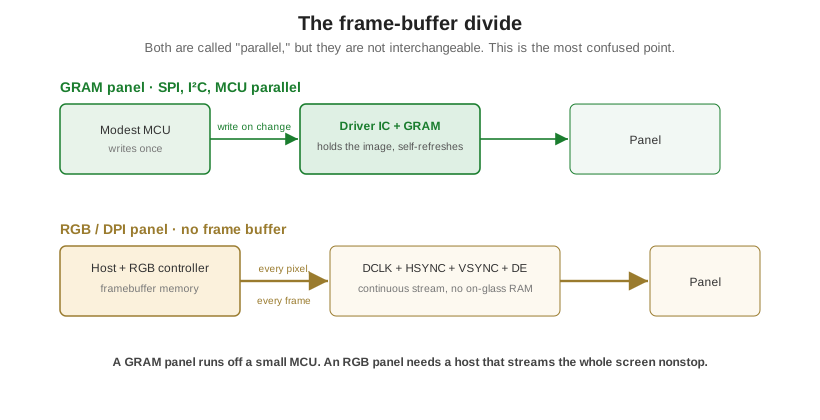
The frame-buffer divide
The single most confused point, because two very different architectures both get called “parallel.” SPI, I²C, and MCU-parallel panels carry an on-glass driver IC with its own display RAM (GRAM): the host writes the image once, and the driver holds and refreshes it, so a modest MCU can drive the panel. RGB / DPI panels have no on-glass frame buffer. The host must stream every pixel of every frame continuously, clocking out DCLK, HSYNC, VSYNC, and DE, which means it needs a real RGB controller and framebuffer memory of its own. A GRAM panel and an RGB panel are not interchangeable even at the same resolution, so confirm which one a “parallel” panel actually is before you design the host around it.
Serial differential vs parallel single-ended
The other split in the table is electrical. I²C, SPI, MCU-parallel, and RGB are single-ended: each signal is one wire referenced to ground. LVDS, MIPI DSI, and eDP are differential serial: each signal is a pair whose two wires swing against each other, which is what lets them run at gigabit rates, tolerate longer cables, and throw off less noise. That is why the ladder inverts near the top: MIPI DSI moves more pixels than RGB over far fewer wires, because a few fast differential lanes beat a wide slow bus. The cost is that the host must speak the serial protocol, or carry a bridge IC that does. Treat every resolution ceiling as practical bandwidth at a normal frame rate, not a physical wall; sources disagree on the exact tops precisely because they depend on frame rate and signal integrity.
Picking a row
Read one row as one interface’s envelope, and move down as the panel grows: I²C or SPI for tiny, SPI or MCU-parallel for small GRAM color panels, RGB for medium video, LVDS for medium-large industrial with a cable, MIPI DSI for compact high-res, eDP for large high-res. The router below is the lookup; the trade-offs behind it, host support, cable length, cost, and power, live in choosing a display interface.
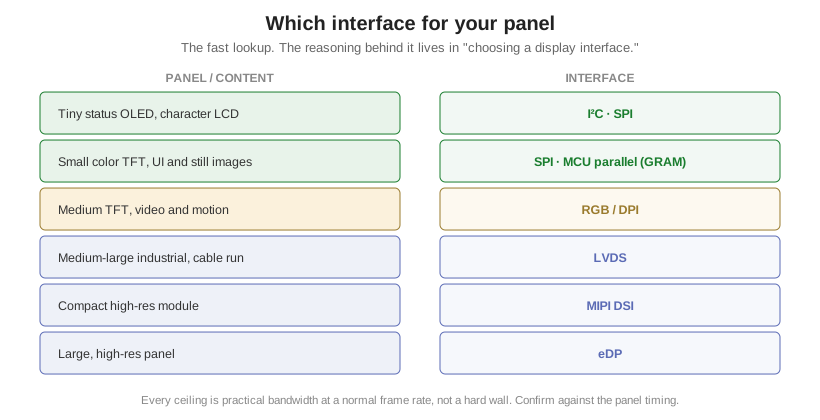
On a custom module the interface is an option, not a fixed attribute of the glass. The same panel can often be offered SPI, MCU-parallel, or RGB depending on the driver IC, and Orient Display can integrate a driver with built-in GRAM so a low-end MCU drives a panel that would otherwise need a full RGB controller. Where host and panel speak different interfaces, a bridge IC (MIPI-to-RGB, RGB-to-LVDS, MIPI-to-eDP) lets you keep the existing processor. For the units on these panels see display units and measurements, and to match an interface to a real part on the TFT and LCD lines.