

Display Units and Measurements
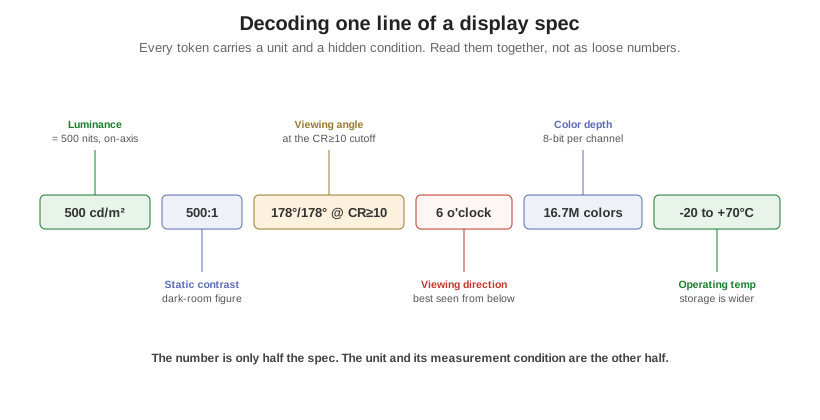
A display spec line is a string of units, and each one carries a hidden condition. “500 cd/m², 500:1, 178°/178° at CR≥10, 6 o’clock, 16.7M colors” is five different measurements with five different gotchas. This is a lookup page for decoding them: what each unit means, its typical range, and the mistake it invites. It pairs with how to read a display datasheet, which walks the datasheet section by section, and with specifying brightness and sunlight readability for the brightness numbers in depth.
Part of the Reference knowledge hub.
Brightness: nits, cd/m², and lux
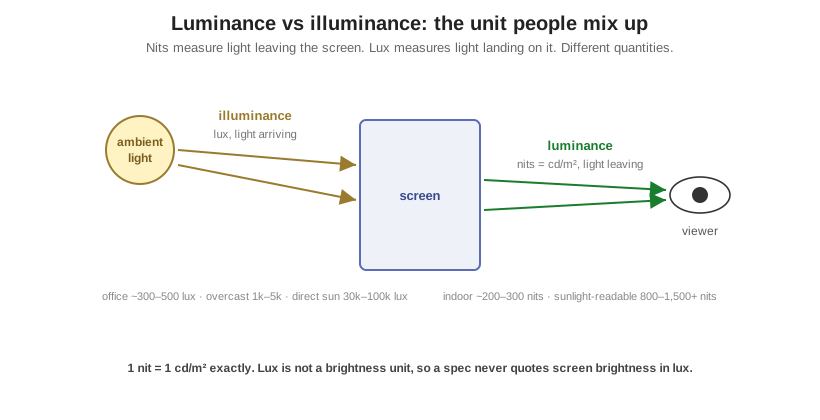
The one fact that clears up most confusion: a nit is one cd/m², exactly. They are the same unit of luminance, the light leaving the screen toward you. “500 nits” and “500 cd/m²” are identical. Lux is a different quantity entirely: it measures illuminance, the ambient light landing on the screen, so it describes the environment, not the display. A spec never quotes screen brightness in lux. As a feel for the numbers, an indoor display runs about 200 to 300 nits, a sunlight-readable one starts around 800 to 1,500 nits and industrial sun-exposed panels push well past that, while the ambient side runs roughly 300 to 500 lux in an office and 30,000 to 100,000 lux in direct sun. Brightness alone does not make a panel sunlight-readable, which is the next unit’s job.
Contrast, and why it collapses in daylight
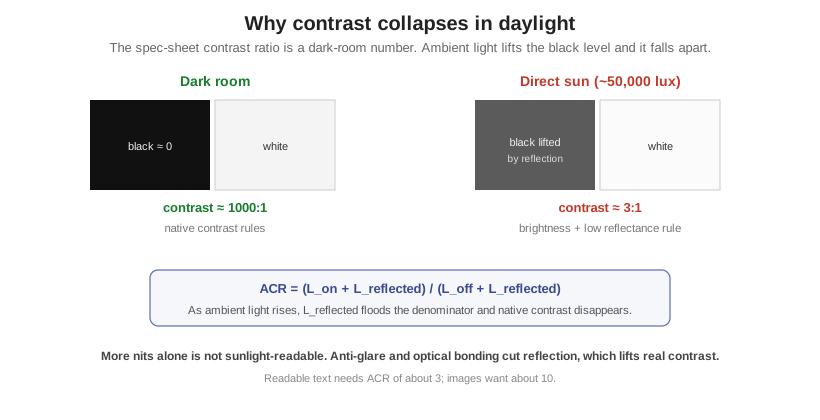
Three different contrast numbers get quoted, and only one predicts the real world. Static (native) contrast ratio, the headline “1000:1,” is the ratio of white to black measured in a dark room; it is a lab figure. Dynamic contrast, the “1,000,000:1” marketing number, measures brightest-ever against darkest-ever over time, not at once, and is not comparable panel to panel. Ambient contrast ratio (ACR) is the one that governs outdoor readability: it folds in the ambient light reflecting off the screen surface. As ambient light rises, that reflected light floods the black level, native contrast disappears, and screen brightness plus low reflectance become the levers. This is why a dim high-contrast panel washes out in sun while a bright, optically bonded, anti-glare panel stays legible. Usable ACR is about 3 for text and about 10 for images.
Viewing angle and direction
Viewing angle is quoted as the maximum angle off the screen normal at which the image stays acceptable, and the industry cutoff for “acceptable” is CR≥10: the angle at which white is still at least ten times brighter than black. A premium panel quotes 178°/178° at CR≥10. The four directions are named like a clock laid over the screen: 12 o’clock is up, 6 o’clock is down, 3 is right, 9 is left, quoted either as up/down/left/right angles or as a single best viewing direction. A 6 o’clock display is optimized to be viewed slightly from below, right for a handheld meter or a dashboard; a 12 o’clock display for viewing from above, right for a wall panel. Direction is mostly a TN concern, since IPS and VA are far more symmetric, and it is fixed at manufacture, so it belongs on the order.
Color: depth, gamut, and white point
Color depth is bits per channel, cubed into a color count: 6-bit gives 262K colors (cheap panels, often dithered up), 8-bit gives 16.7M (“true color,” the mainstream), and 10-bit gives 1.07 billion (HDR and professional). Watch for “8-bit plus FRC” sold as native 10-bit; dithering approximates counts, it does not add true depth. Color gamut is quoted as a percentage of a reference space, and the trap is that % NTSC and % sRGB are different rulers: 100% sRGB is about 72% NTSC by area, so a panel at “72% NTSC” is not worse than one at “100% sRGB,” they are the same coverage measured differently. Always ask which reference the percentage is against. White point is the chromaticity the panel calls white, given as a color temperature in Kelvin: lower is warmer, higher is cooler, and 6500K (D65) is the standard daylight target, while 9300K is a common cheaper native default.
Response, resolution, temperature, and power
The rest of the spec line. Response time is in milliseconds, usually gray-to-gray: IPS runs about 1 to 5 ms, TN under 1 ms, OLED near 0.1 ms, while e-paper is not really a response time at all but a refresh cycle of a few hundred milliseconds. Do not confuse response time (ms) with refresh rate (Hz), the frames per second the panel accepts. Resolution is a raw pixel count and says nothing about sharpness on its own; PPI (pixels per inch, the diagonal pixel count over the diagonal in inches) is what sets perceived sharpness, and dot pitch in millimeters is its inverse, 25.4 / PPI. Temperature comes as two separate specs that must not be conflated: operating range, where the panel works to spec, and storage range, which is always wider because the panel only has to survive it. On power, the logic supply (VDD / VDDIO) is commonly 3.3 V or 1.8 V and must match the host’s I/O rail, while the backlight is a separate rail driven at constant current, quoted as a forward voltage and forward current.
The whole spec line in one table
| Quantity | Unit | Typical range | Note / gotcha |
|---|---|---|---|
| Luminance (brightness) | nit = cd/m² | 200–300 indoor; 800–1,500+ sunlight | 1 nit = 1 cd/m²; light leaving the screen |
| Illuminance (ambient) | lux | 300–500 office; 30k–100k sun | Light arriving; not a brightness unit |
| Static contrast | ratio (X:1) | 500:1 to 1500:1; VA 3000:1+ | Measured in the dark |
| Dynamic contrast | ratio (X:1) | 10⁵:1 and up | Marketing; not comparable |
| Ambient contrast (ACR) | ratio | usable ≥3 text, ≥10 images | Governs real-world readability |
| Viewing angle | degrees | up to 178°/178° | Quoted at CR≥10 |
| Color depth | bits/channel | 6-bit 262K; 8-bit 16.7M; 10-bit 1.07B | Beware 8-bit + FRC as 10-bit |
| Color gamut | % NTSC or % sRGB | 45–72% NTSC; 70–100% sRGB | 100% sRGB ≈ 72% NTSC; state the reference |
| White point | Kelvin | 5000K / 6500K / 9300K | Lower warmer, higher cooler; D65 = 6500K |
| Response time | ms | IPS 1–5; TN <1; OLED ~0.1 | Gray-to-gray; e-paper is a refresh cycle |
| Resolution | pixels | 320×240 to 1920×1080+ | Count only; no sharpness on its own |
| Pixel density | PPI | ~100 to 500+ | √(w²+h²) / diagonal in inches |
| Operating temp | °C | -20 to +70 (to -40/+85 wide) | Works to spec in this range |
| Storage temp | °C | -30 to +80 (wider) | Survives powered off; always wider |
| Logic voltage | V (VDD/VDDIO) | 1.8 / 2.8 / 3.3 | Match the host MCU I/O rail |
| Backlight drive | V_F, I_F | 3.0–3.3 V or 12–24 V; 20–60 mA | Drive at constant current |
Don’t confuse these
| These look alike | But |
|---|---|
| nit vs lux | Light leaving vs light arriving. Not convertible. |
| Static vs dynamic contrast | Only static compares panel to panel. |
| Response time (ms) vs refresh rate (Hz) | Pixel switch speed vs frames per second. |
| Operating vs storage temperature | Works to spec vs merely survives. Storage is wider. |
| % NTSC vs % sRGB | Different rulers. 100% sRGB ≈ 72% NTSC. |
Every unit on this page is a specification you can dictate, and on a custom build, tune. Sunlight readability is an ACR target met with anti-reflective coatings, optical bonding, and transflective modes, not just more nits; viewing direction, temperature grade, color point, and interface voltage are all chosen to the application rather than accepted from a catalog. Knowing what each unit means is how you spec the display you need. For the terms behind the numbers see the display glossary, and to turn a target into a real part on Orient Display’s LCD and TFT lines.