
MOQ, Tooling, and Lead Times for Custom Displays
Once a design points toward a custom display, three commercial numbers decide whether the program is workable: the minimum order quantity, the one-time tooling charge, and the lead time. They move together, they scale with how deep into the glass the customization reaches, and they are widely misunderstood. This article puts realistic ballpark ranges on each and shows how to keep all three down. Every figure here is an industry ballpark that varies by product, size, options, factory, and region; only a drawing-based quote is firm. For the decision of whether to customize at all, see custom vs off-the-shelf displays, and for what actually changes, what you can customize on a display.
Part of the Specifying and Sourcing knowledge hub.
MOQ scales with how custom the glass is
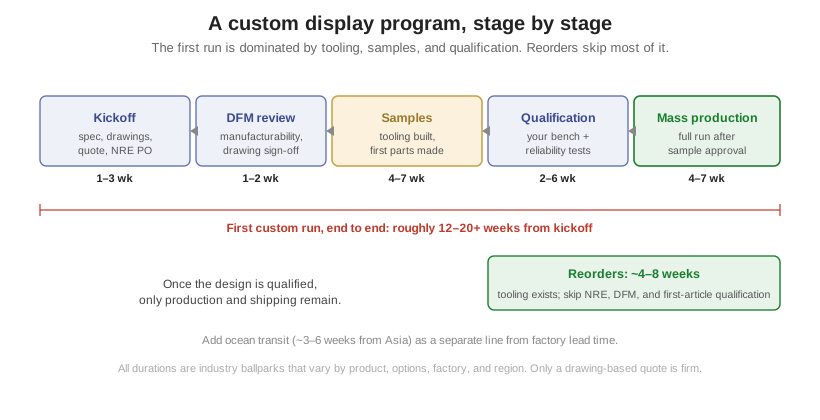
Minimum order quantity is the smallest run a factory will accept, and it exists to amortize the fixed setup a custom part carries. The deeper the customization reaches into the glass, the higher it climbs. A standard module used as-is has effectively no minimum, or a very low one. Semi-custom, where a standard cell is kept and the module around it is modified, runs a moderate minimum, commonly a few hundred to a thousand pieces and often quoted around 500, because the expensive glass mask already exists. A full-custom segment or monochrome part, which needs a new but simple pattern mask, runs roughly 500 to 3,000. A genuinely new color TFT glass cell is the outlier: because a fab allocates capacity by mother-glass sheets, the minimum jumps into the tens of thousands, which is why almost no one tools a new TFT cell for a single product and instead customizes around the closest standard cell. One counter-intuitive note for TFT: a larger glass can carry a lower minimum, because fewer panels fit on a sheet, so one sheet’s worth is a smaller batch.
NRE is a one-time tooling charge
Non-recurring engineering, the tooling fee, covers the design, the physical masks and tooling, and usually a set of prototypes. It is paid once per design, not once per order, and reorders of the same part carry none of it. What drives it is how much new tooling the part needs. A custom segment glass mask is modest, on the order of hundreds to a few thousand dollars, and a complete custom monochrome module lands in the low thousands. A new color TFT cell is a different world, often tens of thousands to over a hundred thousand dollars, while customizing a module around an existing TFT cell is back in the low-thousands to mid-thousands range. Component-level tooling stacks on top: a custom FPC, a custom cover-lens overlay, a custom touch sensor, or a custom backlight each adds its own charge. The single biggest driver of a high NRE is a new glass photomask, which is exactly what the semi-custom path avoids.
Samples come after tooling, in weeks not days
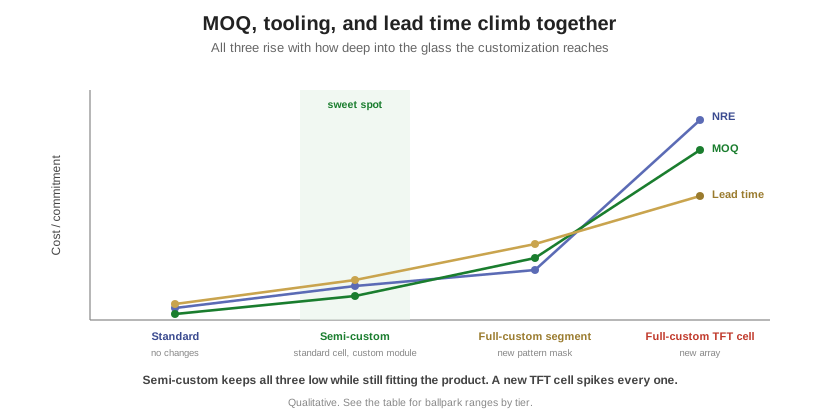
Samples are the first physical parts off the new tooling, so they arrive only after NRE is paid and drawings are approved, and they take weeks because real masks and tooling have to be fabricated. Standard stock ships in days; custom samples take roughly four to seven weeks depending on whether it is a segment or TFT part. A typical custom program runs kickoff and quoting, then a DFM review that checks manufacturability and locks the drawing, then the sample or first-article build, then your qualification and reliability testing, then mass production. End to end, the first custom run is commonly twelve to twenty or more weeks, dominated by tooling, samples, and the qualification loop. The important asymmetry is that reorders are far shorter, roughly four to eight weeks, because the tooling already exists and they skip NRE, DFM, and first-article qualification. Budget ocean transit, about three to six weeks from Asia, as its own line separate from factory lead time.
The four numbers trade against each other
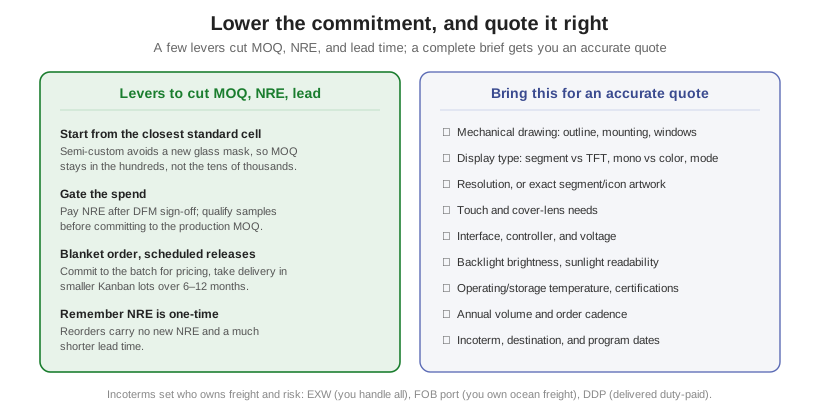
MOQ, NRE, lead time, and per-unit price move together, and you cannot minimize all of them at once. Low or zero NRE, the semi-custom route, means a standard or slightly higher per-unit price and less exact fit; paying full NRE for a dedicated design lowers the per-unit cost at volume and buys an exact part. Larger order commitments unlock lower unit pricing, while small runs pay a premium. The more custom the glass, the longer the first lead time and the higher the minimum. The lever that helps most is the same one that recurs throughout this cluster: choose the closest standard glass or cell and customize the module around it, which cuts NRE, MOQ, and first-run lead time together at the cost of some design freedom. To reconcile a high minimum with lower monthly usage, a blanket order with scheduled Kanban releases lets you commit to the batch for pricing but take delivery in smaller lots over six to twelve months.
| Tier | Typical MOQ | Typical NRE / tooling | First-run lead time |
|---|---|---|---|
| Standard module, no changes | ~1–100 pcs | ~$0 | ~1–2 weeks (stock) |
| Semi-custom (standard cell, custom module) | ~250–1,000 (often ~500) | ~$1,000–$15,000 | ~6–12 weeks |
| Full-custom segment / monochrome | ~500–3,000 | ~$600–$6,500 | ~8–14 weeks |
| Full-custom TFT on a standard cell | ~1,000+ | ~$5,000–$15,000 | ~10–16 weeks |
| Full-custom TFT, new glass cell | ~20,000–50,000+ | ~$70,000–$200,000+ | ~4–6+ months |
| Production reorder (tooling exists) | vendor batch min | $0 (no new NRE) | ~4–8 weeks |
All figures above are public-source industry ballparks and vary widely by product, options, factory, and region. They are planning ranges to frame a conversation, not quotes.
Getting to an accurate quote
A complete brief compresses the kickoff phase and gets you a real number instead of a range. Have ready the mechanical drawing and mounting constraints, the display type and technology, the resolution or exact segment artwork, the touch and cover-lens needs, the interface and voltage, the brightness and any sunlight-readability requirement, the operating and storage temperature and any certifications, the target annual volume and order cadence, and your preferred Incoterm and destination. That last item matters more than buyers expect: Incoterms set who owns freight and risk, from EXW where you handle everything from the factory door, to FOB where the factory delivers to the origin port and you own the ocean freight, to DDP where it arrives duty-paid at your door. Get the Incoterm in writing on the quote.
The most reliable way to keep these numbers sane is to phase the program and stay semi-custom wherever the requirement allows. Orient Display quotes and builds across all of these tiers, from standard modules through semi-custom to fully custom segment and TFT glass, and will steer a project to the lowest-tooling lane that meets the spec. With a complete brief in hand, start a custom project for a quote against your actual drawings and volume.