
Cover Glass and Surface Treatments
The cover lens is the outermost layer of a display, the piece a user actually touches, and it does more than protect the screen. Its material sets how well the product survives scratches and drops; its surface treatments decide how it handles glare and fingerprints; and its printing and shape define the look of the whole face. Getting it right is a small stack of decisions, material, strengthening, coatings, and decoration, each with a clear tradeoff. This article walks through them, including one of the most misread specs in the industry, the “9H” hardness number, and where the lens meets optical bonding beneath it.
Part of the Design and Integration knowledge hub.
Cover lens materials
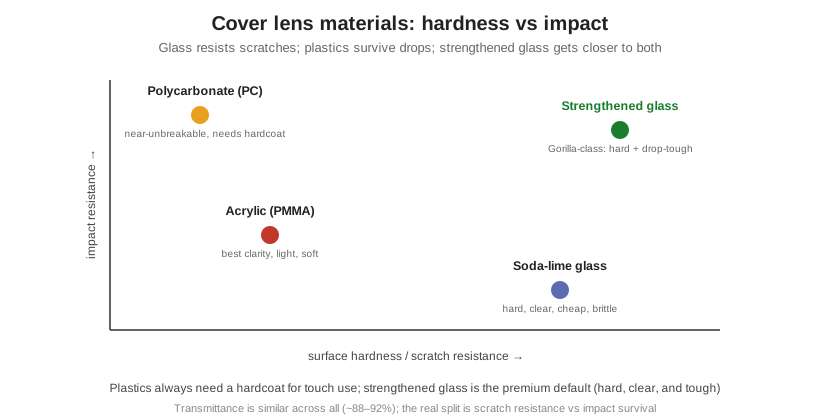
There are four common choices, and they split cleanly between scratch resistance and impact survival. Soda-lime glass is hard, optically clear, and cheap, but brittle, so it suits cost-sensitive indoor products. Chemically strengthened glass, the aluminosilicate family that includes Corning’s Gorilla Glass, keeps glass hardness and clarity but adds dramatically higher break resistance, which is why it is the default for premium and portable devices. Acrylic (PMMA) has the best optical clarity of any option and is light and inexpensive, but it is soft and scratches easily unless hardcoated. Polycarbonate (PC) is nearly unbreakable, hundreds of times the impact resistance of glass, but it is the softest of all and always needs a hardcoat for touch use. Light transmission is similar across all of them, roughly 88 to 92 percent, so the real decision is scratch resistance versus impact resistance versus cost. For more on glass types and chemical strengthening, including IK impact ratings, see our blog.
Chemical strengthening: how glass gets tough
Chemically strengthened glass earns its toughness through ion exchange. The glass is bathed in a molten potassium-salt bath at around 400 degrees C, and the small sodium ions at its surface are swapped for larger potassium ions from the bath. As it cools, those oversized ions are wedged in place, putting the surface into compressive stress and the interior into balancing tension. A crack has to overcome that surface compression before it can spread, so the glass resists both scratching and breakage. The key numbers a datasheet cites are the compressive stress (often 700 to 1000-plus MPa) and the depth of layer, the depth of the compressed skin (typically 20 to 50 microns). One thing strengthening does not change is the intrinsic hardness of the glass, which matters for the next point.
Surface treatments: AR, AG, and AF
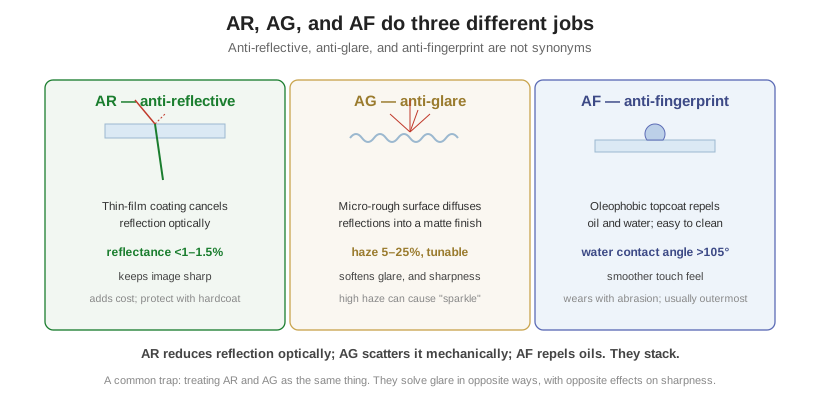
Three coatings get confused constantly, so it is worth stating what each actually does. Anti-reflective (AR) is a multi-layer thin-film coating that cancels reflection at the glass surface through optical interference, cutting reflectance from the bare 4 to 8 percent down below 1 to 1.5 percent. It boosts contrast and sunlight readability with no loss of sharpness, at the cost of a more expensive, more delicate surface. Anti-glare (AG) takes the opposite approach: it roughens the surface, by etch or coating, to scatter reflections into a soft matte finish. It is measured by haze (typically 5 to 25 percent), and while it kills mirror glare it slightly softens the image, and high haze on a high-resolution screen can cause a grainy “sparkle.” Anti-fingerprint (AF), or oleophobic, is a low-surface-energy topcoat that repels oils and water so the screen wipes clean and feels smoother, usually applied as the outermost layer. Under plastics and AR there is often a hardcoat for abrasion resistance, and medical or public products may add an anti-microbial agent. The one thing to remember: AR reduces reflection optically and keeps the image sharp; AG diffuses it mechanically and trades a little sharpness. They are not the same, and they can be combined. For coating selection by application, including outdoor, automotive, and touch, see the complete guide to AG, AF, and AR coatings.
The “9H” hardness myth
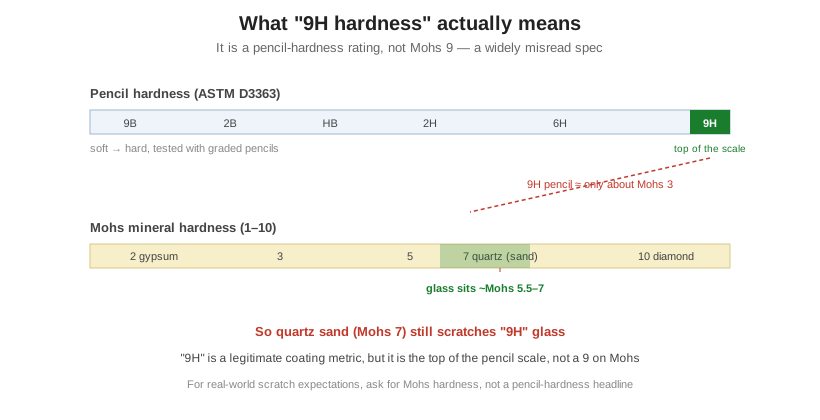
When a cover glass or screen protector is advertised as “9H,” that is a pencil-hardness rating from the ASTM D3363 test, in which graded pencils are drawn across the surface and the hardest one that leaves no mark sets the grade. The pencil scale runs from 9B (soft) up to 9H (hard), so 9H simply means “the top of the pencil scale.” It is routinely misread as “9 on the Mohs mineral scale,” which it is not: a 9H pencil corresponds to only about Mohs 3, while actual glass sits around Mohs 5.5 to 7. That is why quartz sand, at Mohs 7, still scratches “9H” glass and protectors. The rating is legitimate, but for real-world scratch expectations ask for the Mohs hardness, not the pencil-hardness headline.
Decoration and how it all comes together
A finished cover lens is more than a clear sheet. The perimeter usually carries a silkscreen-printed ink border, often several passes for full opacity, that hides the touch sensor’s routing traces and the display edge, and it can add logos, colored decoration, and transparent windows or cutouts for indicator LEDs, cameras, or IR sensors. The lens itself is CNC-cut to shape with holes, chamfers, and custom outlines, then laminated to the touch sensor and display. That lamination is where this article meets optical bonding: filling the gap under the lens removes internal reflections, raises contrast, and seals out dust and condensation, complementing the AR coating on the front surface. The cover lens, its coatings, the touch sensor, and the bond are best specified together as one stack.
| Choice | Options | Pick by |
|---|---|---|
| Material | Soda-lime, strengthened glass, PMMA, PC | Scratch vs impact vs cost vs weight |
| Strengthening | Ion-exchanged (chemical), tempered | Drop and break resistance needed |
| Glare control | AR (optical) or AG (matte) | Sharpness + cost (AR) vs diffuse glare (AG) |
| Surface feel / hygiene | AF / oleophobic, anti-microbial | Cleanability, medical or public use |
| Decoration | Silkscreen border, logos, windows, cutouts | Product face and sensor layout |
Choose by environment: indoor and cost-sensitive leans to soda-lime or acrylic with an AF coat; premium and drop-prone wants strengthened glass with AF and often AR; outdoor and high-ambient light wants AR or AG plus bonding; industrial and rugged wants thick strengthened glass or hardcoated PC; medical and public wants anti-microbial and easy cleaning. Orient Display supplies the cover lens as an integrated custom service, the substrate, shape, printing, and cutouts, plus AR, AG, AF, hardcoat, and anti-microbial treatments, bonded to its touch panels and TFT or LCD modules so the glass, coatings, and bonding are engineered as one system for sunlight-readable and rugged builds. To spec a cover lens for your product, start a custom project.