

LCD Backlight Types
An LCD makes its image by manipulating light, so in the dark it needs a backlight to be seen. Three technologies do the job: LED, CCFL, and EL. LED dominates today because it lasts about 50,000 hours, runs on low-voltage DC with no inverter, handles a wide temperature range, and comes in many colors. CCFL is a legacy option still used in large panels. EL is a thin, uniform, but short-lived choice that is being phased out. For almost every new design the answer is LED. This backlight sits behind the cell described in what an LCD is and how it works, and is only needed for transmissive and transflective displays, not reflective ones, as covered in reflective, transmissive, and transflective LCDs.
Part of the Display Fundamentals knowledge hub.
LED, CCFL, and EL at a glance
The three technologies differ most in service life, how they are powered, and temperature range. Those three rows are usually what decide the choice.
| Attribute | LED | CCFL | EL |
|---|---|---|---|
| Service life | ~50,000 hours | 15,000 to 20,000 hours | ~4,000 hours with inverter |
| Power | Low-voltage DC, no inverter | High-voltage, needs a lamp driver | AC via an inverter |
| Operating temperature | -30 to +80°C | -20 to +50°C | -20 to +50°C |
| Colors | Yellow-green standard, plus red, amber, green, blue, white | White only | White standard, blue, yellow-green |
| Strengths | Long life, efficient, simple 5V drive | Very even, high brightness on large panels | Very thin, uniform glow |
| Status | Dominant, still growing | Legacy, large displays | Declining, short life |
How a backlight is built
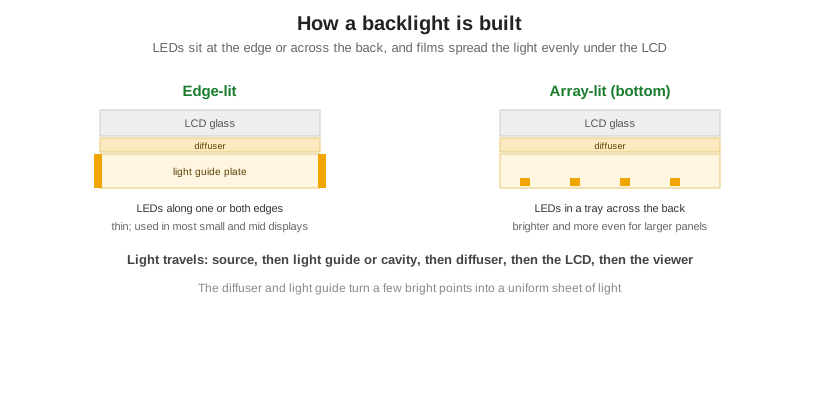
A backlight is a small optical stack, not just a lamp. LEDs sit either along the edges of a light guide plate or in a tray across the back, and a diffuser above them turns a few bright points into an even sheet of light before it reaches the LCD. Edge lighting keeps the module thin and suits small and mid displays. Array lighting from the back is brighter and more uniform for larger panels. The order the light travels is always the same: source, then light guide or cavity, then diffuser, then the LCD, then the viewer.
Getting more brightness from the same light: BEF and DBEF
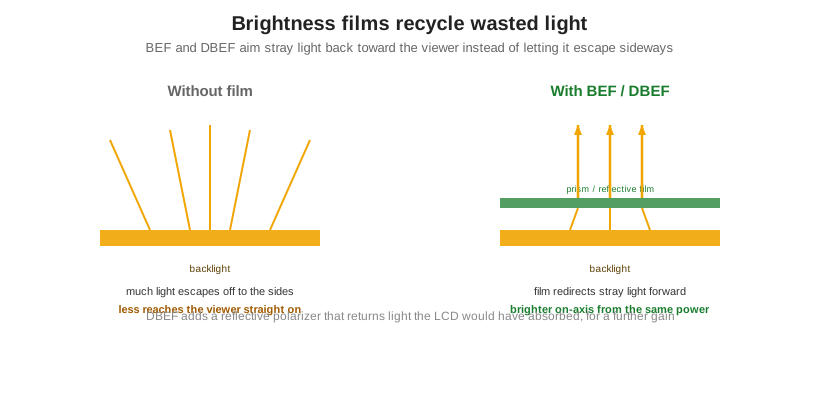
Much of a raw backlight’s output escapes off to the sides and never reaches a viewer looking straight on. Brightness enhancement film (BEF) is a prism layer that redirects that stray light forward, so the display looks brighter on-axis from the same power. Dual brightness enhancement film (DBEF) adds a reflective polarizer that recycles light the LCD would otherwise absorb, for a further gain. These films let a design hit a target brightness with fewer LEDs or less current, which saves power and heat. They are a standard part of the backlight stack, not an add-on.
Choosing a backlight for your product
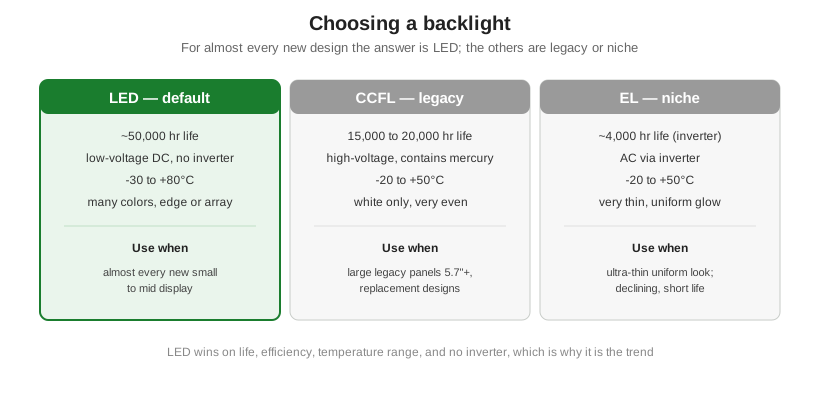
Start with LED and only move off it for a specific reason. LED wins on life, efficiency, temperature range, and the fact that it needs no inverter, which is why it is the industry trend. CCFL still appears in large legacy panels and replacement designs where an existing lamp fixture has to be matched. EL earns a place only when an ultra-thin, perfectly uniform glow matters more than service life. Brightness, size, power source, and operating temperature are the variables that push you off the LED default.
Backlights are almost always custom-matched to the display, the light guide, and the diffuser rather than bought off the shelf. Orient Display designs the LED, light guide, and diffuser stack, including super-thin and high-brightness variants, from concept to production. To scope a backlight for a specific display, start a custom project or see our custom backlight capability.