
What Is E-Paper and How Electronic Paper Displays Work
E-Paper (electronic paper, or an electrophoretic display) is a reflective, bistable screen that forms an image by moving tiny charged pigment particles. It draws power only to change the image, not to hold it, and it reads like ink on paper in direct sunlight. That makes it the lowest-power display technology, and the wrong choice for anything that moves.
Part of the Display Technologies knowledge hub.
Two traits define E-Paper, and everything else follows from them. It is reflective: unlike an LCD, which lights every pixel from a backlight, E-Paper makes no light of its own and instead bounces the ambient light in the room, the way paper does, so there is no backlight to power and no glare-and-blue-light fatigue. And it is bistable: once an image is written, it stays on screen with no power at all until you change it. Those two traits are why an E-Paper tag can run for months on a coin cell and stay readable in full sun, and also why it cannot show video.
How E-Paper works
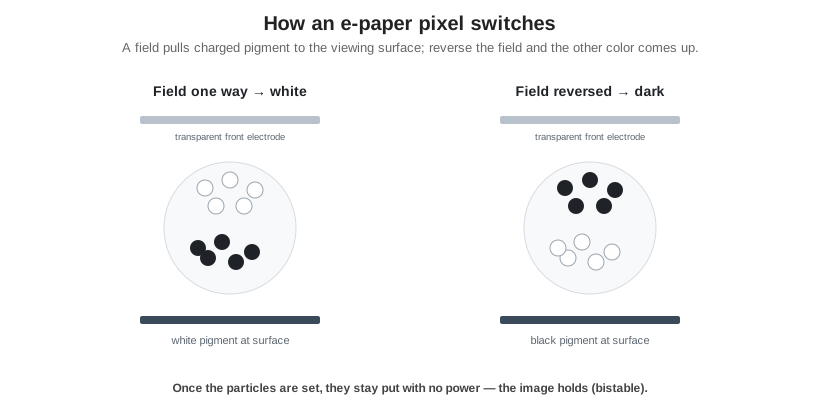
Most E-Paper is an electrophoretic display, which simply means it forms images by moving charged particles through a fluid under an electric field. The ink is a layer of microcapsules, each about the width of a human hair, sitting between a transparent front electrode and a rear electrode. Inside every capsule are charged white and black pigment particles suspended in a clear fluid. Apply a field one way and the white particles are pulled to the viewing surface, so that spot looks white; reverse the field and the black particles come up, so it looks dark. Carefully shaped voltage patterns, called waveforms, produce the gray levels in between.
The key is what happens after the field is removed: short-range surface forces hold the particles where they landed, so the image simply stays put, drawing no current. That is bistability, and it is the whole reason E-Paper sips power. It also explains the technology’s one unavoidable weakness. Rearranging pigment through a fluid takes time, so a refresh runs from a fraction of a second to several seconds, often with a brief flash as the panel clears, which is fine for a page of text and impossible for motion.
Reflective and bistable: the tradeoffs
Because E-Paper reflects ambient light instead of emitting its own, it behaves like printed paper. It gets more readable as the light gets brighter, which is the opposite of an emissive screen that washes out in sun, and it produces no blue light or flicker. The cost of being reflective is that it needs light to be seen (an optional front light solves this in the dark) and its color is muted next to a backlit or emissive display. For how that front light is built and guided across the panel, see e-paper front-light modules.
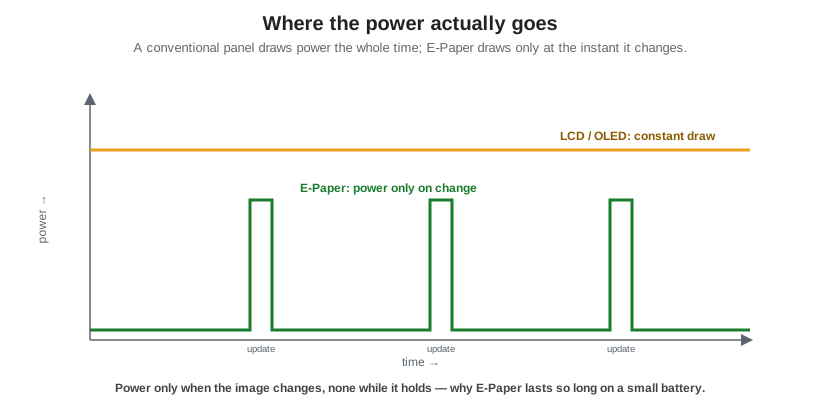
Bistability is the bigger story. A conventional display refreshes dozens of times per second whether the content changes or not, spending power the entire time. E-Paper spends power only at the moment of an update and nothing in between, so a device that changes its screen a few times a day can run for months on a small battery, or even on harvested energy. The trade is speed: slow refresh, a visible clearing flash on full updates, and some ghosting of the previous image if refreshes are not managed. E-Paper is built for static and slowly changing content, not for interfaces that move.
E-Paper against the neighbors
Reflective and bistable only matter relative to something else. The table below lines E-Paper up against the two technologies it gets compared to most, on the axes that actually decide a design.
| Attribute | E-Paper | TFT LCD | OLED |
|---|---|---|---|
| Power to hold a static image | Near zero | Continuous; backlight stays on | Low but nonzero; pixels stay lit |
| Sunlight readability | Excellent; reflects ambient light | Needs a bright backlight or optical bonding | Fair; can wash out |
| Refresh speed | Fraction of a second to several seconds | Fast; full video | Very fast |
| Typical color | Mono to full, muted | Full, vivid | Full, vivid |
Where E-Paper fits, and where it does not
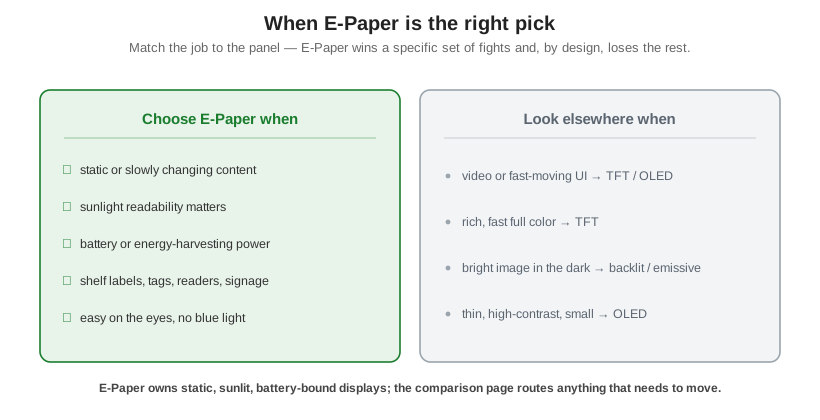
E-Paper wins wherever content is static or changes slowly, power is scarce, and sunlight readability matters. That describes a lot of real products: electronic shelf labels, e-readers, name badges and meeting-room signs, meters and instrument readouts, logistics and asset tags, and battery or energy-harvesting IoT nodes. Color options are expanding from black-and-white to spot color and full color, covered in E-Paper color and types, though color refreshes are slower still. The limits are the flip side of the strengths: slow refresh and clearing flash, ghosting if unmanaged, muted color, and sensitivity to temperature. Ask for motion, rich fast color, or a bright image in the dark without a front light, and another technology is the honest answer. For one application in depth, see how e-ink digital art frames evolved with color e-paper.
“E-Paper” vs “E Ink”: which term to use
The two names get used interchangeably, but they are not the same thing. E-Paper is the general, vendor-neutral category of reflective, bistable displays described on this page. E Ink is the brand of E Ink Corporation, the company that pioneered the microcapsule electrophoretic ink most e-paper products use, and it dominated the category so completely that its name became everyday shorthand for e-paper itself, the same path Xerox and Velcro took from brand to generic term. The shorthand is convenient, but it blurs a real distinction: the category is bigger than any one supplier, and other electrophoretic implementations exist. When you are speccing a part, use “e-paper” or “EPD” (electrophoretic display) in datasheets and requirements, and reserve “E Ink” for when that specific supplier’s ink is actually what you mean.
For E-Paper against the other families in one view, see the display technology comparison.
Orient Display supplies E-Paper modules for low-power and sunlight-readable designs, backed by US-based engineering from datasheet to production. Start a custom project and we will help you match the panel, refresh scheme, and power budget to how your product runs.