

OLED Displays: PMOLED vs AMOLED
An OLED display is an emissive screen whose pixels make their own light from organic material, with no backlight at all. The two kinds, PMOLED and AMOLED, differ in how their pixels are driven, and that single difference decides size, cost, and where each one is used.
Part of the Display Technologies knowledge hub.
OLED stands for organic light-emitting diode. Unlike an LCD, which filters light from a backlight, an OLED pixel emits its own light when current passes through thin organic layers. Because nothing is lit from behind, an OLED can be very thin, show true blacks (a black pixel is simply switched off), hold color across wide viewing angles, and respond almost instantly. The catch is built into the chemistry: organic emitters age, so lifetime and burn-in are real design factors. OLED comes in two families, split by exactly the same passive-versus-active logic that separates a simple LCD from a driven TFT.
How OLED makes light
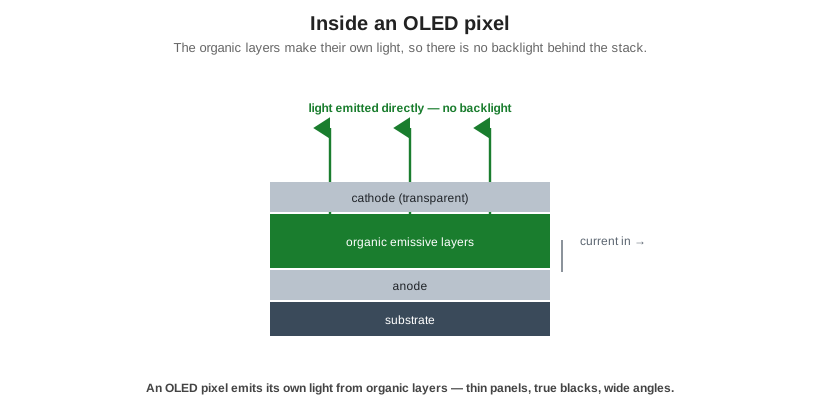
Each OLED pixel is a stack of organic layers between two electrodes, built on a substrate. Apply a voltage and the organic material emits light directly, with red, green, and blue emitters producing color. There is no backlight, no liquid crystal, and no color filter in the classic sense, which is why an OLED panel can be a fraction of the thickness of an equivalent LCD and why its off pixels draw no power and read as genuine black. That self-emitting design is the source of every OLED strength, and its one weakness: because the emitters degrade with use, static content left on screen for long periods can leave a faint permanent shadow, known as burn-in.
PMOLED vs AMOLED
The difference is entirely in how the pixels are driven. A PMOLED (passive-matrix OLED) lights pixels through shared rows and columns, one line at a time, with no storage element at the pixel. An AMOLED (active-matrix OLED) puts a thin-film transistor and a storage capacitor behind every pixel so it holds its state, the same trick a TFT uses.
| Attribute | PMOLED | AMOLED |
|---|---|---|
| Driving | Passive matrix; rows lit sequentially | Active matrix; per-pixel transistor holds state |
| Per-pixel circuit | None | TFT + storage capacitor |
| Typical size | Small, usually under ~3″ | Small to very large |
| Resolution | Low to moderate | Low to very high |
| Power efficiency | Lower; needs high peak brightness per line | Higher |
| Response | Fast | Very fast |
| Relative cost | Low, simple to build | Higher |
| Typical use | Character and small graphic modules, icons, sub-displays | Phones, wearables, larger color panels |
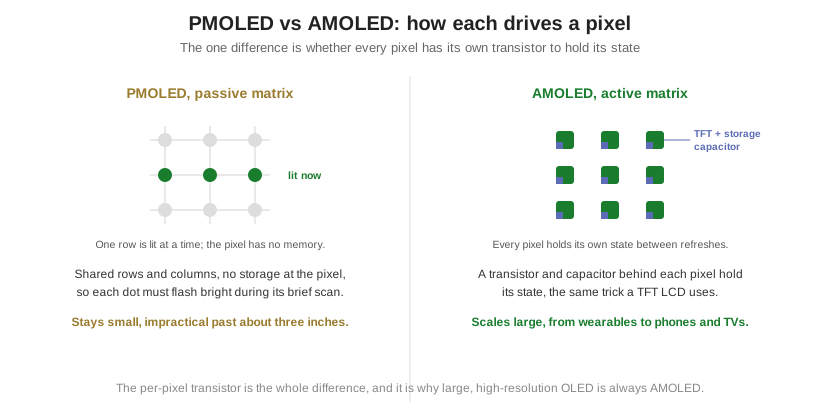
The reason PMOLED stays small comes down to that missing storage: because each pixel is on only briefly as its line is scanned, it must burn brighter during that instant, which raises the voltage and shortens life as the display grows. Past roughly three inches this stops being practical, so large, high-resolution OLED belongs to AMOLED.
At the module scale most embedded products use, OLED almost always means PMOLED: compact character, graphic, and full-color modules that drop onto a board like an LCD. AMOLED is the phone, wearable, and large-panel world, not a module you spec onto a controller.
Where OLED fits, and where it does not
OLED earns its place when the image has to be thin, high in contrast, and readable from any angle at a small size. A crisp white readout on true black, in a slim enclosure, is exactly what OLED does better than an LCD. Three limits set the boundary. Static content left on for long stretches risks burn-in, so OLED is a poor match for a fixed dashboard that never changes. The organic emitters have a finite lifetime, shorter than an LCD backlight in demanding duty cycles. And in direct sunlight an emissive display can wash out, where a reflective technology would win. Weigh those honestly and OLED is a strong, premium choice inside its range.
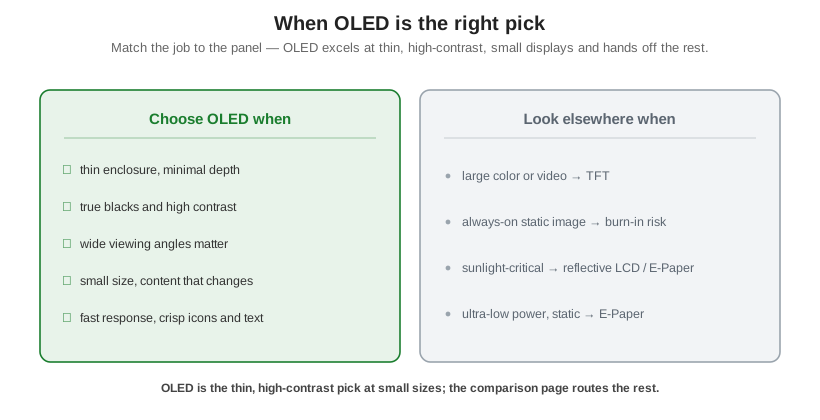
To weigh OLED against the other families in one place, see the display technology comparison.
Orient Display supplies OLED modules, backed by US-based engineering from datasheet to production. Start a custom project and we will help you decide whether an OLED module or an LCD is the better fit for how your product runs.