

TFT Displays
A TFT display is an active-matrix color LCD with a thin-film transistor behind every pixel. That per-pixel switching is what gives TFT its full color, high resolution, and smooth video, and it is why TFT is the default choice for full-color, interactive products.
Part of the Display Technologies knowledge hub.
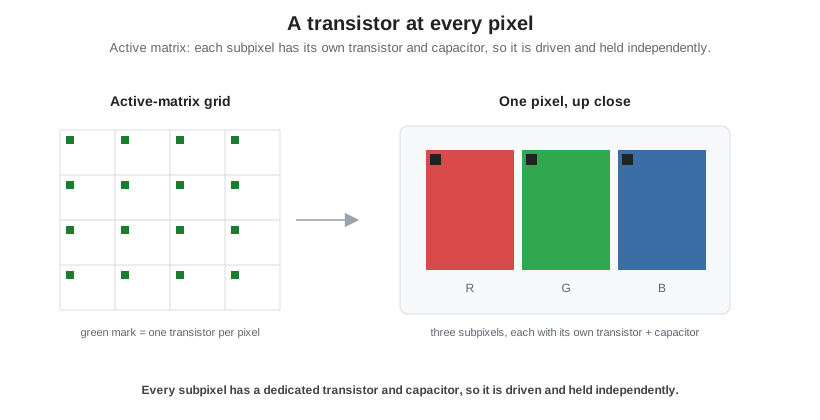
TFT stands for thin-film transistor. A TFT display is still a liquid crystal display, so it works the same fundamental way any LCD does: it switches liquid crystal in front of a backlight to let light through, pixel by pixel. What sets it apart is how those pixels are controlled. Instead of driving them through shared rows and columns, a TFT places a transistor and a small capacitor at every pixel so each one holds its own state. That is what “active matrix” means, and it is the reason TFT can run the millions of pixels a color screen needs without the crosstalk and dimming that hold passive displays back.
How a TFT works: one transistor per pixel
In a passive display, pixels share their wiring, so the controller can only address them a line at a time and each pixel is actually off for most of the frame. That caps how many rows you can drive before contrast falls apart. See how LCDs are driven for the full passive-versus-active picture.
A TFT solves this by giving every subpixel its own thin-film transistor and storage capacitor, fabricated directly on the glass. The transistor switches the subpixel, and the capacitor holds the charge so the subpixel stays set until the next refresh. Because each pixel is driven and held independently, a TFT can support high resolutions, fast refresh, and true video. Color comes from three subpixels per pixel, red, green, and blue, each with its own transistor; varying their levels mixes the full color range. Most TFTs use amorphous-silicon transistors, which keep production cost down.
TFT panel types: TN, IPS, and VA
Not all TFTs behave the same. All three common panel types are active-matrix color LCDs, but they align the liquid crystal differently, and that changes viewing angle, contrast, response speed, and cost. For an embedded product the choice usually comes down to how the display will be viewed and what it has to survive.
| Attribute | TN | IPS | VA |
|---|---|---|---|
| Viewing angle | Narrowest; color and contrast shift off-center (~170/160) | Widest and most stable (~178/178) | Moderate; between TN and IPS |
| Color accuracy | Lowest | Highest and most consistent | Good; better than TN |
| Contrast | Lower | Moderate | Highest; deepest blacks |
| Response / motion | Fastest | Fast; much improved | Slowest; motion blur risk |
| Relative cost | Lowest | Highest | Moderate |
| Typical fit | Cost-sensitive, single-viewer, fast updates | Instruments, medical, multi-viewer HMIs, anything angle- or color-critical | Automotive clusters, high-contrast readouts, video |
In embedded design, IPS is the common upgrade when the operator will not always be head-on, VA earns its place where deep contrast matters, and TN stays where budget and speed lead.
Color, resolution, and sunlight readability
Color depth sets how many shades a TFT can show. A 6-bit panel with dithering reaches roughly 262,000 colors; an 8-bit panel reaches about 16.7 million. Resolution is the pixel count, and pixel density drives how sharp text and fine graphics look at a given size. For deeper color background, see how LCDs produce color.
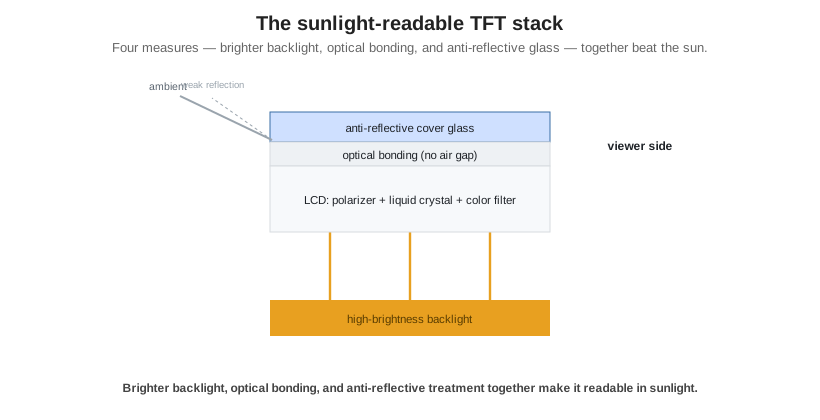
Sunlight readability is the specification that trips up outdoor and industrial designs. A standard TFT washes out in direct sun because reflected ambient light overwhelms the backlight. Four measures fix it, often combined: a high-brightness backlight to outshine the ambient light, transflective construction that also reflects some ambient light to help the image, optical bonding that removes the air gap behind the cover glass to cut internal reflections, and anti-reflective or anti-glare surface treatments. An IPS panel helps too, by holding color steady across the wider angles an outdoor viewer will use.
Where TFT fits, and where it does not
TFT’s strength and its cost come from the same place: the backlight. It buys bright, fast, full color, but it draws power, and without the treatments above it struggles in direct sun. Against the neighbors, TFT scales larger and drives video better than a small OLED, but it is not as thin or as high in contrast; and it uses far more power than E-Paper, which can hold a static image on almost nothing. None of that is a weakness so much as a boundary. When a product needs a rich, moving, full-color interface, TFT is almost always the right tool.
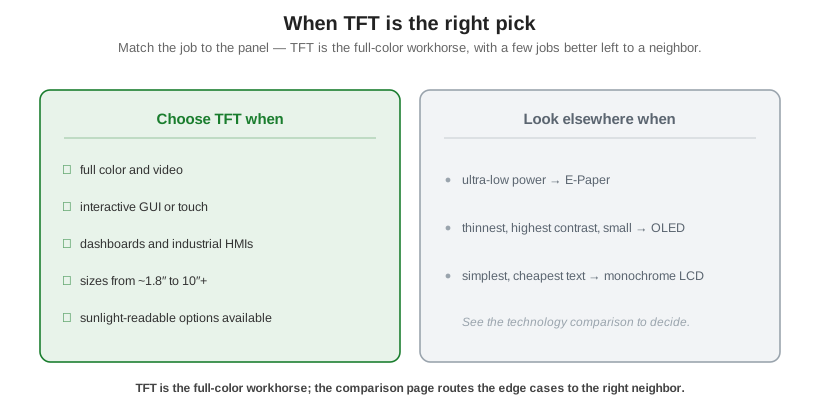
If you are still weighing TFT against the alternatives, the display technology comparison lays out the whole decision.
Orient Display builds TFT modules across standard, IPS, sunlight-readable, and touch configurations, backed by US-based engineering that stays with you from datasheet to production. Start a custom project and we will match the panel type and treatments to how your product will actually be used.