
LCD vs OLED vs E-Paper
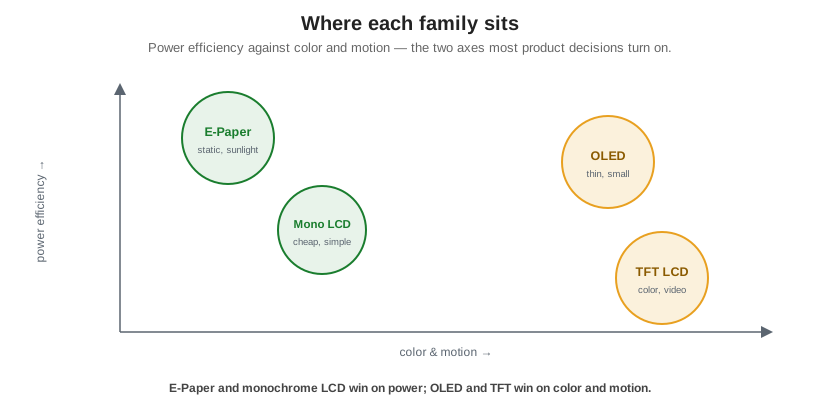
The right display technology follows your first hard constraint. Choose a monochrome LCD for low-cost, low-power text and simple graphics; a TFT LCD for full-color, fast-moving content on a power budget; an OLED for a thin, high-contrast image with wide viewing angles at smaller sizes; and E-Paper for battery-critical, sunlight-readable displays that show static or slowly changing content.
Part of the Display Technologies knowledge hub.
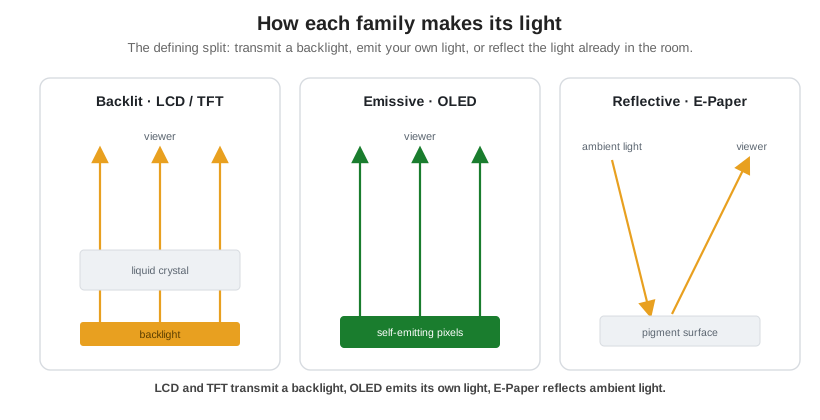
Every one of these technologies turns an electrical signal into a readable image, starting from the same base case: an LCD switching liquid crystal in front of a backlight. What separates them is how they make light, and that single difference drives almost every tradeoff that follows: power draw, sunlight readability, refresh speed, color, and cost. Get the light path right for your product and the rest of the decision falls into place.
How each display makes light
LCD and TFT do not produce light of their own. They sit in front of a backlight and switch liquid crystal to let that light through, pixel by pixel. That backlight costs power, but it also makes these displays bright, fast, and easy to drive. OLED is different: each pixel emits its own light, so there is no backlight at all. That makes OLED thin, high in contrast, and wide in viewing angle, though the organic emitters age over time. E-Paper makes no light at all. It rearranges pigment and reflects the ambient light in the room, the way ink on paper does, so it reads beautifully in sunlight and holds an image with essentially no power, but it cannot move quickly or show video.
The comparison at a glance
The table below lines the four families up against the axes that usually decide a design. Read down your hardest constraint first.
| Attribute | Monochrome LCD | TFT LCD | OLED | E-Paper |
|---|---|---|---|---|
| How it makes light | Backlight through liquid crystal | Backlight through liquid crystal, active matrix | Self-emitting pixels, no backlight | Reflects ambient light, no backlight |
| Color | Monochrome or limited | Full color | Full color; at module scale often monochrome or area color | Monochrome, spot color, or limited full color |
| Sunlight readability | Good in reflective or transflective builds | Needs high brightness or optical bonding | Fair; can wash out | Excellent |
| Power draw | Very low | Moderate to high (backlight) | Low to moderate, content-dependent | Near zero to hold an image |
| Refresh and motion | Slow, simple content | Fast, full video | Very fast | Very slow, not for motion |
| Typical module sizes | Small to medium | ~1.8″ to 10″+ | Small, PMOLED typically under ~3″ | ~1.5″ to large panels |
| Viewing angle | Narrow to moderate | Moderate to wide (IPS) | Very wide | Very wide |
| Relative cost | Lowest | Moderate | Higher | Moderate to higher |
| Lifetime notes | Long and stable | Long | Burn-in risk on static content | Long; image persists unpowered |
A fifth technology, VFD (vacuum fluorescent display), is emissive and known for bright output and a wide operating-temperature range, which keeps it in some industrial and automotive equipment. It is included here for completeness of the landscape.
The four technologies, and where each wins
Monochrome LCD
Passive TN and STN LCDs drive segments, characters, and simple graphics. They sip power, cost the least, and in reflective or transflective builds they read in direct sunlight with no backlight at all. The tradeoff is what they cannot do: no rich color, no video, slower response, and narrower viewing angles. When the job is a meter, a control panel, a thermostat, or a wearable that shows text and icons on a tight budget, a monochrome LCD is usually the honest answer.
TFT LCD
A TFT is an active-matrix color LCD, with a thin-film transistor behind every pixel. That gives full color, high resolution, fast refresh, and true video, which is why TFT dominates dashboards, handhelds, medical devices, and industrial HMIs. The cost is the backlight it depends on: more power, and washout in direct sun unless you specify high brightness or optical bonding. For most full-color, interactive products, TFT is the workhorse. See what a TFT display is for the panel types and how to spec one.
OLED
OLED pixels emit their own light, so the display is thin, extremely high in contrast, and readable from almost any angle, with black pixels that are simply off. At the module scale most products use, OLED means small monochrome and area-color displays, since large full-color panels belong to the phone and TV world. Two real limits temper it: burn-in when static content sits on screen for long periods, and higher cost than an equivalent LCD. For a slim, premium, high-contrast readout at a small size, OLED is hard to beat. The PMOLED vs AMOLED distinction explains which OLED you are actually buying.
E-Paper
E-Paper, or electronic paper, is bistable: once an image is written, it holds with essentially no power until the content changes. It reflects ambient light, so it is superb in sunlight and easy on the eyes, and it is the lowest-power display technology available. The catch is speed. Refresh takes from a fraction of a second to several seconds, so E-Paper is wrong for anything that moves, and color options are still limited compared with an LCD. For shelf labels, name badges, meters, and battery or energy-harvesting devices that update occasionally, nothing else comes close. Start with how E-Paper works and E-Paper color and types.
How to choose, by your first constraint
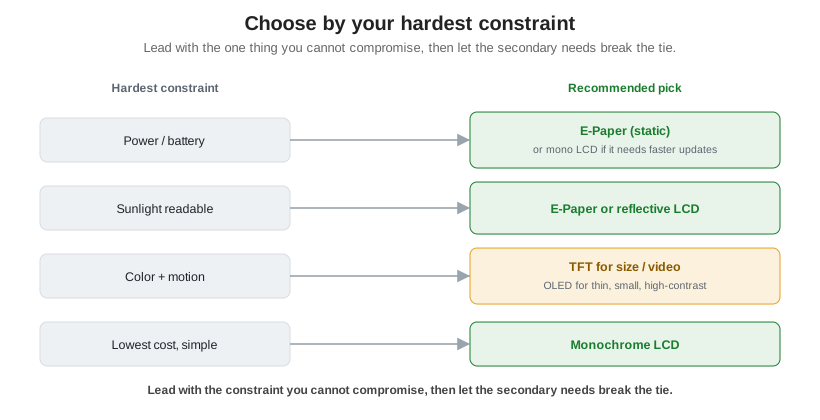
Pick the one requirement you cannot compromise, then let the rest break the tie:
Power is everything. For static or slowly changing content, E-Paper holds its image on almost no power. If you need faster updates but still care about battery life, a monochrome LCD is the low-power fallback.
It has to read in sunlight. E-Paper is the strongest, followed by a reflective or transflective monochrome LCD, or a high-brightness TFT with optical bonding if you also need color.
Full color and motion. TFT for larger sizes and video; OLED when you want the thinnest, highest-contrast, widest-angle image at a smaller size and can accept the cost.
Lowest cost for simple content. A monochrome LCD, almost every time.
Most real designs are a blend, and the honest answer often depends on details a datasheet will not settle. That is the point at which it helps to talk to an engineer who builds all four.
Orient Display supplies monochrome LCD, TFT, OLED, and E-Paper as modules, backed by US-based engineering and non-China sourcing tiers, so the technology you choose is not limited to one supplier’s catalog. Start a custom project and we will help you match the display to the constraint that matters most.