

Blog
The Evolution of Curved Touch Screens in Automotive Cockpits: From Aesthetics to True Flexibility

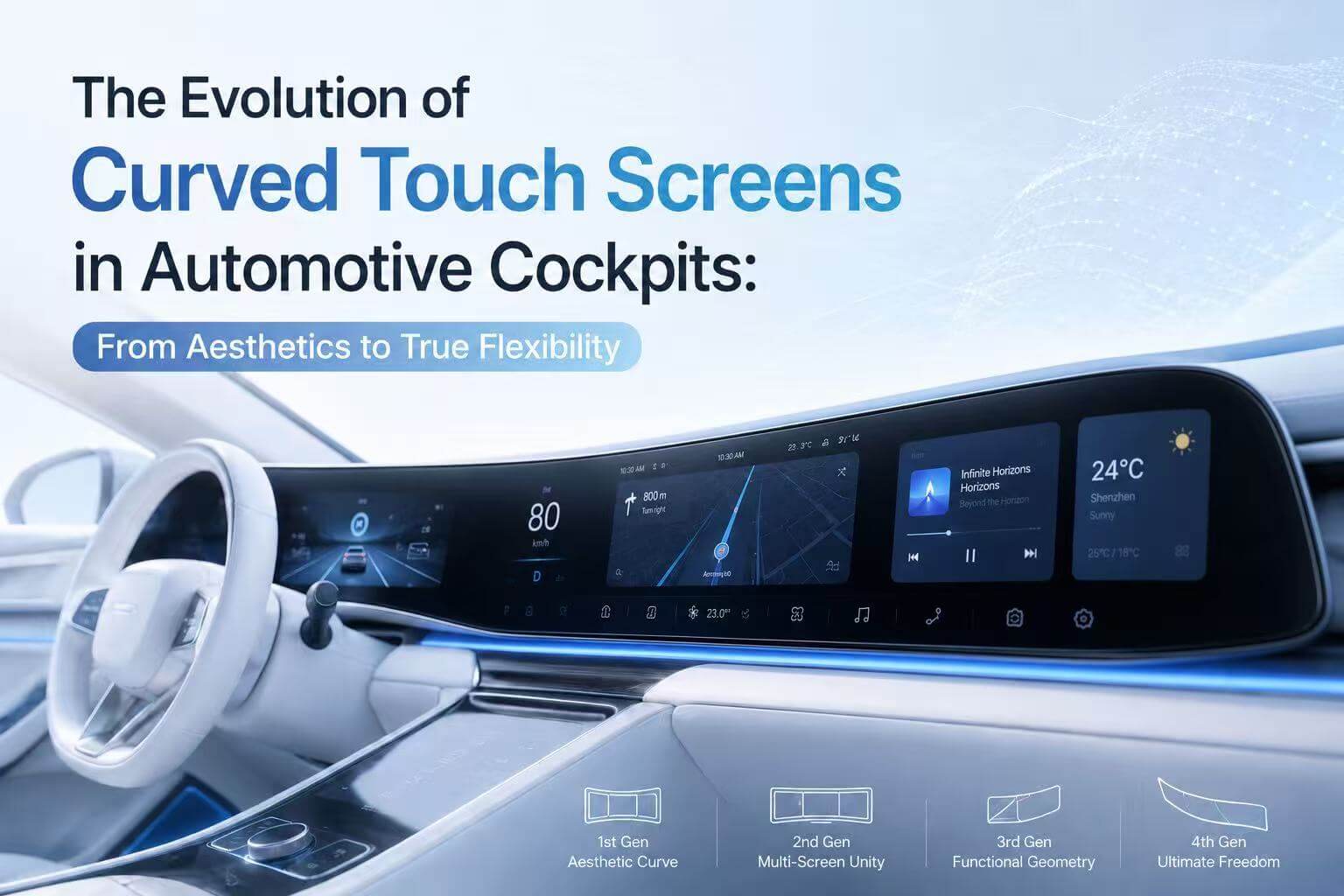
The modern automotive cockpit is undergoing a massive design shift. Gone are the days of rigid, flat, rectangular screens slapped onto the center console. Today, tiers and OEMs are treating the dashboard as a continuous, flowing canvas.
Designing a Curved Touch Screen introduces unique optical, mechanical, and manufacturing complexities that don’t exist with flat glass. Understanding how these screens are built—and where the technology is heading—is crucial for display engineers, product managers, and industrial designers alike.
Let’s break down the four distinct generations of curved touch screen technology, evaluating the mechanical engineering, bonding constraints, and material science behind each.
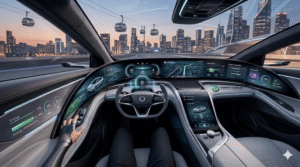
The 4 Generations of Curved Touch Screen Technology
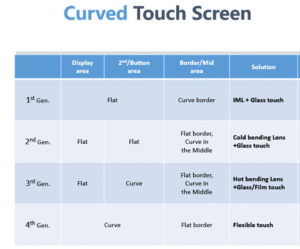
1st Gen: The “Aesthetic” Curve (IML + Flat Glass Touch)
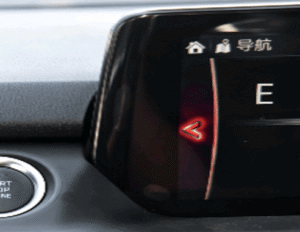
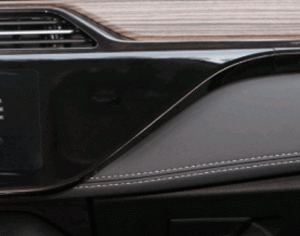
In the early days of curved automotive interiors, the display technology wasn’t curved. The active display area and button area remained completely flat.
Instead, the curvature was restricted entirely to the border/mid area using In-Mold Labeling (IML) or injection-molded plastic trim. A flat glass touch panel was embedded inside a curved housing. While this achieved a fluid look on the dashboard, it lacked seamless integration; the distinct boundary between the flat screen and the curved plastic frame remained highly visible.
2nd Gen: The Multi-Screen Unity (Cold Bending Lens + Glass Touch)
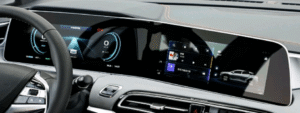
To achieve a premium, single piece look without a massive price tag, the industry developed Cold Bending. This is currently the dominant technology for large, integrated dual or triple-screen setups (the “pillar-to-pillar” display).
- The Architecture: The underlying LCD display panels and touch sensors are flat, but they are covered by a single, large sheet of protective glass that is curved in the middle or at the borders.
- The Process: Glass is chemically strengthened while perfectly flat. During final assembly, it is mechanically forced into a curved bezel frame at room temperature.
- Engineering Advantage: Because the glass isn’t heated, it retains pristine optical quality, suffers no thermal distortion, and keeps manufacturing costs relatively low. However, it is strictly limited to shallow, gentle 2D cylindrical bends because the glass remains under constant internal mechanical stress.
3rd Gen: Functional Geometry (Hot Bending Lens + Glass/Film Touch)
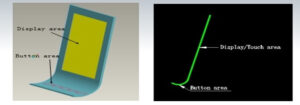
When a design demands aggressive curves, or a complex 3D shape—cold bending fails, which is Hot Bending.
- The Architecture: The primary display area remains flat (to accommodate rigid LCDs), but the button/control area transitions into a steep curve, forming a waterfall screen or an L-shaped console.
- The Process: Flat glass is placed over a precise graphite mold and heated to its softening point (around 600°C–700°C). Gravity or pressure shapes the glass to the mold. Crucially, chemical strengthening must happen after this thermal process, otherwise, the heat destroys the tempering layer.
- The Challenge: Because the touch area now wraps around a tight radius, traditional rigid Glass-on-Glass (GG) touch sensors can crack. Engineers must transition to Film-based touch sensors (Metal Mesh or AgNW on PET) that can flex to conform to the inner curvature of the hot-bent lens.
4th Gen: Ultimate Freedom (True Flexible Touch & Display)
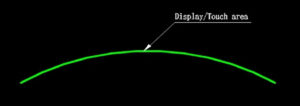
The cutting edge of cockpit design abandons flat internal components altogether. In the 4th generation, both the display area and the touch sensor are natively curved.
- The Architecture: The screen seamlessly flows along the contours of the dashboard, fitting curved instrument clusters or wrapping around the driver in a semi-enclosed cockpit.
- The Technology: This relies on Flexible OLED substrates paired with CPI (Colorless Polyimide) or ultra-thin flexible touch sensors.
- Performance Metrics: These assemblies utilize sensors engineered to withstand tight bending radius, and endure over 200,000 bending cycles, offering massive design freedom while maintaining high reliability in harsh environments (operating from -40C up to 95C).
Key Engineering Challenges in Curved Display Design
Whether implementing a Gen 2 cold-bent system or a Gen 3 hot-bent module, front-end design requires balancing several physical trade-offs:
-
Bonding Methodology: OCA vs. OCR
Connecting a curved cover lens to the display panel is a major yield-rate variable.
- OCA (Optically Clear Adhesive) Tape: Standard flat OCA films tend to struggle on curved surfaces. The internal rebound stress of the bent glass causes the tape to pull away at the edges, leading to delamination and bubbles over time.
- OCR/LOCA (Optically Clear Resin / Liquid Glue): Liquid bonding is highly preferred for curved geometries. The liquid flows naturally to fill the uneven tolerances and gaps created by the curve. However, it requires highly specialized fixture tooling to prevent overflow and ensure a completely uniform bond-line thickness across the bend.
-
Optical Distortion and Reflection Management
Curved surfaces inherently behave like lenses. As the radius of curvature sharpens, light traveling from the flat display through the curved glass bends, causing visual distortion, ghosting, or color shifts at wide viewing angles.
Furthermore, while flat glass reflects ambient light in one predictable direction, a curved surface captures and concentrates glare from multiple angles. Specifying high-performance Anti-Reflective (AR) and Anti-Glare (AG) coatings is mandatory. However, depositing these coatings uniformly across a steep 3D curved surface without pooling or thinning at the apex is a major manufacturing hurdle.
-
Dimensional Tolerance Stack-up
Thermal bending introduces minor batch-to-batch variations in the exact radius of curvature. If the inner radius of your cover glass doesn’t perfectly match the profile of the display or mounting bracket, it creates uneven pressure points. In production, this can cause localized pooling of liquid glue, leading to visual artifacts on the display (the Mura effect) or, worse, causing the display panel to crack under mechanical stress.
Conclusion
The evolution of the curved touch screen is a journey of removing mechanical constraints from user experience design. While Gen 2 cold bending offers an excellent middle ground for cost-effective, wide screen setups today, the future belongs to Gen 4 flexible architectures.
As material science advances in flexible substrates and high-reliability liquid optical bonding, the dashboard will transition from a place where displays are mounted, to a surface that is entirely a display.

If you have questions or would like to explore your next design, please contact our engineering.
