

Blog
Working Principles and Structure of TFT LCD Backlight

What is a backlight
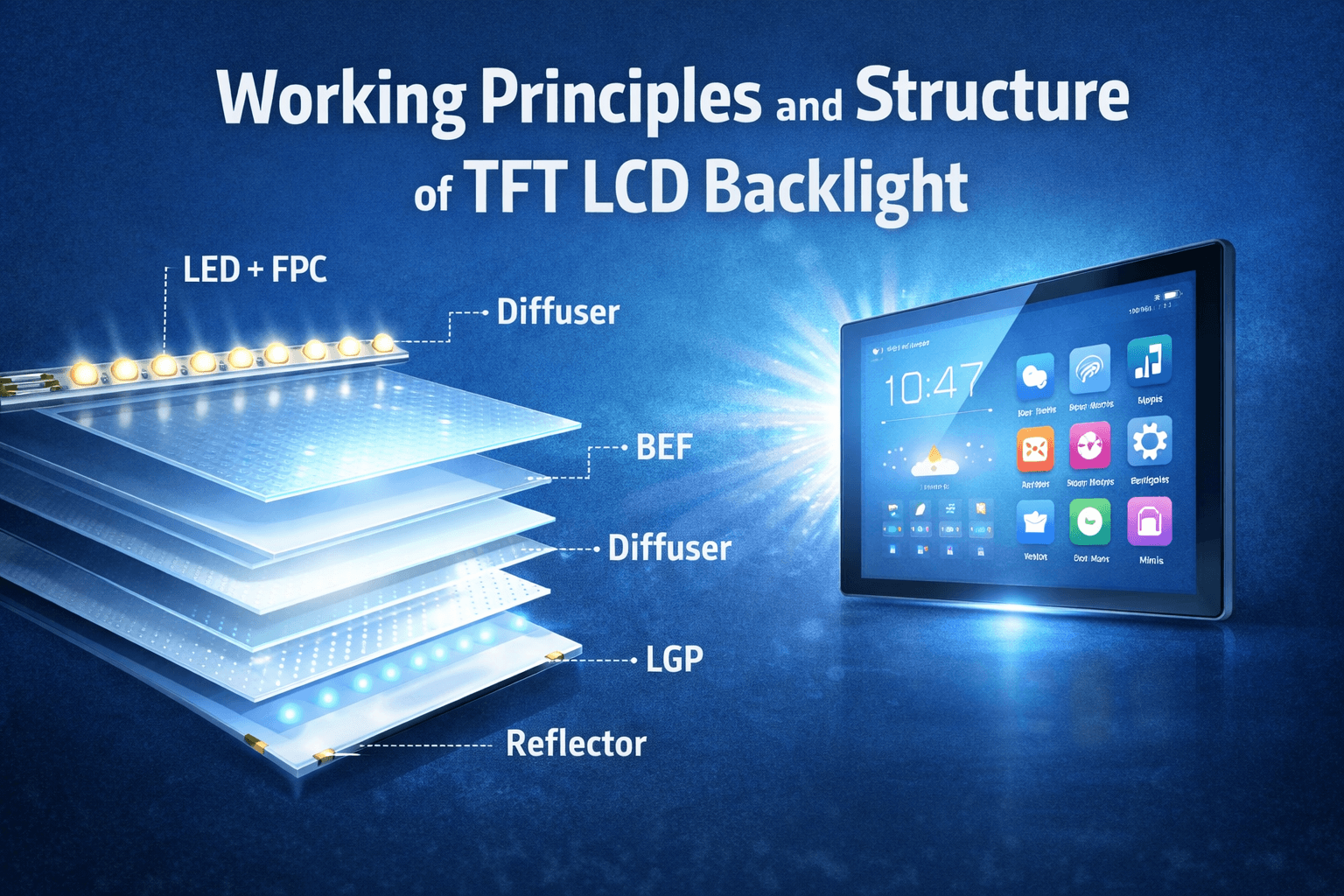
LCDs themselves do not emit light, so they require an external planar light source system to enable image display. This system is called a backlight (Backlight).
Types of backlights
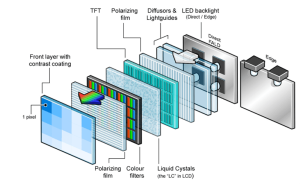
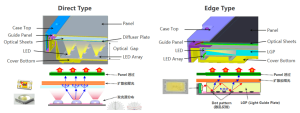
Based on the light emission method, backlights can be divided into direct-lit (direct-type) and edge-lit (side-lit) types. Among them, edge-lit backlights are widely used in small- and medium-sized applications, such as mobile phones, tablets, and computers.
Working principle
The working principle of a backlight is to convert a point light source into a uniform surface (area) light source, providing the external illumination required for LCD display.
Composition of an edge-lit backlight
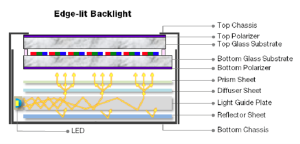
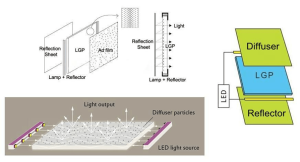
An edge-lit backlight mainly consists of a light bar (LED + FPC), light guide plate (LGP), reflector sheet (R), diffuser film (D), and brightness enhancement film (prism film, BEF), among other components.
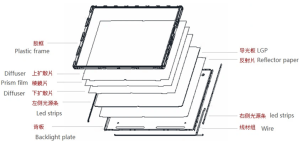
1. LED (Light Emitting Diode)
An LED is the light source of the backlight module. Together with the FPC, it forms what is commonly referred to as the light bar (Light Bar).
The light-emission principle of an LED is as follows:
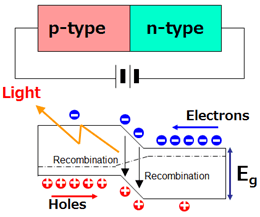
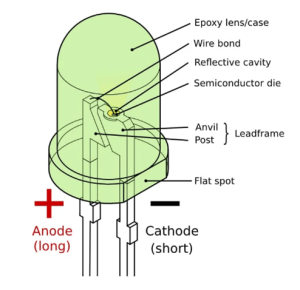 An LED emits light through electroluminescence. When a forward voltage is applied, electrons and holes recombine in the PN junction, releasing energy in the form of photons, thereby producing visible light.
2. Light Guide Plate (LGP)
A linear light source array composed of LEDs injects light into the light guide plate from one side. The light propagates inside the LGP and strikes the micro-dot patterns on the plate, where scattering occurs. As a result, the light exits from the surface of the LGP without dot patterns, forming a uniform surface light source.
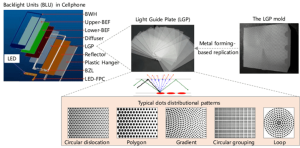
3. Reflector
The reflector reflects the light that leaks from the bottom of the LGP back into the light guide plate for reuse, thereby increasing light utilization efficiency.
4. Diffuser
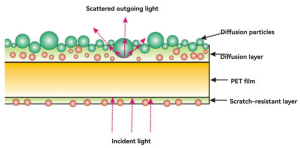
The diffuser uniformizes the light passing through it by refraction and scattering caused by acrylic beads, rough surfaces, or diffusing particles within the film. This process effectively evens out the light distribution and helps mask luminance non-uniformities and defects.
5. Brightness Enhancement Film (BEF)
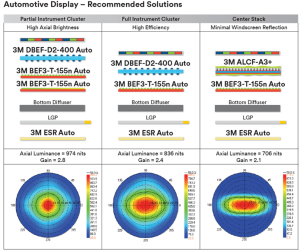
BEF, also known as a prism film, has a light-concentrating function that increases display brightness. As shown below, among the three commonly used film-stack configurations, the high-brightness solution is clearly 2 BEF + 1 DBEF. BEF works by using micro-prism structures to redirect scattered light into the viewing direction, thereby improving on-axis luminance. DBEF (Dual Brightness Enhancement Film) further enhances efficiency by recycling polarized light, resulting in a noticeable brightness gain when combined with BEF.
6. Dimming methods
There are two mainstream backlight dimming methods: DC dimming and PWM dimming. In addition to these, MIX dimming is also a commonly used dimming mode today.
If you have any questions, please contact our engineering.
For more information about backlight, please visit our Knowledge Base.