
Blog
Dragontrail Cover Glass Supply Risk & Transition Plan

Background
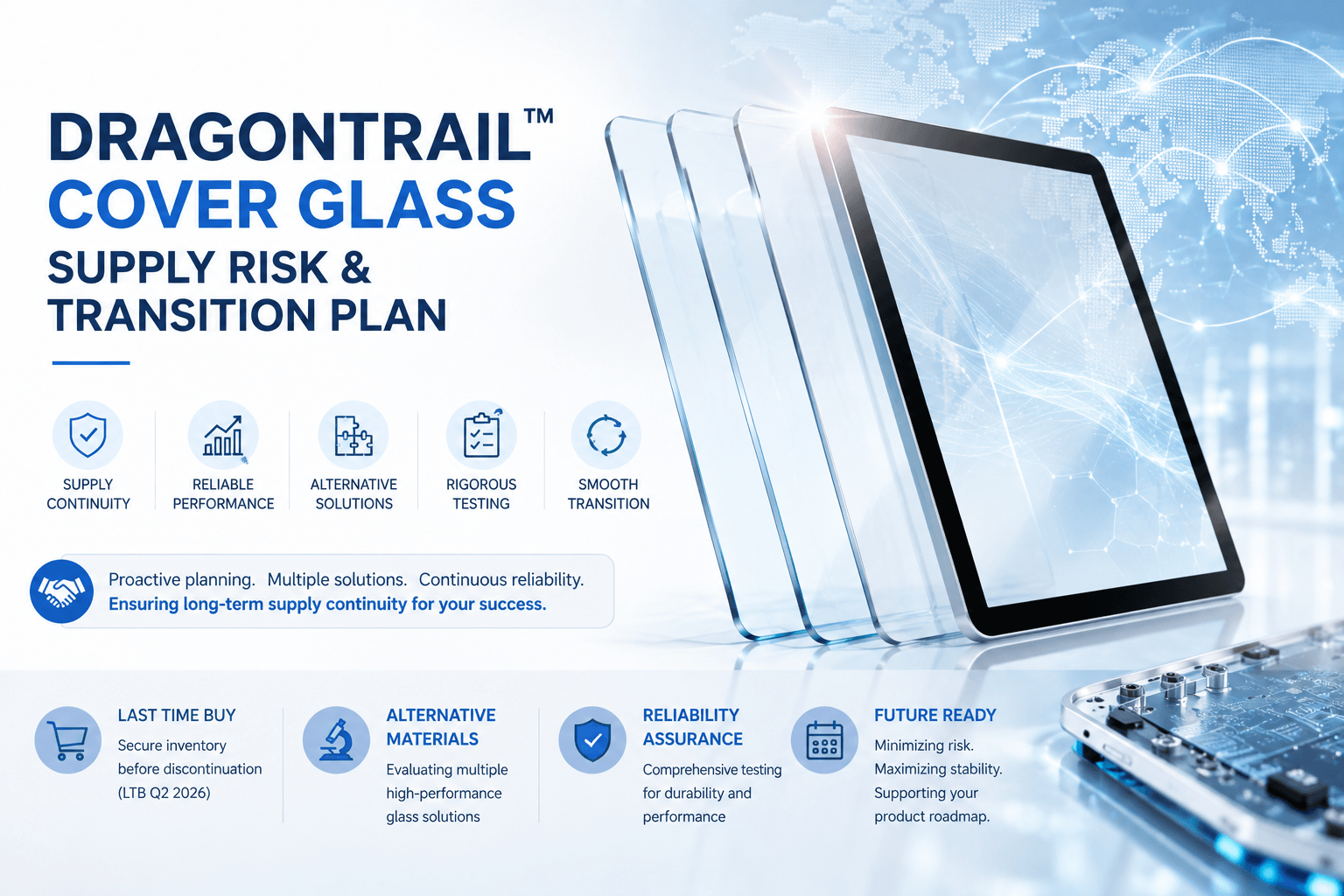
Dragontrail cover glass supplied by AGC Inc. is expected to be discontinued starting in Q3 this year, with LTB 2026 Q2.
This material is currently used as the cover glass for touch panel assemblies in several programs. To ensure supply continuity and minimize disruption, a mitigation and transition plan has been initiated.
Key Timeline
| Milestone | Estimated Timing |
| Supplier discontinuation announcement | Q3 |
| Last Time Buy (LTB) window | Q2 (Apr–May) |
| Safety stock preparation | Q2 |
| Alternative material validation | Q2–Q3 |
| Potential transition window | TBD after validation |
Supply Risk Mitigation Strategy
Safety Stock Preparation
To protect ongoing and future production programs, we plan to secure safety stock of Dragontrail glass depends on project demand.
Benefits include:
- Avoiding short-term supply interruptions
- Preventing unnecessary design changes during active product cycles
- Minimizing the risk of immediate PCN (Product Change Notification) after product launch
Customer support is requested to provide:
- EAU (Estimated Annual Usage)
- Product lifecycle forecast (next 2–3 years)
This information will allow accurate material planning for the LTB order.
Alternative Glass Solutions
To reduce long-term supply risk, alternative chemically strengthened glass materials are being evaluated:
- Aluminosilicate glass
Both Gorilla Glass and Panda Glass are mature industry solutions with strong mechanical performance.
- Low-Iron Soda-Lime Glass with High Optical Transmittance
Low-iron soda-lime glass is a type of float glass with significantly reduced iron content compared to standard soda-lime glass. By lowering Fe₂O₃ concentration, the characteristic green tint in conventional glass is minimized, resulting in improved transparency and higher optical transmittance.
With light transmittance typically exceeding 91%, low-iron soda-lime glass is widely used in applications where visual performance is critical, including: Display cover lenses, Touch panels, Photovoltaic panels, Architectural glazing, Optical components.
In addition to superior transparency, low-iron soda-lime glass provides with good chemical stability, excellent surface flatness, and compatibility with common surface treatments such as anti-reflective (AR), anti-glare (AG), and anti-fingerprint (AF) coatings.
These characteristics make it an ideal material for modern electronic displays and optical systems, balancing clarity, reliability, and cost efficiency.
| Item | Dragontrail | Gorilla Glass | Panda Glass | Low-Iron Soda-Lime
Glass |
| Supplier | AGC Inc. | Corning | Chinese glass manufacturer | AGC, NSG, Guardian, Saint-Gobain, Chinese suppliers(CSG, Kibing, Xinyi) |
| Base Material | Aluminosilicate | Aluminosilicate | Aluminosilicate | Low-iron soda-lime-silica glass |
| Strengthening process | Ion-exchange | Ion-exchange | Ion-exchange | Thermal tempering or chemical strengthening |
| Surface hardness | ~7H–9H | ~7H–9H | ~7H–8H | ~6H – 7H |
| Light transmittance | ~91–92% | ~91–92% | ~90–91% | ~90–92% |
| Surface Compression Stress (CS) | ~800–900 MPa | ~800–900 MPa | ~700–850 MPa |
~400–700 MPa |
| Depth of Layer (DOL) | ~35–50 μm | ~40–60 μm | ~30–50 μm | ~10–40 µm |
| Dielectric properties | Baseline | Similar | Slightly different – RF verification recommended | Similar |
| Cost level | Medium | Higher | Lower | Lower |
| Supply availability | Discontinuing Q3 | Stable global supply | Stable regional supply | Multiple global suppliers |
Reliability Test Requirements and Technical Considerations
The product may need to pass some durability and reliability tests (acceptance criteria: no glass breakage). Following are some test examples depends on different application:
- Terminal Drop Test – eg: 1.0 m drop, granite surface, 6 sides + 4 corners
- Mohs Hardness Test – eg: >6H (preferred up to 9H)
- Steel Ball Impact Test – eg: 173 g ball, minimum 4 inch drop height
- Continuous Vertical Force Test – eg: 40 lbs force, 30 seconds
- Coating Verification(AF/AR/AG etc.)
Some tests require system-level validation with the finished device.
- Finished product drop testing
- Mechanical integration verification
- RF / wireless signal performance testing
Because different glass materials have slightly different dielectric properties, wireless communication performance shall be considered.
Next Steps
- Secure Dragontrail LTB inventory
- Continue alternative material validation
- Coordinate system-level testing if material transition is required
Our goal is to ensure stable supply, maintained product reliability, and minimal disruption to customer programs.
If you have any questions, please contact our engineering.
