

Blog
Understanding a-Si, IGZO, LTPS, and LTPO Display Technologies

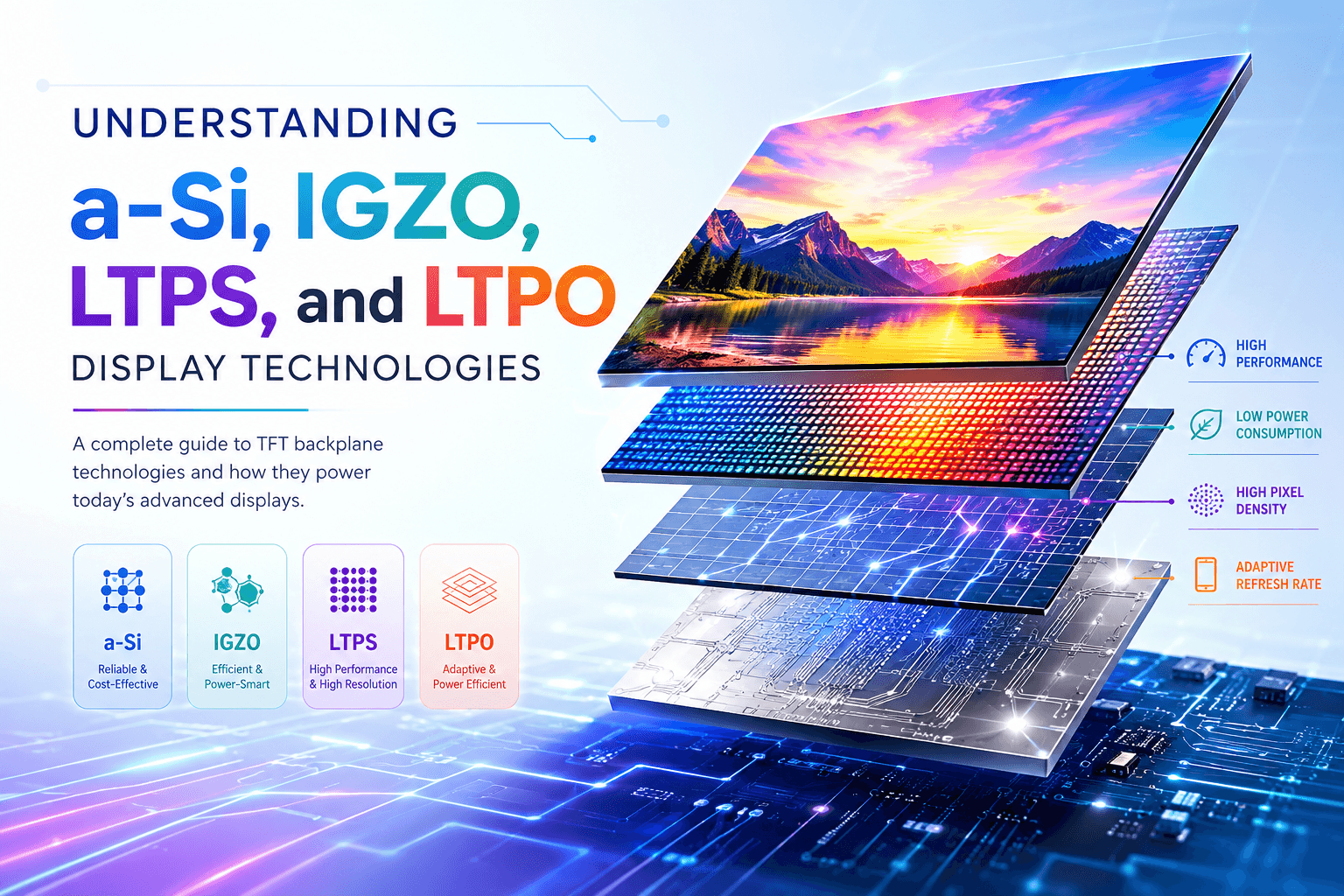
As display technology continues to evolve, consumers are increasingly seeing terms like a-Si, IGZO, LTPS, and LTPO in product specifications. While these names are often associated with LCD or OLED displays, they do not describe the display panel itself. Instead, they refer to the thin-film transistor (TFT) backplane technology that controls every individual pixel.
The TFT backplane plays a critical role in determining display performance, including resolution, refresh rate, power consumption, brightness stability, and manufacturing cost.
This article explains how these four technologies work, compares their strengths and weaknesses, and discusses where each is best suited.
1. The Role of the TFT Backplane
A simplified display structure consists of:
- Backlight (for LCD)
- TFT Backplane
- Liquid Crystal Layer (LCD only)
- Color Filter
- Polarizers
For OLED displays, the backlight is eliminated, but the TFT backplane remains essential because each OLED pixel must be individually driven.
The TFT backplane acts like millions of tiny switches that control each pixel. Different TFT technologies determine how efficiently and accurately those pixels can be driven.
2. Evolution of TFT Technologies
The development of TFT technologies generally follows this path:
a-Si
├────────► IGZO
└────────► LTPS
│
▼
LTPO
Each new generation improves performance while introducing additional manufacturing complexity and cost.
3. a-Si (Amorphous Silicon)
Overview
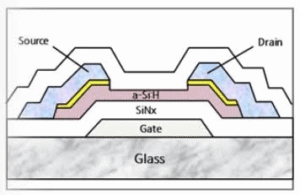
Amorphous Silicon (a-Si) is the oldest and most widely adopted TFT technology. It has been the industry standard for LCD manufacturing for more than two decades.
Unlike crystalline silicon, amorphous silicon has a disordered atomic structure. As electrons move through the material, they encounter many obstacles, resulting in relatively poor electrical performance.
Typical electron mobility:
0.5–1 cm²/V·s
Advantages
Lowest Manufacturing Cost
a-Si benefits from mature manufacturing processes, high production yields, and relatively inexpensive equipment.
It remains the preferred choice for:
- Large LCD televisions
- Office monitors
- Entry-level notebooks
- Budget smartphones
Excellent Manufacturing Yield
Because the fabrication process is simple and well established, manufacturers can achieve consistently high yields, making a-Si highly cost-effective.
Ideal for Large Panels
Large displays such as:
- 65-inch TVs
- 75-inch TVs
- 85-inch TVs
- 98-inch TVs
are still predominantly manufactured using a-Si TFT technology.
Limitations
a) Low Electron Mobility
The relatively slow movement of electrons limits charging speed for each pixel.
As a result, a-Si struggles with:
- Ultra-high resolutions
- Very high pixel densities
- Extremely high refresh rates
For example:
- 4K at 60 Hz is well within its capability.
- 4K at 240 Hz becomes extremely difficult.
b) Higher Power Consumption
Because leakage current is relatively high, pixels require more frequent refreshing, increasing overall power consumption.
c) Not Suitable for OLED
OLED pixels require stable current control rather than simple switching. The electrical characteristics of a-Si make it unsuitable for driving OLED panels.
IGZO (Indium Gallium Zinc Oxide)
Overview
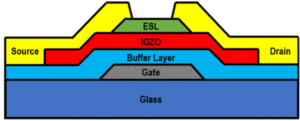
IGZO is an oxide semiconductor technology that offers significantly higher electron mobility than a-Si while maintaining extremely low leakage current.
Typical electron mobility:
10–50 cm²/V·s
This represents roughly a 10–50× improvement over a-Si.
Advantages
Excellent Power Efficiency
One of IGZO’s greatest strengths is its extremely low leakage current.
Pixels can maintain their electrical charge for much longer, reducing the need for constant refreshing.
This makes IGZO particularly efficient when displaying static content such as:
- Documents
- Web pages
- PDFs
- Spreadsheets
Higher Resolution Support
The improved mobility allows significantly higher pixel density, making IGZO well suited for Retina-class displays.
High Refresh Rate Capability
IGZO comfortably supports:
- 120 Hz
- 144 Hz
- 165 Hz
making it an excellent choice for premium LCD products.
Perfect Match for Mini LED LCD
Mini LED displays rely on thousands of local dimming zones that require fast and precise control.
IGZO provides the speed and efficiency needed for these premium displays.
Limitations
- Higher Manufacturing Cost
Compared to a-Si, IGZO requires more advanced materials and manufacturing equipment.
- Lower Mobility than LTPS
Although much faster than a-Si, IGZO still cannot match the extremely high electron mobility of LTPS.
For applications demanding maximum pixel density and the fastest switching speeds, LTPS remains superior.
LTPS (Low Temperature Polycrystalline Silicon)
Overview
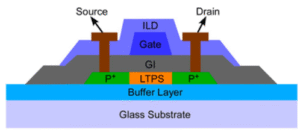
LTPS is created by transforming amorphous silicon into polycrystalline silicon using laser annealing.
The resulting crystal structure allows electrons to move much more freely.
Typical electron mobility:
100–200 cm²/V·s
This is over 100 times faster than a-Si.
Advantages
Extremely High Pixel Density
LTPS can support pixel densities exceeding:
- 500 PPI
- 600 PPI
- 700 PPI
making it ideal for smartphones and other compact displays.
Excellent High Refresh Rate Performance
LTPS easily supports:
- 120 Hz
- 165 Hz
- 240 Hz
and even higher refresh rates.
Smaller TFTs
Because LTPS transistors are more efficient, they occupy less space.
This allows:
- Narrower bezels
- Higher aperture ratio
- Improved display efficiency
Ideal for OLED
OLED displays require precise analog current control for every pixel.
LTPS provides the high drive capability necessary for excellent OLED image quality.
Today, most smartphone OLED displays use LTPS technology.
Limitations
Higher Leakage Current
The same characteristics that enable high-speed operation also increase leakage current.
Static images therefore consume more power compared with IGZO.
More Expensive Manufacturing
Laser annealing equipment is expensive, and process control is considerably more complex than for a-Si or IGZO.
LTPO (Low Temperature Polycrystalline Oxide)
Overview
LTPO is not a completely new semiconductor material.
Instead, it combines the strengths of both LTPS and IGZO within the same TFT backplane.
A simplified view is:
- LTPS provides high-speed pixel driving.
- IGZO minimizes leakage current and maintains pixel charge.
Together, they deliver both high performance and excellent energy efficiency.
The Biggest Advantage of LTPO: Variable Refresh Rate
The defining feature of LTPO is its ability to dynamically adjust refresh rate over a very wide range.
For example:
- 1 Hz while displaying a static image
- 10 Hz during Always-On Display mode
- 30–60 Hz for reading
- 90–120 Hz while scrolling
- 120–165 Hz during gaming
This dramatically reduces power consumption without sacrificing responsiveness.
Always-On Display
LTPO enables displays to refresh at just 1 Hz, allowing the screen to remain active while consuming minimal power.
This capability has become a defining feature of flagship smartphones and smartwatches.
Technology Comparison
| Feature | a-Si | IGZO | LTPS | LTPO |
| Electron Mobility | Low | Medium | Very High | Very High |
| Power Consumption | Medium | Very Low | Medium | Very Low |
| Leakage Current | High | Extremely Low | High | Low |
| High PPI Support | Fair | Good | Excellent | Excellent |
| High Refresh Rate | Fair | Good | Excellent | Excellent |
| Variable Refresh Rate | Limited | Limited | Limited | Outstanding |
| OLED Compatibility | Poor | Limited | Excellent | Excellent |
| Manufacturing Cost | Lowest | Medium | High | Highest |
| Manufacturing Complexity | Low | Medium | High | Very High |
Typical Applications
a-Si
- LCD televisions
- Office monitors
- Budget laptops
- Industrial displays
IGZO
- Premium LCD monitors
- Mini LED displays
- Tablets
- Professional monitors
LTPS
- Smartphone OLED displays
- High-resolution mobile LCDs
- AR/VR displays
LTPO
- Flagship smartphones
- Smartwatches
- Premium OLED mobile devices
Which Technology Is Best?
There is no single “best” TFT technology. Each one is optimized for different priorities.
- a-Si remains the most economical solution for large displays where cost is the primary concern.
- IGZO provides an excellent balance of power efficiency, image quality, and performance, making it ideal for premium LCD products.
- LTPS delivers the highest driving capability and pixel density, making it the preferred choice for smartphone OLED displays.
- LTPO combines the speed of LTPS with the efficiency of IGZO, enabling adaptive refresh rates and significantly improved battery life. It has become the technology of choice for today’s flagship mobile devices.
Final Thoughts
Although consumers often focus on display resolution or brightness, the TFT backplane technology is one of the most important factors determining the overall user experience.
From the affordability of a-Si, to the efficiency of IGZO, the high performance of LTPS, and the adaptive intelligence of LTPO, each technology represents a different balance between cost, power consumption, and display capability.
Understanding these technologies helps explain why different products—from budget monitors to premium smartphones—are built the way they are, and why manufacturers continue to invest in more advanced TFT backplane technologies as display performance continues to evolve.
If you have questions or would like to explore your next design, please contact our engineering.