

Control Board Applications
Automatic Call Distribution System
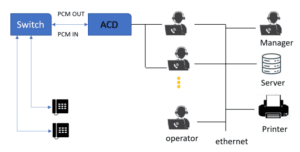
Automatic Call Distribution is used where a large number of incoming calls are processed. The system enables the processing of an increased number of daily incoming calls, and facilitates supervisor’s management of the operators. The monitoring of on and off duty, the work efficiency, wage administration, etc., are all processed automatically by computers.
The system reasonably arranges the operator resources according to a specific algorithm, and analyzes the customer’s call number, call time, selected service and other factors, and automatically assigns the customer’s call to the most suitable operator.
Functions
- IVR intelligent navigation: Provide customers with self-service voice services and guide customers to choose manual service content or self-service.
- ACD intelligent distribution: ACD (Automatic Distributed Traffic) intelligently queues up customer calls and distributes traffic according to a pre-set strategy.
- Service time strategy: Set up corresponding service procedures according to different time periods such as commuting and holidays.
- Member identification: When a customer calls, the member information is inquired according to the caller number, and different service processes are entered according to the membership status.
- Seat queue: The operator is added to the agent queue, and the system automatically allocates the traffic, and monitors the traffic situation of the agent queue in real time.
- Satisfaction survey: After the call, guide the customer to evaluate the service, and evaluate the overall service quality through statistical reports.
Target Industry
- Government
- Education
- Finance
- Hospital
- Hotel
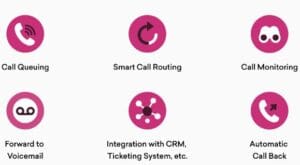
ACD Features that elevate call center performance with features like:
ACD System Diagram:
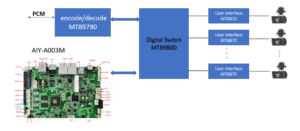
ACD Diagram:
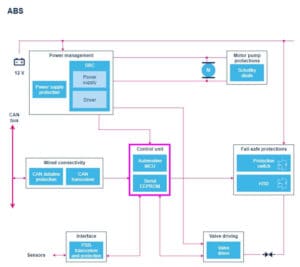
Anti-Lock Braking System (ABS)
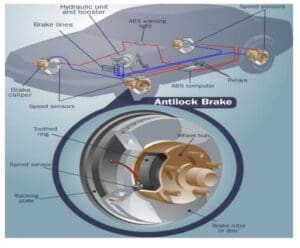
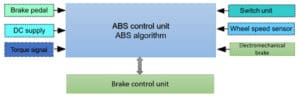
ABS is used to prevent a vehicle’s wheel from locking as a result of excessive operation of the service brake, especially on a slippery road surface. During such situations, the vehicle may become unstable and/or less controllable.
Overall diagram of an ABS in a car:
Features:
- Based STM32F446MC, 512K Flash+128K SRAM
- uClinux
- u-boot
Automobile Anti-Collision Radar System
The automobile anti-collision radar system based on frequency-modulated continuous wave (FMCW), can measure the distance and velocity of a target and effectively avoid car crashes by alarming or braking, making the driving safety from “passive” to “active”.
The system comprises three parts:
- Signal collection: use radar sensor and filter measure the speed of the vehicle, the speed of the vehicle ahead, and the distance between the two vehicles.
- Data processing: the spectral analysis is performed by means of FFT and the frequency measurement results are converted into distance information and velocity information; and different warning modes are adopted according to the measurement results.
- Actuator: Responsible for implementing instructions from the data processing system, issuing alarms and reminding the driver to brake. If the driver does not execute the instructions, the actuator will take measures, such as closing the windows, adjusting the seat position, locking the steering wheel, and automatically braking.
Radar Features:
- Modulation: FMCW
- Transmit frequency: 77GHz
- Accurately measure the direction, range, velocity and angle of stationary and moving targets
- Detection Range: 0.2~170m (short, middle mode, ±45˚), MAX detection range 170 meters, assist drivers to make judgement in advance to ensure the safety of vehicles and personnel.
- Accuracy: ±0.1m
Applications:
- Traffic Monitoring
- Speed/Direction Reporting
- Presence Detection
- Collision Avoidance
- Lane Change assistant
- Rear crash collision warning
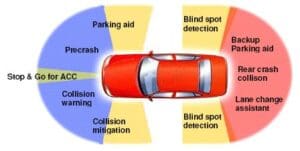
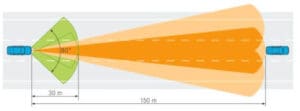
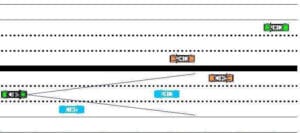
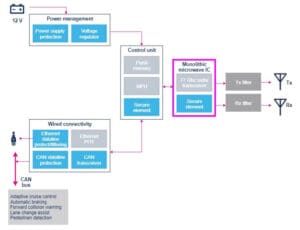
77G FMCW radar system
Control Unit:
- STM32F767ZI: High-performance Arm® Cortex®-M7 32-bit RISC core and DSP with FPU, Arm Cortex-M7 MCU with 2 Mbytes of Flash memory and 512 Kbytes of SRAM, 216 MHz CPU, Art Accelerator, L1 cache, SDRAM, TFT, JPEG codec, DFSDM.
- U-BOOT, busy-box and linux2.6.28 kernel
Connecting devices and sharing data are game-changers across industries. Whether you’re developing a new product from scratch or have an existing product that could be enhanced with an IoT solution, Orient Display partners will work with you to identify the best opportunities and build smart, advanced and connected products.
- Smart home, appliances and devices
- Wearables and smaller devices with connectivity
- Large industrial devices and machines with connectivity
- Medical devices with connectivity (IoMT)
- Mobile asset monitoring and tracking
- Inventory management systems & predictive replenishment
- Cloud data monetization